answer.
Ask question
Login Signup
Ask question
All categories
  • English
  • Mathematics
  • Social Studies
  • Business
  • History
  • Health
  • Geography
  • Biology
  • Physics
  • Chemistry
  • Computers and Technology
  • Arts
  • World Languages
  • Spanish
  • French
  • German
  • Advanced Placement (AP)
  • SAT
  • Medicine
  • Law
  • Engineering
Alex_Xolod [135]
2 years ago
3

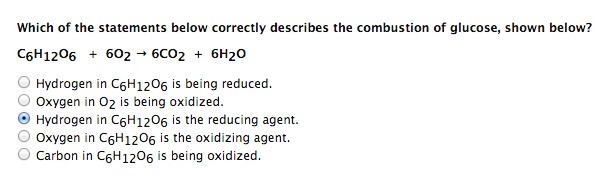
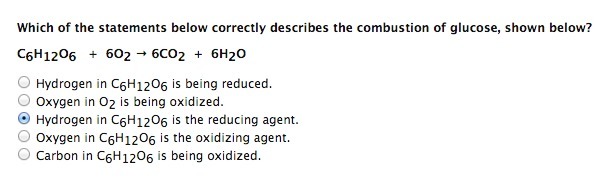
Which of the statements below correctly describes the combustion of glucose, shown below? c6h12o6 + 6o2 → 6co2 + 6h2o?

Chemistry
1 answer:
docker41 [41]2 years ago
3 0
I think I found the complete problem with the given choices. We know that O₂ is the oxidizing agent or the one that's reduced, while glucose is the reducing agent or the one that's oxidized. Following these information, the answer would be letter C, or the third choice.

The oxidation number of H before the reaction is -1, which became 1 after the reaction. The oxidation number increased, thus, H is the reducing agent.

You might be interested in
This unit discusses in detail the role of catalysts to lower the activation energy of reactions. The term catalyst appears in no
Naddik [55]
Catalyst has found usage in non-scientific terms as an almost metaphorical word for something provokes or speeds up action or change. The word's applicability to many topics made it easy for it to find its way out of the scientific lexicon and into other domains, in this case political. 

Its meaning is roughly the same, in that a catalyst in this context is something that facilitated or sped up the process of glasnost.

One distinct meaning that I notice is that "catalyst" in more casual or non-scientific speech is that it is often used as a creator of action all its own, an actor in itself, rather than a facilitating agent to a reaction, as its scientific definition states. 
7 0
2 years ago
What is the mass of a solution that has a density of 0.775 g/ml and a volume of 50.0ml?
Margarita [4]
Hey there!

D = m / V

0.775 = m / 50.0

m = 0.775 * 50.0

m = 38.75 g
6 0
2 years ago
Find a part of the article that describes signals that are sent within Diego’s body. Where does the signal come from, and how do
ycow [4]

Answer:

The sensory receptors send signals to Diego's brain cells. These signals are messages that help Diego figure out what to do next. As Diego thinks, more signals move from one brain cell to another.

6 0
1 year ago
The article "The Melting Arctic" attempts to win over public opinion by making use of persuasive techniques. One such technique
Anastasy [175]
Scientific data/ emotions ethics
3 0
2 years ago
Read 2 more answers
The decomposition of copper(II) nitrate on heating is endothermic reaction. 2Cu(NO3)2(s) → 2C10(s) + 4NO2(g) + O2(g) Calculate t
Basile [38]

Answer:

The enthalpy change for the given reaction is 424 kJ.

Explanation:

2Cu(NO_3)_2(s)\rightarrow 2CuO(s) + 4NO_2(g) + O_2(g),\Delta H_{rxn}=?

We have :

Enthalpy changes of formation of following s:

\Delta H_{f,Cu(NO_3)_2}=-302.9 kJ/mol

\Delta H_{f,CuO}=-157.3 kJ/mol

\Delta H_{f,NO_2}= 33.2 kJ/mol

\Delta H_{f,O_2}= 0 kJ/mol (standard state)

\Delta H_{rxn}=\sum [\Delta H_f(product)]-\sum [\Delta H_f(reactant)]

The equation for the enthalpy change of the given reaction is:

\Delta H_{rxn} =

=(2 mol\times \Delta H_{f,CuO}+4\times \Delta H_{f,NO_2}+1 mol\times \Delta H_{f,O_2})-(2mol\times \Delta H_{f,Cu(NO_3)_2})

\Delta H_{rxn}=

(2mol\times (-157.3 kJ/mol)+4\times 33.2 kJ/mol=1 mol\times 0 kJ/mol)-(2 mol\times (-302.9 kJ/mol)

\Delta H_{rxn}=424 kJ

The enthalpy change for the given reaction is 424 kJ.
6 0
2 years ago
Other questions:
  • The Karez well system _______. a. was the first known use of wells b. was a postindustrial system c. transported groundwater fro
    6·2 answers
  • Richardo throws a football straight into the air. It goes up to a height of 10 meters and then falls back down into his hands. W
    5·2 answers
  • Police often monitor traffic with "K-band" radar guns, which operate in the microwave region at 22.235 GHz (1 GHz = 109 Hz). Fin
    7·1 answer
  • 3.0 mL of 0.02 M Fe(NO3)3 solution is mixed with 3.0 mL of 0.002 M NaNCS and diluted to the mark with HNO3 in 10 mL volumetric f
    6·1 answer
  • Give the coordination number, the charge of the central metal ion, and select the correct name in each coordination compound: A.
    12·1 answer
  • Hitesh wants to learn swimming. He brought swimming costumes and a cap. What kind of material should these be made of and why?
    11·1 answer
  • Imagine you are volunteering in a 1st grade classroom. The students recently learned about the water cycle. One student raises h
    10·1 answer
  • How many moles of NaOH are present in 65.00 g of NaOH(s)? *
    12·1 answer
  • Emma wants to go swimming the first day the pool opens in May, but she is worried it will be too cold since summer only just sta
    14·1 answer
  • Based on what you have read, write two to three sentences explaining what James Cross Giblin probably wants readers to think abo
    7·2 answers
Add answer
Login
Not registered? Fast signup
Signup
Login Signup
Ask question!