answer.
Ask question
Login Signup
Ask question
All categories
  • English
  • Mathematics
  • Social Studies
  • Business
  • History
  • Health
  • Geography
  • Biology
  • Physics
  • Chemistry
  • Computers and Technology
  • Arts
  • World Languages
  • Spanish
  • French
  • German
  • Advanced Placement (AP)
  • SAT
  • Medicine
  • Law
  • Engineering
borishaifa [10]
2 years ago
9

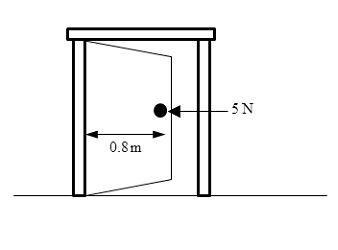
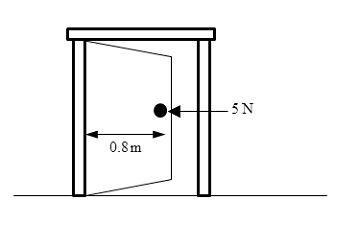
A 72.0-kg person pushes on a small doorknob with a force of 5.00 N perpendicular to the surface of the door. T?

Physics
2 answers:
PolarNik [594]2 years ago
8 0

-- The torque he applies to the door is

                         (force) x (distance from the hinge)

                     =    (5 N)  x  (0.8 m)  =    4 N-m  .

-- Torque  = (moment of inertia) x (angular acceleration)

     4 N-m  =  (moment of inertia)  x  (2 /s²)

     Moment of inertia  =  (4 N-m) / (2 /s²)

                                   = (4 kg-m²/s²) /  (2 /s²)

                                   =       2 kg-m²

Note that the pusher's mass makes no difference, only the force exerted
perpendicular to the door.  It could be an elephant pushing lightly, or even
a mosquito if he could get up the required 5 N (about 18 ounces of force).
dybincka [34]2 years ago
6 0

The moment of inertia of the door about the hinges is \boxed{2\,{\text{kg - }}{{\text{m}}^{\text{2}}}} .

Further Explanation:

Since the force is applied perpendicular to the door and the door is hinged at the other end, the force will produce a torque in the door.

The torque produced in the door due to the applied force is given by:

\tau  = F\times d

Here, F  is the force applied and d  is the distance of application of force from the axis of rotation.

Substitute 5\,{\text{N}}  for F  and 0.8\,{\text{m}}  for d   in above expression.

\begin{aligned}\tau=5\times0.8\\=4\,{\text{N}}\cdot{\text{m}}\\\end{aligned}

The torque acting on the door produces an angular acceleration in the door. The torque is represented in terms of angular acceleration of the door as:

\tau=I\times\alpha  

Here, I  is the moment of inertia of the door and \alpha  is the angular acceleration of the door.

Substitute the values of \tau  and \alpha  in above expression.

\begin{aligned}4\,{\text{N}}\cdot{\text{m}}&=I\times 2\,{{{\text{rad}}}\mathord{\left/{\vphantom{{{\text{rad}}}{{{\text{s}}^{\text{2}}}}}}\right.\kern-\nulldelimiterspace}{{{\text{s}}^{\text{2}}}}}\\I&=\frac{4}{2}\,\\&=2\,{\text{kg-}}{{\text{m}}^{\text{2}}}\\\end{aligned}

Thus, the moment of inertia of the door about the hinge is \boxed{2\,{\text{kg - }}{{\text{m}}^{\text{2}}}} .

Learn More:

1. A toy train rolls around a horizontal 1.0-m-diameter track <u>brainly.com/question/9575487 </u>

2. On a highway a car is driven 80 <u>brainly.com/question/504792 </u>

3. Assume that, at a certain angular speed ω2, the radius r becomes twice l. Find ω2 <u>brainly.com/question/5813257 </u>

Answer Details:

Grade: High School

Subject: Physics

Chapter: Moment of Inertia

Keywords:

Moment of inertia, door, hinges, 72 kg person, small doorknob, 5.00 N, frictionless hinges, torque, angular acceleration, 2.0 rad/s^2.

You might be interested in
What is the atomic number z of 73li?
aev [14]
I think thats a trick question on the periodic table there is no Z, theres Zi which is zinc but no Z
3 0
2 years ago
Read 2 more answers
Sally finds herself stranded on a frozen pond so slippery that she can't stand up or walk on it. To save herself, she throws one
8_murik_8 [283]

Answer:

a) 2.5 m/s. (In the opposite direction to the direction in which she threw the boot).

b) The centre of mass is still at the starting point for both bodies.

c) It'll take Sally 12 s to reach the shore which is 30 m from her starting point.

Explanation:

Linear momentum is conserved.

(mass of boot) × (velocity of boot) + (mass of sally) × (velocity of Sally) = 0

5×30 + 60 × v = 0

v = (-150/60) = -2.5 m/s. (Minus inicates that motion is in the opposite direction to the direction in which she threw the boot).

b) At time t = 10 s,

Sally has travelled 25 m and the boot has travelled 300 m.

Taking the starting point for both bodies as the origin, and Sally's direction as the positive direction.

Centre of mass = [(60)(25) + (5)(-300)]/(60+5)

= 0 m.

The centre of mass is still at the starting point for both bodies.

c) The shore is 30 m away.

Speed = (Distance)/(time)

Time = (Distance)/(speed) = (30/2.5)

Time = 12 s

Hope this Helps!!!

7 0
2 years ago
Read 2 more answers
if a torque of 55.0 N/m is required and the largest force that can be exerted by you is 135 N what is th e length of the lever a
Whitepunk [10]

Answer:

r=0.41m

Explanation:

Torque is defined as the cross product between the position vector ( the lever arm vector connecting the origin to the point of force application) and the force vector.

\tau=r\times F

Due to the definition of cross product, the magnitude of the torque is given by:

\tau=rFsin\theta

Where \theta is the angle between the force and lever arm vectors. So, the length of the lever arm (r) is minimun when sin\theta is equal to one, solving for r:

r=\frac{\tau}{F}\\r=\frac{55\frac{N}{m}}{135N}\\r=0.41m

7 0
2 years ago
In certain cases, using both the momentum principle and energy principle to analyze a system is useful, as they each can reveal
SpyIntel [72]

Answer:

A) F_g = 26284.48 N

B) v = 7404.18 m/s

C) E = 19.19 × 10^(10) J

Explanation:

We are given;

Mass of satellite; m = 3500 kg

Mass of the earth; M = 6 x 10²⁴ Kg

Earth circular orbit radius; R = 7.3 x 10⁶ m

A) Formula for the gravitational force is;

F_g = GmM/r²

Where G is gravitational constant = 6.67 × 10^(-11) N.m²/kg²

Plugging in the relevant values, we have;

F_g = (6.67 × 10^(-11) × 3500 × 6 x 10²⁴)/(7.3 x 10⁶)²

F_g = 26284.48 N

B) From the momentum principle, we have that the gravitational force is equal to the centripetal force.

Thus;

GmM/r² = mv²/r

Making v th subject, we have;

v = √(GM/r)

Plugging in the relevant values;

v = √(6.67 × 10^(-11) × 6 x 10²⁴)/(7.3 x 10⁶))

v = 7404.18 m/s

C) From the energy principle, the minimum amount of work is given by;

E = (GmM/r) - ½mv²

Plugging in the relevant values;

E = [(6.67 × 10^(-11) × 3500 × 6 × 10²⁴)/(7.3 x 10⁶)] - (½ × 3500 × 7404.18)

E = 19.19 × 10^(10) J

5 0
2 years ago
This means that the speed at which the bullet travels across Earth's surface (its magnitude of horizontal velocity) does not aff
Dmitry_Shevchenko [17]

Answer: the speed at which it falls toward the Earth.


Explanation:


A bullet travelling across Earth's surface with some horizontal velocity is classical example of projectile motion.


Projectile motion is an idealization of the motion under the action of gravity neglecting the influence of the air (no drag force nor friction).


This  kind of motion is the result of two independent motions: vertical motion and horizontal motion.


The observed net velocity is the vectorial sum of the vertical and horizontal velocities.


The horizontal velocity is constant, since there is not any force acting in the horizontal axis. Thi is, the object, following the first Law of Newton (inertia law) tends to continue in uniform rectilinear movement (with zero acceleration).


The vertical velocity, this is the velocity at which the bullet falls toward the Earth, is influenced (accelerated) by the action of the gravity of the Earth. So, the vertical velocity is accelerated by the pull of the Earth.


Vertical and horizontal velocities are independent of each other, which means that the speed or the magnitude of the horizontal velocity does not affect the speed at which an object (the bullet) falls toward the Earth.

6 0
2 years ago
Other questions:
  • During a car accident, a 125 kg driver is moving at 31 m/s and in 1.5 seconds is brought to rest by an inflating air bag. What i
    14·2 answers
  • A baseball player is running to second base at 5.03 m/s. when he is 4.80 m from the plate he goes into a slide. the coefficient
    10·2 answers
  • The electric field near the earth's surface has magnitude of about 150n/c. what is the acceleration experienced by an electron n
    5·1 answer
  • A hot–air balloon is moving at a speed of 10.0 meters/second in the +x–direction. The balloonist throws a brass ball in the +x–d
    10·1 answer
  • Type the correct answer in each box. Use numerals instead of words. If necessary, use / for the fraction bar(s).
    8·2 answers
  • A car starting from rest (i.e. initial velocity = 0.0 m/s), moves in the positive X-direction with a constant average accelerati
    14·1 answer
  • A 35-kg girl is standing near and to the left of a 43-kg boy on the frictionless surface of a frozen pond. The boy throws a 0.75
    12·1 answer
  • You live on a planet far from ours. "Based on extensive communication with a physicist on earth", you have determined that all l
    6·1 answer
  • A positively charged particle Q1 = +45 nC is held fixed at the origin. A second charge Q2 of mass m = 4.5 μg is floating a dista
    10·1 answer
  • In downtown Chicago, the east-west blocks are 400 ft long while the north-south blocks are 280 ft long. Because of the many one-
    12·1 answer
Add answer
Login
Not registered? Fast signup
Signup
Login Signup
Ask question!