answer.
Ask question
Login Signup
Ask question
All categories
  • English
  • Mathematics
  • Social Studies
  • Business
  • History
  • Health
  • Geography
  • Biology
  • Physics
  • Chemistry
  • Computers and Technology
  • Arts
  • World Languages
  • Spanish
  • French
  • German
  • Advanced Placement (AP)
  • SAT
  • Medicine
  • Law
  • Engineering
Bumek [7]
2 years ago
4

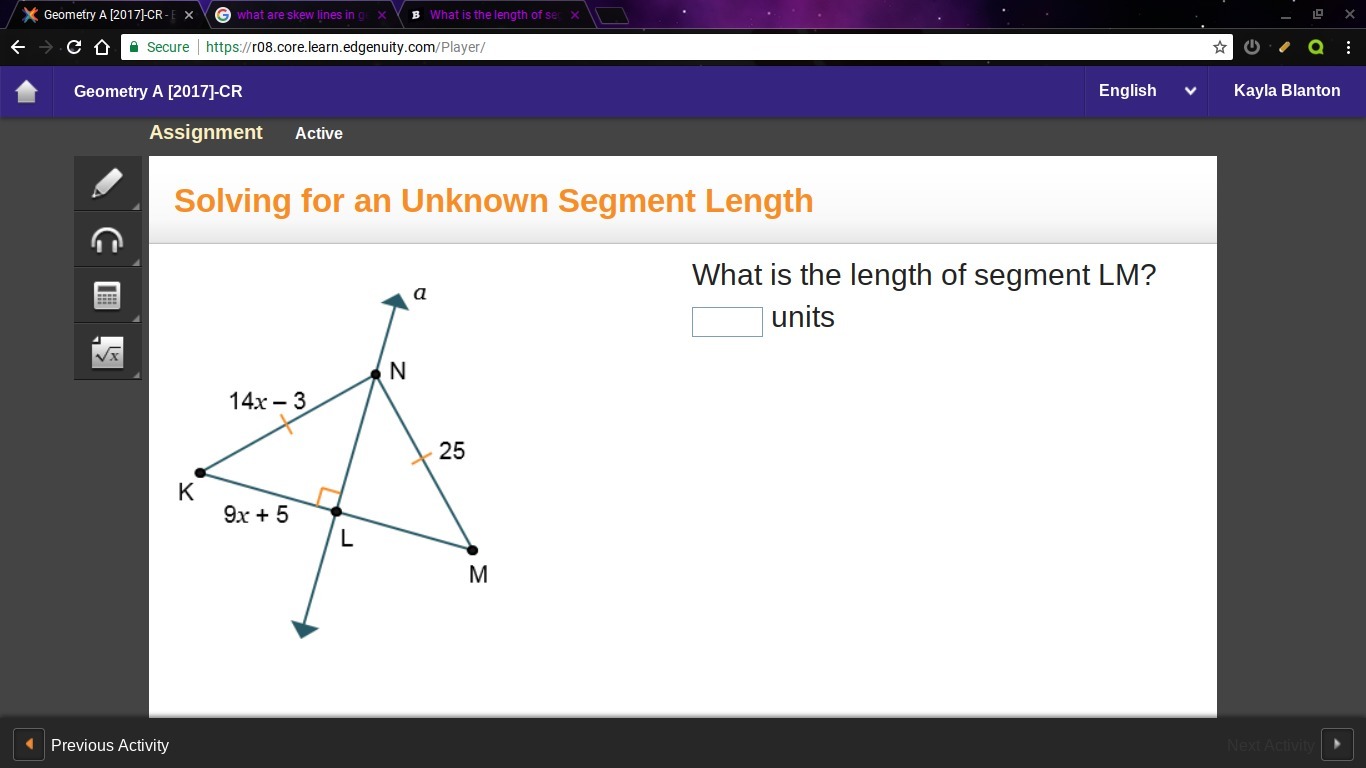
What is the length of segment LM? ___ units

Mathematics
2 answers:
rosijanka [135]2 years ago
6 0
KM is congruent to LM so the length of KM is also the length of LM. X is 2 because KN is also congruent to MN so 14 would have to be multiplied by 2 the subtracted by 3 to equal to 25. Knowing that x is 2 you’ll plug x Into KL & it equals 23 therefore LM is 23
Ulleksa [173]2 years ago
6 0

Answer:

The answer is: The length of segment LM is 23 units.

Step-by-step explanation:

From the figure, we know that:

KL ≅ LM

9x + 5 = LM

KN ≅ NM

14x - 3 =25

With that alone we can solve for what x is:

14x - 3 = 25              Add 3 to both sides of the equation to eliminate -3

14x - 3+ (3) = 25 + (3)\\ 14x = 28

\dfrac{14x}{14}=\dfrac{28}{14}\\\\ x = 2 Divide both sides by 14 to eliminate 14


Now that we have x, we just plug that in our equation of KL to solve for LM:

9x + 5 = LM\\9(2) + 5 = LM\\18 + 5 = LM\\23 = LM

You might be interested in
In a certain community, eight percent of all adults over age 50 have diabetes. If a health service in this community correctly d
____ [38]

Complete question is;

In a certain community, 8% of all people above 50 years of age have diabetes. A health service in this community correctly diagnoses 95% of all person with diabetes as having the disease, and incorrectly diagnoses 10% of all person without diabetes as having the disease. Find the probability that a person randomly selected from among all people of age above 50 and diagnosed by the health service as having diabetes actually has the disease.

Answer:

P(has diabetes | positive) = 0.442

Step-by-step explanation:

Probability of having diabetes and being positive is;

P(positive & has diabetes) = P(has diabetes) × P(positive | has diabetes)

We are told 8% or 0.08 have diabetes and there's a correct diagnosis of 95% of all the persons with diabetes having the disease.

Thus;

P(positive & has diabetes) = 0.08 × 0.95 = 0.076

P(negative & has diabetes) = P(has diabetes) × (1 –P(positive | has diabetes)) = 0.08 × (1 - 0.95)

P(negative & has diabetes) = 0.004

P(positive & no diabetes) = P(no diabetes) × P(positive | no diabetes)

We are told that there is an incorrect diagnoses of 10% of all persons without diabetes as having the disease

Thus;

P(positive & no diabetes) = 0.92 × 0.1 = 0.092

P(negative &no diabetes) =P(no diabetes) × (1 –P(positive | no diabetes)) = 0.92 × (1 - 0.1)

P(negative &no diabetes) = 0.828

Probability that a person selected having diabetes actually has the disease is;

P(has diabetes | positive) =P(positive & has diabetes) / P(positive)

P(positive) = 0.08 + P(positive & no diabetes)

P(positive) = 0.08 + 0.092 = 0.172

P(has diabetes | positive) = 0.076/0.172 = 0.442
8 0
2 years ago
Put the following numbers in order from least to greatest: -3.15, 3.3, -3 1/5, -3.3
Bas_tet [7]
-3.15, -3.3,-3 1/5,3.3,
6 0
2 years ago
Report Error Suppose $P(x)$ is a polynomial of smallest possible degree such that: $\bullet$ $P(x)$ has rational coefficients $\
motikmotik

Answer:

We want a polynomial of smallest degree with rational coefficients with zeros in \sqrt{7}, 1 - \sqrt{6} and -3. The last root gives us the factor (x+3). Hence, our polynomial is

P(x) =(x+3)q(x)

where q is a polynomial with rational coefficients and roots \sqrt{7} and 1 - \sqrt{6}. The root \sqrt{7} gives us a factor x-\sqrt{7}, but in order to obtain rational coefficients we must consider the factor x^2-7.

An analogue idea works with 1 - \sqrt{6}. For convenience write  x - 1 + \sqrt{6} = ( x - 1) + \sqrt{6}. This gives the factor (x-1)^2-6. Hence,

P(x) = (x+3)(x^2-7)((x-1)^2-6)=x^5+x^4-18x^3-22x^2+77x+105

Notice that P(-1)=24. So, in order to satisfy the last condition we divide by 3 the whole polynomial, without altering its roots. Finally, the wanted polynomial is

P(x) =(1/3)x^5+(1/3)x^4-6x^3-(22/3)x^2+(77/3)x+35

Step-by-step explanation:

We must have present that any polynomial it's determined by its roots up to a constant factor. But here we have irrational ones, in order to eliminate the irrational coefficients that a factor of the type x-\sqrt7 will introduce in the expression, we need to multiply by its conjugate x+\sqrt7. Hence, we will obtain x^2-7 that have rational coefficients. Finally, the last condition is given with the intention to fix the constant factor. Usually it is enough to evaluate in the point and obtain the necessary factor.

4 0
2 years ago
Mr. Gupta gave his students a quiz with three questions on it. Let X represent the number of questions
irakobra [83]

Answer:

24.5 points

8 points

Step-by-step explanation:

khan academy

7 0
2 years ago
A 2001 study asked 1,924 male and 3,666 female undergraduate college students their favorite color. A 95% confidence interval fo
Mashcka [7]
The answer is false
5 0
2 years ago
Other questions:
  • Sam is observing the velocity of a car at different times. After two hours, the velocity of the car is 50 km/h. After six hours,
    8·1 answer
  • A vegetable store sold 3 tons of vegetables less on the first day than on the second, and on the third day it sold 5/9 of the am
    10·2 answers
  • Sarah was collecting money for charity. By Sunday night she had collected 55% of her target amount. On Monday she collected anot
    15·2 answers
  • A scale diagram of a garden shows the length as 14.5 cm. If the scale is 1:150, what is the actual length? The garden is m in le
    9·1 answer
  • The idle time for taxi drivers in a day are normally distributed with an unknown population mean and standard deviation. If a ra
    8·1 answer
  • Assume that the number of hours of daylight in New Orleans in 1994 is given by the function D(x) = 7 3 sin 2π 365 x + 35 3 , whe
    5·1 answer
  • 21.05 divided by 0.2
    6·2 answers
  • Which graph represents the function f (x) = StartFraction 1 Over x EndFraction minus 1?
    6·1 answer
  • give real-world examples of 2 similar situations in which one is a proportional relationship and the second one is nonproportion
    5·2 answers
  • Myrtle Gould's total sales last month were $180,700, and her commission was $5,040. She earns a
    12·1 answer
Add answer
Login
Not registered? Fast signup
Signup
Login Signup
Ask question!
