answer.
Ask question
Login Signup
Ask question
All categories
  • English
  • Mathematics
  • Social Studies
  • Business
  • History
  • Health
  • Geography
  • Biology
  • Physics
  • Chemistry
  • Computers and Technology
  • Arts
  • World Languages
  • Spanish
  • French
  • German
  • Advanced Placement (AP)
  • SAT
  • Medicine
  • Law
  • Engineering
Komok [63]
2 years ago
7

An aqueous solution is 0.467 m in hcl. what is the molality of the solution if the density is 1.23 g/ml?

Chemistry
2 answers:
OLga [1]2 years ago
6 0

The molality of the given solution is \boxed{0.385{\text{ mol/kg}}}.

Further explanation:

Molarity:

The molarity of the solution can be defined as the concentration of the solution and is equal to the number of moles of the solute dissolved in 1 liter of the solution.

The expression of molarity (M), volume (V) and number of moles (n) is as follows:

{\text{M}}=\frac{{{\text{n}}\left({{\text{mol}}}\right)}}{{{\text{V}}\left({\text{L}}\right)}} …… (1)

Here, V is a volume of solution in liters and n is a number of moles of solute.

Molality:

The molality of the solution can be defined as the measure of the amount of solute dissolved in one kilogram of the solvent. The expression of molality is,

{\text{m}}=\frac{{{\text{n}}\left({{\text{mol}}}\right)}}{{{\text{mass of solvent}}\left({{\text{kg}}}\right)}} …… (2)

Here, m is a molality and n is a number of moles of solute.

The molarity of given aqueous solution of HCl is 0.467 M. This means 0.467 moles of HCl are dissolved in 1 liter of the solution.

Therefore, the mass of 0.467 moles of HCl can be calculated as follows:

\begin{gathered}{\text{Mass of HCl}}=\left({{{\text{n}}_{{\text{HCl}}}}}\right)\times\left({{\text{molar mass of HCl}}}\right)\\=\left({0.467{\text{ mol}}}\right)\times\left({36.5{\text{ g/mol}}}\right)\\=17.0455{\text{ g}}\\\end{gathered}

Since the density of the solution is 1.23 g/mL, it means that the mass of 1 mL solution is 1.23 g. Therefore, the mass of 1 liter solution is calculated as follows:

\begin{gathered}{\text{Mass of solution}}=\left( {\frac{{1.23\;{\text{g}}}}{{1\;{\text{mL}}}}}\right)\left({\frac{{1000\;{\text{mL}}\;}}{{1\;{\text{L}}}}}\right)\\=1230\;{\text{g/L}}\\\end{gathered}

The mass of solvent (water) is calculated as follows:

\begin{gathered}{\text{Mass of solvent}}={\text{mass of solution}}\left({aq{\text{ HCl}}}\right)-{\text{mass of solute}}\left({{\text{HCl}}}\right)\\=1230{\text{ g}}-17.0455{\text{ g}}\\{\text{=1212}}{\text{.95 g}}\times\left({\frac{{1{\text{ kg}}}}{{1000\;{\text{g}}}}}\right)\\=1.21295{\text{ kg}}\\\end{gathered}

Substitute 1.21295 kg for mass of solvent and 0.467 number of moles of solute (HCl) in equation (2).

\begin{gathered}{\text{m}}=\frac{{{\text{n}}\left({{\text{mol}}} \right)}}{{{\text{mass of solvent}}\left({{\text{kg}}}\right)}}\\=\frac{{0.467{\text{ mol}}}}{{1.21295{\text{ kg}}}}\\=0.385{\text{ mol/kg}}\\\end{gathered}

Therefore, molality of the given solution is {\mathbf{0}}{\mathbf{.385 mol/kg}}.

Learn more:

1. Determine the number of moles of chlorine in 8 moles of carbon tetrachloride: brainly.com/question/3064603

2. Determine how many moles of water produce: brainly.com/question/1405182

Answer details:

Grade: Senior school

Subject: Chemistry

Chapter: Solutions

Keywords: Molecules, elements, atom, solution, molarity, molality, hydrogen, chlorine, 0.385, 0.467 mol/L, number of moles.


Reika [66]2 years ago
5 0
Answer:
molarity = 0.385 moles/kg

Explanation:
Assume that the volume of the aqueous solution given is 1 liter = 1000 ml
Now, density can be calculated using the following rule:
density = mass / volume
Therefore:
mass = density * volume = 1.23 * 1000 = 1230 grams
Now, 0.467 m/L * 1L = 0.467 moles of HCl
We will get the mass of the 0.467 moles of HCl as follows:
mass = molar mass * number of moles = (1+35.5)*0.467 = 17.0455 grams
Now, we have the mass of the solution (water + HCl) calculated as 1230 grams and the mass of the HCl calculated as 17.0455 grams. We can use this information to get the mass of water as follows:
mass of water = 1230 - 17.0455 = 1212.9545 grams
Finally, we will get the molarity as follows:
molarity = number of moles of solute / kg of solution
molarity = (0.467) / (1212.9594*10^-3)
molarity = 0.385 mole/kg 

Hope this helps :)

You might be interested in
A 100.0mL bubble of hot gases at 225 C and 1.80 atm escapes from an active volcano, what is the new volume of the bubble outside
Inessa05 [86]
<h3>Answer:</h3>

112.08 mL

<h3>Explanation:</h3>

From the question we are given;

  • Initial volume, V1 = 100.0 mL
  • Initial temperature, T1 = 225°C, but K = °C + 273.15

thus, T1 = 498.15 K

  • Initial pressure, P1 = 1.80 atm
  • Final temperature , T2 = -25°C

                                     = 248.15 K

  • Final pressure, P2 = 0.80 atm

We are required to calculate the new volume of the gases;

  • According to the combined gas law equation;

\frac{P1V1}{T1}=\frac{P2V2}{T2}

Rearranging the formula;

V2=\frac{P1V1T2}{T1P2}

Therefore;

V2=\frac{(1.80atm)(100mL)(248.15K)}{(498.15K)(0.80atm)}

V2=112.08mL

Therefore, the new volume of the gas is 112.08 mL

8 0
2 years ago
What is the molarity of a solution that contains 2.35 g of nh3 in 0.0500 l of solution?
tankabanditka [31]
The molarity is the number of moles in 1 L of the solution. 
The mass of NH₃ given - 2.35 g
Molar mass of NH₃ - 17 g/mol
The number of NH₃ moles in 2.35 g - 2.35 g / 17 g/mol = 0.138 mol
The number of moles in 0.05 L solution - 0.138 mol 
Therefore number of moles in 1 L - 0.138 mol / 0.05 L x 1L = 2.76 mol
Therefore molarity of NH₃ - 2.76 M
3 0
2 years ago
Read 2 more answers
. Calculate the mass of O2 produced if 3.450 g potassium chlorate is completely decomposed by heating in presence of a catalyst
Vesnalui [34]
 <span>2 KClO3(s) → 3 O2(g) + 2 KCl(s) 

</span><span>Note: MnO2 (Manganese Dioxide) is not part of the reaction. A catalyst lowers the activation energy and increases both forward and reverse reactions at equal rates. 
</span>
molar mass of KClO3 = 122.5
Moles of KClO3 =  3.45 / 122.55 = 0.028

Moles of O2 produce = \frac{3}{2} \times 0.028

= 0.042 moles

molar mass of O2 = 32

so, mass of O2 = 32 x 0.042  = 1.35 g


5 0
2 years ago
Which statement is true of a reversible reaction at equilibrium?
Vedmedyk [2.9K]

Answer:

D.

The concentration of reactants and the concentration of products are constant.

Explanation:

pls mark as brainliest

7 0
2 years ago
Read 2 more answers
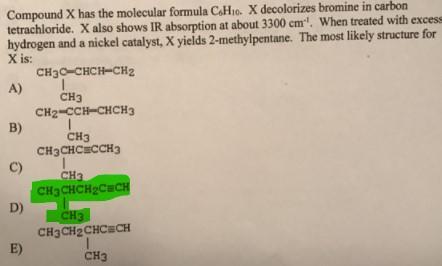
Compound X has the molecular formula C6H10. X decolorizes bromine in carbon tetrachloride. X also shows IR absorption at about 3
pychu [463]

Answer:

The correct answer is - option D. (check image)

Explanation:

Alkynes and alkenes both decolorized bromine in carbon tetrachloride. The absorption of the IR at about 3300 cm-1 for the X here that are found in the terminal alkynes absorption range only. In presence of excess hydrogen and a nickel catalyst, x gives the  2-methyl pentane.

The most likely structure for X is: CH3-CH3-ch-CH2-C≡CH

3 0
1 year ago
Other questions:
  • According to the kinetic theory, collisions between molecules in a gas _____.
    12·2 answers
  • Water is dissolved into n-butanol (a polar liquid). Which is the second step at the molecular level as water dissolves into n-bu
    8·2 answers
  • Calculate the number of millimoles contained in 500mg of FeSO4•C2H4(NH3)2SO4.4H20 Calculate the number of grams of BaCrO4 that w
    8·1 answer
  • Stephanie has been doing research on how petroleum is formed. She says that oxygen must be present while the tiny plants and ani
    12·2 answers
  • Tamara is doing a scientific investigation to answer the question, "Do corn seeds germinate faster at warmer temperatures than t
    12·1 answer
  • After a reaction, a new compound contains 0.73 g Mg and 0.28 g N. What is the empirical formula of this compound?
    12·1 answer
  • The average adult human burns 2.00x20^3 kcal per day in energy. What is this rate in kJ per hour?
    11·1 answer
  • the image above shows a chamber with a fixed volume filled with gas at a pressure of 1560 mmHg and a temperature of 445.0 K. If
    11·1 answer
  • We are all familiar with the general principles of operation of an internal combustion engine: the combustion of fuel drives out
    15·1 answer
  • A chemist forms 16.6 g of potassium iodide by combining 3.9 g of potassium with 12.7 g of iodine. Show that these results are co
    10·1 answer
Add answer
Login
Not registered? Fast signup
Signup
Login Signup
Ask question!