answer.
Ask question
Login Signup
Ask question
All categories
  • English
  • Mathematics
  • Social Studies
  • Business
  • History
  • Health
  • Geography
  • Biology
  • Physics
  • Chemistry
  • Computers and Technology
  • Arts
  • World Languages
  • Spanish
  • French
  • German
  • Advanced Placement (AP)
  • SAT
  • Medicine
  • Law
  • Engineering
svetoff [14.1K]
2 years ago
15

We are all familiar with the general principles of operation of an internal combustion engine: the combustion of fuel drives out

the piston. It is possible to imagine engines that use reactions other than combustions, and we need to assess the work they can do. A chemical reaction takes place in a container of cross-sectional area 100.0 cm^2; the container has a piston at one end. As a result of the reaction, the piston is pushed out through 10 cm against a constant external pressure of 100 kPa. Calculate the work done by the system in Joules.
Chemistry
1 answer:
Alexus [3.1K]2 years ago
7 0

Answer:

The work done by the system is 100 J

Explanation:

Given details

The cross sectional area of the of the container is A = 100.0 cm^2 = 0.01m²

The total distance pushed by the piston is d = 10 cm = 0.10m

The total external pressure by which piston pushed is P = 100 kPa

From above data, the following relation can be used to determine the change in volume of the container

∆V = A * d

∆V = 0.01 * 0.10 = 0.001 m³

By using the following relation, the work done by the system is calculated as;

Work done W = P * ∆V

W = 100 * 0.001 = 0.1 kJ = 100 J

The work done by the system is 100 J

You might be interested in
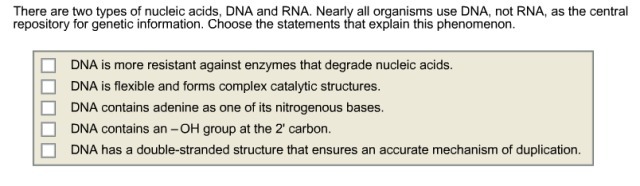
There are two types of nucleic acids, dna and rna. nearly all organisms use dna, not rna, as the central repository for genetic
Leya [2.2K]
Found the choices. Pls see attachment. 

The statements that explains this phenomenon are:
1) DNA contains adenine as one of its nitrogenous bases.
2) DNA has a double-stranded structure that ensures an accurate mechanism of duplication.

6 0
2 years ago
The values used in the scale of pH and pOH are derived from a system designed by ______. Gordonsen Sorenson Curie Dalton
yaroslaw [1]

Sorenson

Explanation:

The values used in the scale of pH and pOH are derived from a system designed by Sorenson. Søren Peter Lauritz Sørensen, a Danish chemist introduced the system of pH and pOH for describing the alkalinity and acidity of substances.

  • The pH and pOH scale is logarithmic scale that ranks the acidity and bascity of compounds.
  • pH is the negative logarithm of the concentration of  hydrogen/hydroxonium ions in solution i.e

              pH = -log₁₀{H⁺]

  • pOH is the negative log of the concentration of the hydroxyl ions in a solution i.e

             pOH = -log₁₀{OH⁻]

Learn more:

calculating pH: brainly.com/question/12985875

pH scale: brainly.com/question/11063271

#learnwithBrainly

3 0
2 years ago
Dry ice is solid carbon dioxide. A 0.050-g sample of dry ice is placed in an evacuated 4.6-L vessel at 30 °C. Calculate the pres
goldenfox [79]

The answer is 6.1*10^-3 atm.

The pictures and explanations are there.

3 0
2 years ago
the hydrogen gas generated when calcium metal reacts with water is collected over water at 20 degrees C. The volume of the gas i
Gala2k [10]

Answer:

There is 0.0677 grams of H2 gas obtained

Explanation:

Step 1: Data given

The total pressure (988 mmHg) is the sum of the pressure of the collected hydrogen + the vapor pressure of water (17.54 mmHg).  

ptotal = p(H2)+ p(H2O)

p(H2) = ptotal - pH2O = 988 mmHg - 17.54 mmHg = 970.46 mmHg

Step 2: Calculate moles of H2 gas

Use the ideal gas law to calculate the moles of H2 gas

PV = nRT

n = PV / RT

 ⇒ with p = pressure of H2 in atm = 970.46 mmHg * (1 atm /760 mmHg) = 1.277 atm

⇒ V = volume of H2 in L = 641 mL x (1 L / 1000 mL) = 0.641 L

⇒ n = the number of moles of H2 = TO BE DETERMINED

⇒ R = the gas constant = 0.08206 L*atm/K*mol

⇒ T = the temperature = 20.0 °C = 293.15 Kelvin

n = (1.277)(0.641) / (0.08206)(298.15) = 0.0335 moles H2

Step 3: Calculate mass of H2

Mass of H2 = moles H2 ¨molar H2

0.0335 moles H2 * 2.02 g/mol H2  = 0.0677g H2

There is 0.0677 grams of H2 gas obtained

7 0
2 years ago
One hour of bicycle riding can require 500-900 kcal of energy, depending on the speed, the terrain, and the weight of the racer.
solniwko [45]

Answer:

145 hours

Explanation:

Since one hour of riding a bicycle takes up 505 kcal of energy. It is also stated that one gram of body fat is equal to 7.70 kcal. Also, it is given that 1 pound of body fat is equal to 454 g.

Hence;

1 Ib= 454 g

21 Ib= 21 × 454/1 = 9534 g

But

1g of body fat = 7.70kcal

9534 g of body fat = 9534 × 7.70 kcal/1 = 73411.8 kcal

If 505 kcal is lost in 1 hour

73411.8 kcal is lost in 73411.8 kcal × 1hour/505k cal = 145 hours

3 0
2 years ago
Other questions:
  • If you produce 14.5 g of O2 in the lab from a reaction that you showed by calculation could produce a maximum of 22.0 g of O2, w
    6·2 answers
  • The lower the ph of a solution, the ______.
    15·2 answers
  • What is the molar mass of 56.75 g of gas exerting a pressure of 2.87 atm on the walls of a 5.29 l container at 230 k?
    15·1 answer
  • How many moles are contained in 3.131 × 1024 particles?
    8·1 answer
  • From the options provided for each element below, choose the properties that it may have based on its location in the periodic t
    10·2 answers
  • Elements that’s are gases, brittle & poor conductors at room temperature are
    13·1 answer
  • If you add a chunk of zinc to a beaker of acid and zinc shavings to another beaker of acid, the sample with the zinc shavings wi
    13·1 answer
  • Suppose 1.65 moles of C₆H₆ react with excess oxygen to produce carbon dioxide and water.
    6·2 answers
  • A radioisotope is placed near a radiation detector, which registers 80 counts per second. Eight hours later, the detector regist
    11·1 answer
  • A student is trying to classify an unidentified, solid gray material as a metal or a nonmetal. Which question will best help the
    6·1 answer
Add answer
Login
Not registered? Fast signup
Signup
Login Signup
Ask question!