Answer:
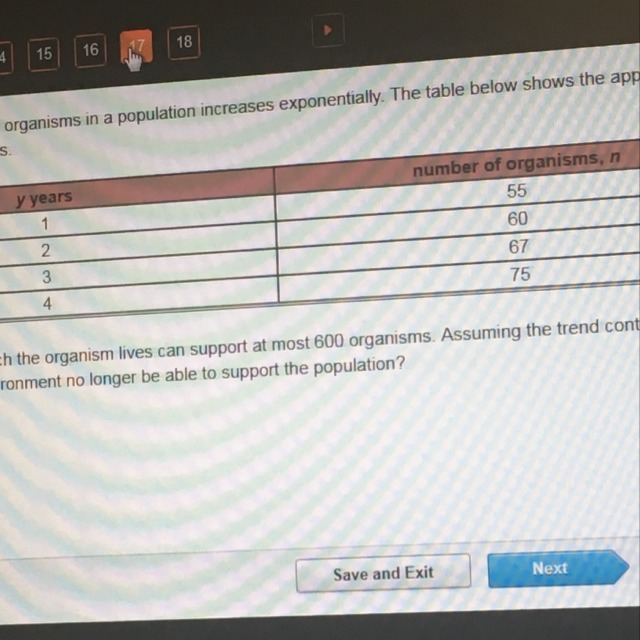
The correct answer is 29; the closest from the multiple choices given is B)24.
Step-by-step explanation:
Exponential functions are of the form
 ,
,
where <em>a</em> represents the initial population, <em>b</em> represents the percentage of growth as a decimal plus 1 (to represent keeping 100% of the original population) and <em>x</em> is the number of time periods.
We do not have the percentage of growth or the original population. We can, however, write two equations in two variables to represent the information we are given.
For the first year, we know the total to be 55. We would then have the equation

For the second year, we know the total to be 60. We would then have the equation

We want to isolate one of the variables in order to use substitution to solve this system. Using the first equation, we will solve for <em>a</em>. We do this by dividing both sides by <em>b</em>:

We can now substitute this for <em>a</em> in the second equation:

Divide both sides by 55:

We can now use this in the first equation to solve for <em>a:</em>

Divide both sides by 60/55 (remember when you divide by a fraction, you multiply by the reciprocal):

This gives us the exponential equation

We are solving for the number of years (time periods) that it would take for the population to reach the maximum, 600. Substitute 600 in for y:

Divide both sides by 50.4167:

We will use logarithms to solve this:

This means at 28 years, the population will not be at the max; at 29 years, it will be over.