answer.
Ask question
Login Signup
Ask question
All categories
  • English
  • Mathematics
  • Social Studies
  • Business
  • History
  • Health
  • Geography
  • Biology
  • Physics
  • Chemistry
  • Computers and Technology
  • Arts
  • World Languages
  • Spanish
  • French
  • German
  • Advanced Placement (AP)
  • SAT
  • Medicine
  • Law
  • Engineering
zysi [14]
2 years ago
10

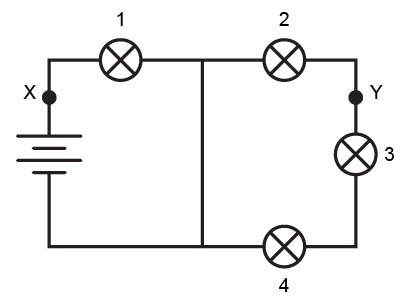
A wire is joined to points X and Y in the circuit diagram shown.

Physics
2 answers:
Yanka [14]2 years ago
8 0

when wire is added short Circuit occurs  makes bulb 1 and 2 turn off but keeps bulb 3 and 4 on .

Alexeev081 [22]2 years ago
3 0

Answer: A short circuit occurs. only Bulb 3 and 4 glow.

Explanation:

When a wire is connected between points X and Y, a short circuit is created. Current always chooses the least resistive path to flow. When a wire without any resistive element is joined, current gets a short path to flow. Thus, bulb 1 and 2 will be isolated from the circuit and won't glow. Only 3 and 4 would glow.

You might be interested in
Which statements describe vectors? Check all that apply. -Vectors have magnitude only. -Vectors have direction only. -Vectors ha
Natali [406]

Answer:

Vectors have both magnitude and direction

Explanation:

Vectors show how strong the force in because the bigger the arrow, the stronger the force.  Also, it obviously shows direction because its an arrow.

6 0
2 years ago
Read 2 more answers
Which of the following is not a factor in whether a reaction will spontaneously occur? A. Entropy change of the system B. Enthal
Delvig [45]

Answer:

D

Explanation:

pressure change have nothing to do with the spontaneity.

Entropy change , enthalpy change , temperature have roles in deciding spontaneity.

6 0
2 years ago
A 92-kg skier is sliding down a ski slope that makes an angle of 30 degrees above the horizontal direction. The coefficient of k
9966 [12]

Answer:

a = 4.05 m/s²

Explanation:

Known data

m= 92 kg  : mass of the  skier

θ =30°  :angle θ of the ski slope  with respect to the horizontal direction

μk= 0.10 : coefficient of kinetic friction

g = 9.8 m/s² : acceleration due to gravity

Newton's second law:

∑F = m*a Formula (1)

∑F : algebraic sum of the forces in Newton (N)

m : mass s (kg)

a : acceleration  (m/s²)

We define the x-axis in the direction parallel to the movement of the block on the ramp and the y-axis in the direction perpendicular to it.

Forces acting on the skier

W: Weight of the skier : In vertical direction

N : Normal force : perpendicular to the ski slope

f : Friction force: parallel to the ski slope

Calculated of the W

W= m*g

W=  92kg* 9.8 m/s² = 901,6 N

x-y weight components

Wx= Wsin θ= 901,6 N *sin 30° = 450.8 N

Wy= Wcos θ = 901,6 N *cos 30° =780.8 N

Calculated of the N

We apply the formula (1)

∑Fy = m*ay    ay = 0

N - Wy = 0

N = Wy

N = 780.8 N

Calculated of the f

f = μk* N=  0.10*780.8 N  

f = 78.08 N

We apply the formula (1) to calculated acceleration of the skier:

∑Fx = m*ax  ,  ax= a  : acceleration of the block

Wx - f = m*a

450.8- 78.08 = ( 92)*a

372.72 =  (92)*a

a = (372.72)/ (92)

a = 4.05 m/s²
6 0
2 years ago
The hammer throw was one of the earliest Olympic events. In this event, a heavy ball attached to a chain is swung several times
Aleonysh [2.5K]

Answer:

Given that

T= 0.43 s

Radius of the ball path's , r=2.1 m

a)

We know that

f= 1/T

Here f= frequency

      T= Time period

Now by putting the values

f= 1/T

T= 0.43 s

f= 1/0.43

f=2.32 Hz

b)

We know that

V= ω r

ω = 2 π f

ω=Angular speed

V= Linear speed

ω = 2 π f=ω = 2 x π x 2.32 =14.60 rad/s

V= ω r= 14.60 x 2.1 = 30.66 m/s

c)

Acceleration ,a

a =ω ² r

a= 14.6 ² x 2.1 = 447.63 m/s²

We know that g = 10 m/s²

So

a= a/g= 447.63/10 = 44.7 g m/s²

a= 44.7 g m/s²

7 0
2 years ago
You have a 2m long wire which you will make into a thin coil with N loops to generate a magnetic field of 3mT when the current i
Anni [7]

Answer:

<em>radius of the loop =  7.9 mm</em>

<em>number of turns N ≅ 399 turns</em>

Explanation:

length of wire L= 2 m

field strength B = 3 mT = 0.003 T

current I = 12 A

recall that field strength B = μnI

where n is the turn per unit length

vacuum permeability μ  = 4\pi *10^{-7}  T-m/A = 1.256 x 10^-6 T-m/A

imputing values, we have

0.003 = 1.256 x 10^−6 x n x 12

0.003 = 1.507 x 10^-5 x n

n = 199.07 turns per unit length

for a length of 2 m,

number of loop N = 2 x 199.07 = 398.14 ≅ <em>399 turns</em>

since  there are approximately 399 turns formed by the 2 m length of wire, it means that each loop is formed by 2/399 = 0.005 m of the wire.

this length is also equal to the circumference of each loop

the circumference of each loop = 2\pi r

0.005 = 2 x 3.142 x r

r = 0.005/6.284 = 7.9*10^{-4} m = 0.0079 m =<em> 7.9 mm</em>

8 0
2 years ago
Other questions:
  • A top of rotational inertia 4.0 kg m2 receives a torque of 2.4 nm from a physics professor. the angular acceleration of the body
    12·1 answer
  • What is the direction of the current in the loop as the loop rotates clockwise through the magnetic field from as viewed from th
    14·2 answers
  • A skier is moving down a snowy hill with an acceleration of 0.40 m/s2. The angle of the slope is 5.0∘ to the horizontal. What is
    12·1 answer
  • A foam ball of mass 0.150 g carries a charge of -2.00 nC. The ball is placed inside a uniform electric field, and is suspended a
    5·1 answer
  • a 10.0 kg block on a smooth horizontal surface is acted upon by two forces: a horizontal force of 30 N acting to the right and a
    15·1 answer
  • You need to determine the density of an unknown liquid and decide to perform an experiment. You notice that a wooden block float
    9·1 answer
  • A +4.0- μC charge is placed on the x axis at x = +3.0 m, and a −2.0- μC charge is located on the y axis at y = −1.0 m. Point A i
    9·1 answer
  • A 0.025-kg block on a horizontal frictionless surface is attached to an ideal massless spring whose spring constant is The block
    11·1 answer
  • PLEASE HELP John is rollerblading down a long, straight path. At time zero, there is a mailbox about 1 m in front of him. In the
    5·1 answer
  • 4. A trolley of mass 2kg rests next to a trolley of mass 3 kg on a flat
    8·1 answer
Add answer
Login
Not registered? Fast signup
Signup
Login Signup
Ask question!
