answer.
Ask question
Login Signup
Ask question
All categories
  • English
  • Mathematics
  • Social Studies
  • Business
  • History
  • Health
  • Geography
  • Biology
  • Physics
  • Chemistry
  • Computers and Technology
  • Arts
  • World Languages
  • Spanish
  • French
  • German
  • Advanced Placement (AP)
  • SAT
  • Medicine
  • Law
  • Engineering
-Dominant- [34]
2 years ago
9

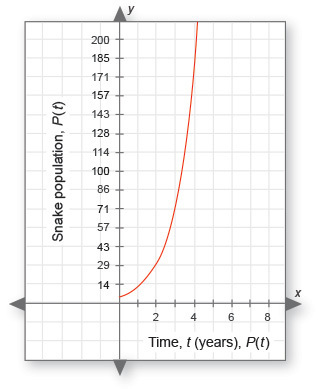
Below is the graph of the boa constrictor population. The x-axis is t, the time in years, and the y-axis is P(t), the snake popu

lation for any given year. In this case, t = 0 indicates the year they started keeping track of the boa population. Scientists want to know how the snake population is changing every two years so they can make predictions about the next two years.
Students' Conjectures:

Two students, Sarah and Ernest, agree that the graph is exponential but disagree on how the rate changes between successive time periods.

1. Complete the table below to summarize each classmate's conjecture. (2 points: 1 point for each row of the chart)
Classmate Conjecture
Ernest


Sarah


2. Using your knowledge of exponential functions, who do you think is correct? (1 point)


Analyzing the Data:

3. Is this graph increasing or decreasing? Does this imply that the boa constrictor population is growing or diminishing? (1 point)


4. Looking at this graph, would you agree that the boa constrictor population could be a problem? (1 point)


5. What is the horizontal asymptote of this graph? (1 point)


6. What is the range? Explain. (1 point)


7. What is the y-intercept? What does this mean in terms of the snake population? (1 point)


Here is the function for this graph, where t is the time in years: P(t) = 5e0.89t.

8. Use this formula to estimate the boa constrictor population in 2 years, 4 years, and 6 years. (6 points: 2 points for each year, including 1 point for showing your work and 1 point for the answer)
t: Time in years P(t): Estimated snake population at time t
2


4


6


9. Find the rate of change for the snake population from year 0 to year 2. (2 points)


10. Apply the rate of change you found in question 9 in order to estimate the snake population for year 4. How does your answer compare with the calculated value? (1 point)


11. If there are approximately 36,660 snakes (rounded to the nearest 10) in year 10, how many will there be in year 12? (1 point)


Making a Decision:

12. Given your calculations above, is Ernest's or Sarah's conjecture correct? (2 points)

Mathematics
1 answer:
lidiya [134]2 years ago
5 0
I WILL ANSWER THE QUESTION FROM NUMBER 3 BECAUSE NUMBER 1 AND 2 ARE MISSING.

3. The graph is increasing, this is because the values of P(t) increase with the value of time. Therefore we conclude that the population of boa constrictor is growing.

4. From the graph we can actually conclude that the population of boa constrictor can actually be a very big problem. this is because the population is increasing at a very fast rate, having started at P(t)=7 when t=0, and P(t)=176 at time t=4 years.

5. The horizontal asymptote  of the graph given is at point:
P(t)=7

6. Since the initial the initial population at t=0 is P(t)=7 and the population is still growing with time, the range of the graph will be:
[7,∞)

7. The y-intercept is at the point when t=0, hence at t=0, P(t)=7, therefore the y-intercept is at P(t)=7 otherwise at point (0,7)

8. From the the formula given, the boa population at the intervals given will be as follows:
i. t=2 years:
Using the formula:
P(t)=5e0.89t
plugging t=2 we obtain:
P(2)=5e(0.89×2)
simplifying this we obtain:
P(2)=29.65
Thus the population after 2 years is 29.65~30

ii. t=4 years
Using the formula:
P(t)=5e0.89t
plugging t=4 years and simplifying we obtain:
P(4)=5e(0.89×4)
P(4)=175.82

thus the population after 4 years will be P(4)=175.82~176

iii. t=6 years.
As above we use the formula:
P(t)=5e0.89t
thus plugging in our values we obtain:
P(6)=5e(0.89×6)
simplifying this gives us:
P(6)=1042.56
Thus the population after 6 years will be P(t)=1042.56~1043

The rate of change of the population form t=0 to t=2 will be given by:
[P(2)-P(0)]/(2-0)
From the formula given:
P(0)=5e(0.89*0)
P(0)=5*1=5
P(2)=30
thus:
plugging the values we obtain:
(30-5)/(2-0)
=25/2
=12.5 
Thus the rate of change is:
12.5 


10. Using our rate of change, the formula will be:
P=(rate of change)*(time)
thus, when t=4 years:
P=12.5*4=50
The answer is lower than the calculated value because the we have assumed the population grows linearly but in reality it is growing exponentially. 

11. If there are approximately 36,660 snakes(rounded to the nearest 10) in year 10, the number of snakes in year 12 will be as follows:
Using the formula:
P(t)=5e0.89t
plugging the value t=12 years, we shall have:
P(12)=5e(0.89×12)
this will give us:
P(12)=5e10.68
P(12)=217,387.75
rounding to the nearest 10, we shall have
P(12)=217, 388


You might be interested in
HURRY! Which table represents a linear function?
jeka94
Remember that to tell if a function is linear for a table, you should look for a constant rate of change, and the only function that has a constant rate of change is the first one. x is increasing by 1, and y is increasing by 0.5.

Now that we know that, lets find the equation of our table.
First, lets take tow points from our table: (1,\frac{1}{2}) and (2,1).
Next, use the slope formula: m= \frac{y_{2}-y_{1}}{x_{2}-x_{1} } 
We know for our points that y_{2}=1, y_{1}= \frac{1}{2},x_{2}=2, and x_{1}=1, so lets replace those point in our formula to find m:
m= \frac{1- \frac{1}{2} }{2-1}
m= \frac{1}{2}

Finally, we can use the point slope formula y-y_{1}=m(x-x_{1}) to find our equation:
y- \frac{1}{2} = \frac{1}{2} (x-1)
y- \frac{1}{2} = \frac{1}{2} x- \frac{1}{2}
y= \frac{1}{2}x

We can conclude that the first table represents a linear function, and its equation is y= \frac{1}{2}x  
7 0
2 years ago
At a cafe, for every 5 sodas sold there are 9 teas sold. What is the ratio of teas sold to sodas sold? A) 5 : 9 B) 9 : 5 C) 9 :
frutty [35]
For 5 sodas sold, there are 9 teas sold


the ratio is tea: soda, or 9:5

B) 9:5 is your answer

hope this helps
7 0
2 years ago
Read 2 more answers
G identify the solution of the recurrence relation an = 6an − 1 – 8an − 2 for n ≥ 2 together with the initial conditions a0 = 4,
maksim [4K]
Via the generating function method, let

G(x)=\displaystyle\sum_{n\ge0}a_nx^n

Then take the recurrence,

a_n=6a_{n-1}-8a_{n-2}

multiply everything by x^n and sum over all n\ge2:

\displaystyle\sum_{n\ge2}a_nx^n=6\sum_{n\ge2}a_{n-1}x^n-8\sum_{n\ge2}a_{n-2}x^n

Re-index the sums or add/remove terms as needed in order to be able to express them in terms of G(x):

\displaystyle\sum_{n\ge2}a_nx^n=\sum_{n\ge0}a_nx^n-(a_0-a_1x)=G(x)-4-10x

\displaystyle\sum_{n\ge2}a_{n-1}x^n=\sum_{n\ge1}a_nx^{n+1}=x\sum_{n\ge1}a_nx^n=x\left(G(x)-a_0\right)=x(G(x)-4)

\displaystyle\sum_{n\ge2}a_{n-2}x^n=\sum_{n\ge0}a_nx^{n+2}=x^2\sum_{n\ge0}a_nx^n=x^2G(x)

So the recurrence relation is transformed to

G(x)-4-10x=6x(G(x)-4)-8x^2G(x)
(1-6x+8x^2)G(x)=4-14x
G(x)=\dfrac{4-14x}{1-6x+8x^2}=\dfrac{4-14x}{(1-4x)(1-2x)}=\dfrac1{1-4x}+\dfrac3{1-2x}

For appropriate values of x, we can express the RHS in terms of geometric power series:

G(x)=\displaystyle\sum_{n\ge0}(4x)^n+3\sum_{n\ge0}(2x)^n=\sum_{n\ge0}\bigg(4^n+3\cdot2^n\bigg)x^n

which tells us that

a_n=4^n+3\cdot2^n
3 0
2 years ago
HELP MEEEEE!!!!!!!!!!!
Nina [5.8K]

Answer:

B. ii and iii

Sorry if im wrong

Step-by-step explanation:

6 0
2 years ago
Connor has seven more nickels than dimes and twice as many quarters as dimes. If he has $6.20, how many nickels does he have?
Novosadov [1.4K]
Connor has 16 nickels. If you have 9 dimes (90 cents) and you doubled it that would give you 18 quarters ($4.50). you have 7 more nickels than dimes, so you do 7+9 which equals 16 nickels (80 cents). 90+450+80=620.
8 0
2 years ago
Other questions:
  • Use the slider to change the value of m. As the value of m changes from 1 to 3, the graph . As the value of m changes from –6 to
    9·2 answers
  • Solve: 3.6 (5x4) divided 3+5.0=
    8·1 answer
  • A customer's stock value seems to be rising exponentially. The equation for
    14·1 answer
  • Three brothers Adam, Paul, and Jake are standing on a large carnival scale. The total weight for all three boys reads 180 pounds
    11·1 answer
  • Let X be a random day of the week, coded so that Monday is 1, Tuesday is 2, etc. (so X takes values 1, 2,..., 7, with equal prob
    9·1 answer
  • A random sample of 64 credit sales in a department store showed an average sale of $75.00. From past data, it is known that the
    15·1 answer
  • a consumer magazine counts the number of tissues per box in a random sample of 15 boxes of No- Rasp facial tissues. The sample s
    6·1 answer
  • The cost of in-state tuition at the University of Florida is $6,380 and is increasing at a rate of 3.1% per year. Write and use
    12·1 answer
  • Evaluate -32 + (2-6)(10).
    10·2 answers
  • Which inequality is true if p= 3.4?
    12·1 answer
Add answer
Login
Not registered? Fast signup
Signup
Login Signup
Ask question!