answer.
Ask question
Login Signup
Ask question
All categories
  • English
  • Mathematics
  • Social Studies
  • Business
  • History
  • Health
  • Geography
  • Biology
  • Physics
  • Chemistry
  • Computers and Technology
  • Arts
  • World Languages
  • Spanish
  • French
  • German
  • Advanced Placement (AP)
  • SAT
  • Medicine
  • Law
  • Engineering
natka813 [3]
2 years ago
3

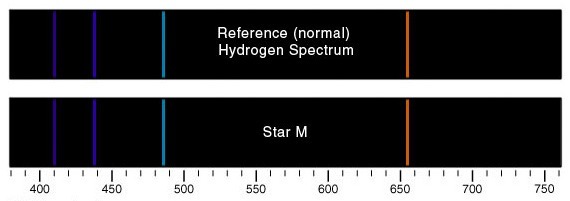
1. The spectra of Star M is compared to a reference hydrogen spectrum. What can be concluded about Star M? Select all that apply

.
(PICTURE BELOW IT'S THE FIRST ONE!)

Star M is showing radial motion
Star M is moving toward the Earth
Star M is moving away from the Earth
Star M is not showing radial motion, but it may have transverse motion
2. The blackbody curve for a star named Theta is shown below. The most intense radiation for this star occurs in what spectral band?

(PICTURE BELOW IT'S THE SECOND ONE!)

ultraviolet light
visible light
infrared radiation
radio waves
3. Select all that apply.

The following diagram shows the path a planet around the Sun. Kepler discovered that _____.

(PICTURE BELOW IT'S THE THIRD ONE!)

the distance from P3 to P4 is the same as the distance from P4 to P5
the speed from P3 to P4 is the same as the speed from P4 to P5
the area of B equals the area of C
the area of B does not equal the area of C
Physics
2 answers:
sdas [7]2 years ago
8 0

Answer:

1) D.So it's not showing radial motion, but it may have transverse motion

2) A.Ultraviolet

3) D. B is equal to the area C

Explanation:

This is a simpler and faster version of answers from my good friend AL2006. Hope you get that hundred

MrRa [10]2 years ago
4 0
<span>1. The spectrUM of Star M is compared to a reference hydrogen spectrum. 

Star M is not showing any radial radial motion.  That is, it's not moving
toward the Earth or away from the Earth.  If it were doing either of those
motions, the star's Hydrogen lines would be shifted toward longer wave-
lengths (moving way), or toward shorter wavelengths (moving toward).
So it's not showing radial motion, but it may have transverse motion,
since motion across our sightline doesn't shift the star's spectrum. 

2. The blackbody curve for a star named Theta is shown below.
The peak intensity of this star's radiated wavelength occurs at
roughly 100 to 150 nanometers.  That's certainly much shorter 
than visible light, much much shorter than infrared, and much 
much much shorter than radio.  So from the choices listed, the
only one that COULD be correct is ultraviolet.  But to be honest,
100-150 nanometers is so very short, I think it actually belongs
in the X-ray family.
What I really want to know about this star is:  How did astronomer's
discover that its name is Theta ?

3. Referring to the third diagram that you attached, which shows the
</span><span>path of a planet around the Sun:

--  </span>the distance from P3 to P4 is obviously shorter than the distance
from P4 to P5, because P4-P5 is generally closer to the sun;
<span>
-- </span>the speed from P3 to P4 is obviously less than the speed from
P4 to P5, because the diagram says that planet covers both arcs
in the same amount of time (t).
<span>
-- </span>Kepler discovered that the area of B equals the area of C .
<span>The line from the sun to the planet "sweeps" over equal areas
in equal amounts of time.
When you think about it, this means that any object in orbit around
the sun moves faster when it's closer to the sun, and slower when 
it's farther away from the sun.


In conclusion, I would be remiss if I didn't pause to express my gratitude
for the bounty of 5 points with which I have been showered in return for
this answer.  Not only do I cherish each and every one of those points,
but the green crust and warm turgid water have also been a welcome
and satisfying treat. </span>
You might be interested in
A satellite in geostationary orbit is used to transmit data via electromagnetic radiation. The satellite is at a height of 35,00
mote1985 [20]

Answer:

1. 6.99x 10^-6V/m

2. 18m

Explanation:

See attached file

7 0
2 years ago
A 0.3 mm long invertebrate larva moves through 20oC water at 1.0 mm/s. You are creating an enlarged physical model of this larva
AleksandrR [38]

Answer:

Explanation:

For the problem, we should have same reynolds number

ρvd/mu = constant

1000×1×10⁻³×0.3×10⁻³/1.002×10⁻³ = 1400×0.5×d/600

d = 25.66 cm

5 0
2 years ago
A 2650-lb car is traveling at sea level at a constant speed. its engine is running at 4500 rev/min and is producing 175 ft-lb of
Zepler [3.9K]
Check the attached file for the answer.

6 0
2 years ago
Read 2 more answers
A 2200 kg truck has put its front bumper against the rear bumper of a 2400 kg SUV to give it a push. With the engine at full pow
leonid [27]

Answer:

a) The maximum possible acceleration the truck can give the SUV is 7.5 meters per second squared

b) The force of the SUV's bumper on the truck's bumper is 18000 newtons

Explanation:

a) By Newton's second law we can find the relation between force and acceleration of the SUV:

F=ma

With F the maximum force the truck applies to the SUV, m the mass of the SUV and a the acceleration of the SUV; solving for a:

a=\frac{F}{m}=\frac{18000}{2400}\approx7.5\,\frac{m}{s^{2}}

b) Because at this acceleration the truck's bumper makes a force of 18000 N on the SUV’s bumper by Third Newton’s law the force of the SUV’s bumper on the truck’s bumper is 18000 N too because they are action-reaction force pairs.

7 0
2 years ago
A student placed a pencil in a cup of water. The pencil appears broken because light- always travels in a straight line makes th
il63 [147K]
<span>None of the choices makes a correct statement.  The third choice is close,
but misleading.

The pencil appears broken because light bends away from a straight line
when it crosses the boundary between air and water.</span>
5 0
2 years ago
Read 2 more answers
Other questions:
  • The square loop shown in the figure moves into a 0.80 T magnetic field at a constant speed of 10 m/s. The loop has a resistance
    12·1 answer
  • A tall cylinder contains 30 cm of water. oil is carefully poured into the cylinder, where it floats on top of the water, until t
    8·2 answers
  • a force of 25.0 newtons is applied so as to move a 5.0 kg mass a distance of 20.0 meters. How much work was done? with work plea
    6·1 answer
  • Peter often gets sore muscles in the back of his lower legs from jogging what flexibility exercise could help him
    7·1 answer
  • A turtle takes 3.5 minutes to walk 18 m toward the south along a deserted highway. A truck driver stops and picks up the turtle.
    11·1 answer
  • According to Archimedes’ principle, the mass of a floating object equals the mass of the fluid displaced by the object. Use this
    13·1 answer
  • Where would the weight of an explorer be greater?The summit of Chimborazo, in Ecuador, which is at a distance of about 6,384 km6
    7·1 answer
  • Water is stored in a municipal water tank at a mean height of 25 m. If a faucet of diameter 1.2 cm is opened in a house at groun
    7·1 answer
  • Suppose that we are designing a cardiac pacemaker circuit. The circuit is required to deliver pulses of 1ms duration to the hear
    13·1 answer
  • In the year 2090, and Burt is still alive! Well, he’s really just a brain connected to a “life machine.” Since Burt has no body,
    7·1 answer
Add answer
Login
Not registered? Fast signup
Signup
Login Signup
Ask question!
