answer.
Ask question
Login Signup
Ask question
All categories
  • English
  • Mathematics
  • Social Studies
  • Business
  • History
  • Health
  • Geography
  • Biology
  • Physics
  • Chemistry
  • Computers and Technology
  • Arts
  • World Languages
  • Spanish
  • French
  • German
  • Advanced Placement (AP)
  • SAT
  • Medicine
  • Law
  • Engineering
Olin [163]
2 years ago
8

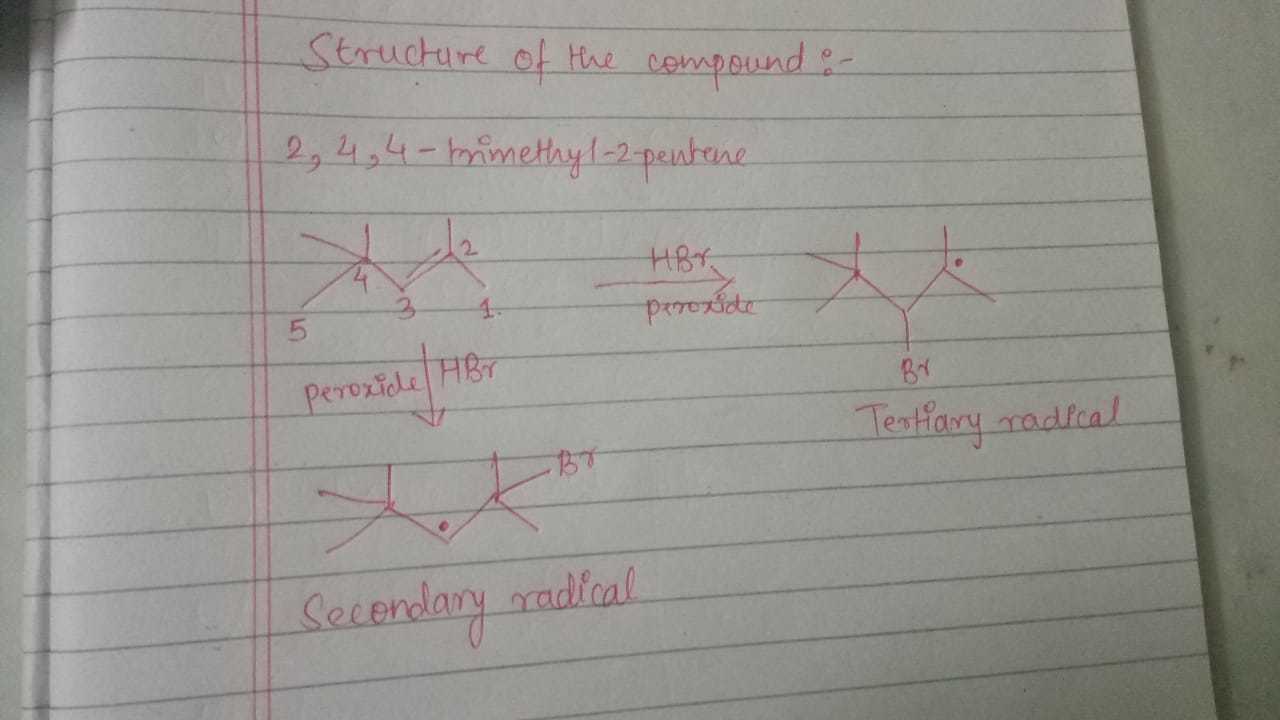
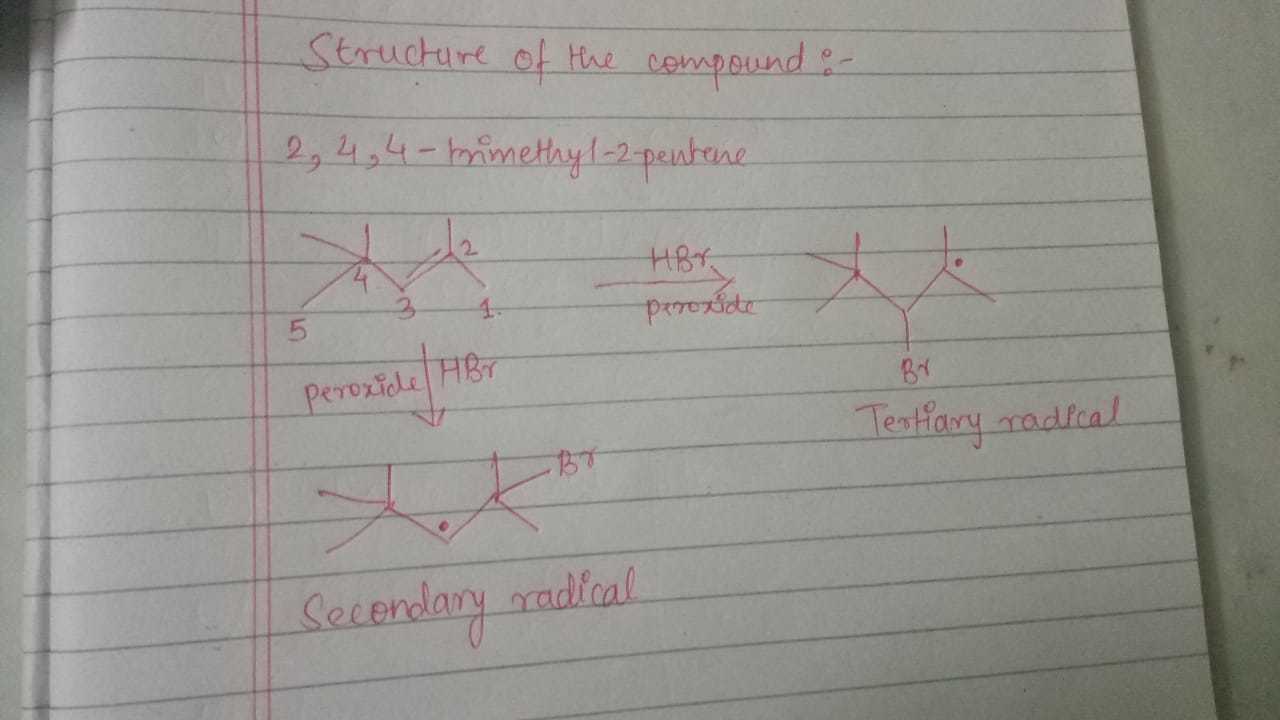
Draw the structures of the major and minor organic products formed when hbr reacts with 2,4,4-trimethyl-2-pentene in the presenc

e of peroxides. when drawing hydrogen atoms on a carbon atom, either include all hydrogen atoms or none on that carbon atom, or your structure may be marked incorrect.

Chemistry
1 answer:
OLEGan [10]2 years ago
3 0
Answer : The major and minor products of 2,4,4-trimethy-2-pentene will be a tertiary radical of Br which will be in major quantity whereas secondary radical of Br will be in minor quantity.

As the reaction follows anti-markonikov's rule the radical formed in tertiary state will be more stable and the secondary state will be much unstable as compared to tertiary state.

Note -  The structures are arranged in the attachment

You might be interested in
For the reaction A+2B→C under a given set of conditions, the initial rate is 0.100 M/s.What is Δ[B]/Δt under the same conditions
Oliga [24]

Answer: The rate of disappearance ( -Δ[B]/Δt) under the same conditions is 0.200 M/s.

Explanation:

A+2B\rightarrow C

Initial Rate of the reaction = 0.100 M/s

Rate of disappearance of B:

-\frac{1}{2}\frac{\Delta [B]}{\Delta t}=0.100 M/s

-\frac{\Delta [B]}{\Delta t}=2\times 0.100 M/s=0.200 M/s

The rate of disappearance ( -Δ[B]/Δt) under the same conditions is 0.200 M/s.

6 0
2 years ago
Read 2 more answers
Write a net ionic equation for the reaction that occurs when nickel(ii carbonate and excess hydrobromic acid (aq are combined.
seropon [69]
First, we write the reaction equation:
NiCO₃ + 2HBr → NiBr₂ + H₂CO₃

Now, writing this in ionic form:
NiCO₃ + 2H⁺ + 2Br⁻ → NiBr₂ + 2H⁺ + CO₃⁻²

(NiCO₃ is insoluble so it does not dissociate in to ions very readily)

Overall equation:
NiCO₃ + 2Br⁻ → NiBr₂ + CO₃⁻²
7 0
2 years ago
Marie and Calvin dissolved 10 grams of KNO3 in 100 grams of water at 25oC. Next they added 5 grams more. Calvin told Marie that
PSYCHO15rus [73]
Hello!

Calvin told Marie that they could continue to add solute until the reached 40 grams because the solution was still unsaturated.

Unsaturated solutions are those in which the solvent (in this case water) can still dissolve more solute (in this case KNO₃) at the given pressure and temperature. This can be seen visually when adding more solute doesn't result in the presence of grains of solids that settle in the bottom of the flask. That happens because the rate of dissolving is higher than the rate of crystallization. 

Have a nice day!
8 0
2 years ago
Water is dissolved into n-butanol (a polar liquid). Which is the second step at the molecular level as water dissolves into n-bu
sergeinik [125]
<span>The steps of solubility of water in N-butanol is as follows:1. N-butanol molecules are attracted to the surface of the water, 2. N-butanol molecules surround water molecules, 3. Butanol mixes with water and 4. Water molecules are carried into N-butanol.</span>
7 0
2 years ago
Read 2 more answers
A 0.216 g sample of an aluminium compound X reacts with an excess of water to produce a single hydrocarbon gas. This gas burns c
makkiz [27]
0.216g of aluminium compound X  react with an excess of water water to produce gas. this gas burn completely  in O2  to form H2O and 108cm^3of CO2 only . the volume of CO2 was measured at room temperature and pressure

0.108 / n  =  24 / 1 
n = 0.0045 mole ( CO2 >>0.0045 mole 
0.216 - 0.0045 = 0.2115
so Al =   0.2115 / 27  =>  0.0078 mole 
C = 0.0045 * 1000 => 4.5    and Al  = 0.0078 * 1000 = 7.8 
7 0
2 years ago
Other questions:
  • In the example above, imagine that the sunlight, solar cell, and fan form a closed system and no heat is generated. In this situ
    15·2 answers
  • Reaction 1: c3h8(g)+5o2(g)→3co2(g)+4h2o(g), δh1=−2043 kj reaction 2: 6c3h8(g)+30o2(g)→18co2(g)+24h2o(g), δh2=?
    10·2 answers
  • A 5.36–g sample of NH4Cl was added to 25.0 mL of 1.00 M NaOH and the resulting solution diluted to 0.100 L. (a) What is the pH o
    15·1 answer
  • A vial contains radioactive iodine-131 with an activity of 2.0 mCi/mL. If a thyroid test requires 2.9 mCi in an "atomic cocktail
    13·1 answer
  • How many grams of lithium nitrate, LiNO3 (68.9 g/mol), are required to prepare 342.6 mL of a 0.783 M LiNO3 solution ? A) 0.00389
    11·1 answer
  • A 50.0 mL Volumetric flask filled with aqueous solution of hydrogen peroxide has a total mass of 88.5 g. The mass of the volumet
    12·1 answer
  • In recent years, assistive technologies have been developed to give people
    12·1 answer
  • How many total bond are in the Lewis structure for HSIN?
    14·1 answer
  • The planet Venus is surrounded by a thick layer of gases. In fact, the atmospheric pressure on Venus is over 90 times greater th
    11·1 answer
  • What amount of SeC16 is needed to produce 4.45 mol of chlorine gas in the
    14·1 answer
Add answer
Login
Not registered? Fast signup
Signup
Login Signup
Ask question!