answer.
Ask question
Login Signup
Ask question
All categories
  • English
  • Mathematics
  • Social Studies
  • Business
  • History
  • Health
  • Geography
  • Biology
  • Physics
  • Chemistry
  • Computers and Technology
  • Arts
  • World Languages
  • Spanish
  • French
  • German
  • Advanced Placement (AP)
  • SAT
  • Medicine
  • Law
  • Engineering
Snezhnost [94]
2 years ago
5

A turtle crawls along a straight line, which we will call the x-axis with the positive direction to the right. the equation for

the turtle's position as a function of time is x(t)=50.0cm+(2.00cm/s)t−(0.0625cm/s2)t2. find the turtle's initial acceleration.

Physics
2 answers:
padilas [110]2 years ago
7 0

The turtle's initial acceleration is -0.125 cm/s²

<h3>Further explanation</h3>

Acceleration is rate of change of velocity.

\large {\boxed {a = \frac{v - u}{t} } }

\large {\boxed {d = \frac{v + u}{2}~t } }

<em>a = acceleration ( m/s² )</em>

<em>v = final velocity ( m/s )</em>

<em>u = initial velocity ( m/s )</em>

<em>t = time taken ( s )</em>

<em>d = distance ( m )</em>

Let us now tackle the problem !

<u>Given:</u>

x = 50 + 2t - 0.0625t^2

We will find the velocity function by deriving the displacement function above.

v = \frac{dx}{dt}

v = 0 + 2 - 0.0625(2) t^{2-1}

v = 2 - 0.0625(2) t^{2-1}

v = 2 - 0.125t cm/s

Next, we will find the acceleration function by deriving the velocity function above.

a = \frac{dv}{dt}

a = 0 - 0.125

a = -0.125 cm/s²

<h3>Conclusion:</h3>

The turtle's initial acceleration is -0.125 cm/s²

<h3>Learn more</h3>
  • Velocity of Runner : brainly.com/question/3813437
  • Kinetic Energy : brainly.com/question/692781
  • Acceleration : brainly.com/question/2283922
  • The Speed of Car : brainly.com/question/568302

<h3>Answer details</h3>

Grade: High School

Subject: Physics

Chapter: Kinematics

Keywords: Velocity , Driver , Car , Deceleration , Acceleration , Obstacle , Speed , Time , Rate, Turtle , Initial , Differentiation

nadya68 [22]2 years ago
6 0

Answer: - 0.1250 cm/s^2

Acceleration is rate of change of velocity.

The equation of turtle's position as a function of time is given by:x(t)=50+2t-0.0625t^2

Differentiate the above equation to find the velocity as a function of time:

\frac{dx}{dt}=v(t)=2-2\times 0.0625t

Differentiating further, we would get the equation for acceleration:

\frac{d^2x}{dt^2}=a(t)=-0.1250\\ \Rightarrow a(0)=-0.1250

Therefore, initial acceleration is - 0.1250 cm/s^2

You might be interested in
A solid cylindrical bar conducts heat at a rate of 25 W from a hot to a cold reservoir under steady state conditions. If both th
expeople1 [14]

Answer:

Using the new cylinder the heat rate between the reservoirs would be 50 W

Explanation:

  1. Conduction could be described by the Law of Fourierin the form: Q=kA\frac{T_1-T_2}{L} where Q is the rate of heat transferred  by conduction, k is the thermal conductivity of the material, T_1 and T_2 are the temperatures of each heat deposit, A is the cross area to the flow of heat, and {L} is the distance that the flow of heat has to go.
  2. For the original cylinder the Fourier's law would be: kA_1\frac{T_1-T_2}{L_1}=25W, and if A_1=\frac{\pi D_{1}^{2}}{4}, then the expression would be:k\frac{\pi D_1^{2}}{4} \frac{T_1-T_2}{L_1}=25W where D_1 is the diameter of the original cylinder, and {L_1} is the length of the original cylinder.
  3. For the new cylinder, in the same fashion that for the first, Fourier's Law would be: Q_2=k\frac{\pi D_2^2}{4}\frac{T_1-T_2}{L_2},where Q_2 is the heat rate in the second case, D_2 and {L_2 are the new diameter and length.
  4. But, D_2=2D_1 and L_2=2L_1, substituting in the expression for Q_2: Q_2=k\frac{\pi (2D_1)^2}{4}\frac{T_1-T_2}{2L_1}.
  5. Rearranging: Q_2=\frac{2^2}{2}(k\frac{\pi D_1^2}{4}\frac{T_1-T_2}{L_1}).
  6. In the last declaration of  Q_2, it could be noted that the expressión inside the parenthesis is actually  Q_1, then:  Q_2=\frac{2^2}{2}(25W)=50W.
  7. <u>It should be noted, that the temperatures in the hot and cold reservoirs never change.</u>
7 0
2 years ago
A very long line of charge with charge per unit length +8.00 μC/m is on the x-axis and its midpoint is at x = 0. A second very l
artcher [175]

Answer:

at y=6.29 cm the charge of the two distribution will be equal.

Explanation:

Given:

linear charge density on the x-axis, \lambda_1=8\times 10^{-6}\ C

linear charge density of the other charge distribution, \lambda_2=-6\times 10^{-6}\ C

Since both the linear charges are parallel and aligned by their centers hence we get the symmetric point along the y-axis where the electric fields will be equal.

Let the neural point be at x meters from the x-axis then the distance of that point from the y-axis will be (0.11-x) meters.

<u>we know, the electric field due to linear charge is given as:</u>

E=\frac{\lambda}{2\pi.r.\epsilon_0}

where:

\lambda= linear charge density

r = radial distance from the center of wire

\epsilon_0= permittivity of free space

Therefore,

E_1=E_2

\frac{\lambda_1}{2\pi.x.\epsilon_0}=\frac{\lambda_2}{2\pi.(0.11-x).\epsilon_0}

\frac{\lambda_1}{x} =\frac{\lambda_2}{0.11-x}

\frac{8\times 10^{-6}}{x} =\frac{6\times 10^{-6}}{0.11-x}

x=0.0629\ m

∴at y=6.29 cm the charge of the two distribution will be equal.

9 0
2 years ago
Ugonna stands at the top of an incline and pushes a 100−kg crate to get it started sliding down the incline. The crate slows to
Anna [14]

Answer:(a)891.64 N

(b)0.7

Explanation:

Mass of crate m=100 kg

Crate slows down in s=1.5 m

initial speed u=1.77 m/s

inclination \theta =30^{\circ}

From Work-Energy Principle

Work done by all the Forces is equal to change in Kinetic Energy

W_{friction}+W_{gravity}=\frac{1}{2}mv_i^2-\frac{1}{2}mv_f^2

W_{gravity}=mg(0-h)=mgs\sin \theta

W_{gravity}=-mgs\sin \theta

W_{gravity}=-100\times 9.8\times 1.5\sin 30=-735 N

change in kinetic energy=\frac{1}{2}\times 100\times 1.77^2=156.64 J

W_{friction}=156.64+735=891.645

(b)Coefficient of sliding friction

f_r\cdot s=W_{friciton}

891.645=f_r\times 1.5

f_r=594.43 N

and f_r=\mu mg\cos \theta

\mu 100\times 9.8\times \cos 30=594.43

\mu =0.7

5 0
2 years ago
Consider a father pushing a child on a playground merry-go-round. the system has a moment of inertia of 84.4 kg · m2. the father
-Dominant- [34]
<span>At time t1 = 0 since the body is at rest, the body has an angular velocity, v1, of 0. At time t = X, the body has an angular velocity of 1.43rad/s2. Since Angular acceleration is just the difference in angular speed by time. We have 4.44 = v2 -v1/t2 -t1 where V and t are angular velocity and time. So we have 4.44 = 1.43 -0/X - 0. Hence X = 1.43/4.44 = 0.33s.</span>
6 0
2 years ago
Read 2 more answers
Margy is trying to improve her cardio endurance by performing an exercise in which she alternates walking and running 100.0 m ea
madreJ [45]
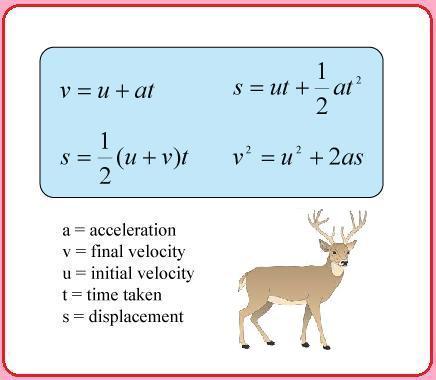
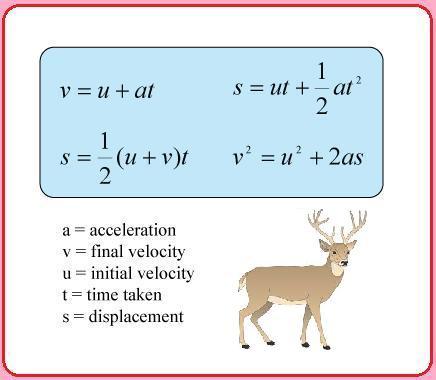
In order to answer this exercise you need to use the formulas

 S = Vo*t + (1/2)*a*t^2

Vf = Vo + at

The data will be given as

Vf = final velocity = ?

Vo = initial velocity = 1.4 m/s

a = acceleration = 0.20 m/s^2

s = displacement = 100m

And now you do the following:

100 = 1.4t + (1/2)*0.2*t^2

t = 25.388s

and

Vf = 1.4 + 0.2(25.388)

Vf = 6.5 m/s

So the answer you are looking for is 6.5 m/s
7 0
2 years ago
Read 2 more answers
Other questions:
  • The speed of a bus increases uniformly from 15 ms per second to 60 ms per second in 20 seconds. calculate 1. the average speed 2
    10·2 answers
  • Select all that apply. Greenhouse gases _____. absorb solar energy absorb carbon dioxide release carbon dioxide are released dur
    7·1 answer
  • You use energy to heat your home. what ultimately happens to the energy that you pay for in your heating bill?
    14·2 answers
  • Just after a motorcycle rides off the end of a ramp and launches into the air, its engine is turning counterclockwise at 8325 re
    8·2 answers
  • A motion sensor is used to create the graph of a student’s horizontal velocity as a function of time as the student moves toward
    8·1 answer
  • Andre really likes his new car, and he knows it has a certain amount of mechanical energy. Which types of energy are included in
    8·2 answers
  • Two narrow, parallel slits separated by 0.85 mm are illuminated by 600 nm light, and the viewing screen is 2.8 m away from the s
    7·1 answer
  • Wet sugar that contains one-fifth water by mass is conveyed through an evaporator in which 85% of the of the entering water is e
    12·1 answer
  • You decide to work at a heart rate of 150 instead of 120. What area of F.I.T.T. did you change?
    12·1 answer
  • Examine each of the four circles containing molecules.
    6·1 answer
Add answer
Login
Not registered? Fast signup
Signup
Login Signup
Ask question!