answer.
Ask question
Login Signup
Ask question
All categories
  • English
  • Mathematics
  • Social Studies
  • Business
  • History
  • Health
  • Geography
  • Biology
  • Physics
  • Chemistry
  • Computers and Technology
  • Arts
  • World Languages
  • Spanish
  • French
  • German
  • Advanced Placement (AP)
  • SAT
  • Medicine
  • Law
  • Engineering
12345 [234]
2 years ago
4

The resolution calculated for the tlc separation of a two-component mixture is determined to be equal to 2.0. does the represent

good separation or not? explain
Chemistry
1 answer:
BartSMP [9]2 years ago
4 0

Answer: No, it does not represent a good separation.

Explanation: Resolution is the measure of extent of separation between two components and the base-line separation. It is calculated using the formula

R_s=2\times \frac{(Rt_1-Rt_2)}{(W_1+W_2)}

Where, R_s = resolution

(Rt_1-Rt_2) = Difference between the retention times of two components.

W_1+W_2 = Spot widths of two components.

The perfect resolution is considered as 100.

Here, we are given that the two components in a mixture both have a resolution at 2.0 that means both the peaks are overlapping each other and thus the components cannot be determined accurately.

Thus, this does not represent a good separation as as the two components are spotted closely.

You might be interested in
En una determinación cuantitativa se utilizan 17.1 mL de Na2S2O3 0.1N para que reaccione todo el yodo que se encuentra en una mu
lozanna [386]

Answer:

La cantidad de yodo en la muestra es 0.217 g

Explanation:

Los parámetros dados son;

Normalidad de la solución de Na₂S₂O₃ = 0.1 N

Volumen de la solución de Na₂S₂O₃ = 17.1 mL

Masa de muestra = 0.376 g

La ecuación de reacción química se da de la siguiente manera;

I₂ + 2Na₂S₂O₃ → 2 · NaI + Na₂S₄O₆

Por lo tanto, el número de moles de sodio por 1 mol de Na₂S₂O₃ en la reacción = 1 mol

Por lo tanto, la normalidad por mol = 1 M × 1 átomo de Na = 1 N

Por lo tanto, 0.1 N = 0.1 M

El número de moles de Na₂S₂O₃ en 17,1 ml de solución 0,1 M de Na₂S₂O₃ se da de la siguiente manera;

Número de moles de Na₂S₂O₃ = 17.1 / 1000 × 0.1 = 0.00171 moles

Lo que da;

Un mol de yodo, I₂, reacciona con dos moles de Na₂S₂O₃

Por lo tanto;

0,000855 moles de yodo, I₂, reaccionan con 0,00171 moles de Na₂S₂O₃

La masa molar de yodo = 253.8089 g / mol

La masa de yodo en la muestra = 253.8089 × 0.000855 = 0.217 g.

5 0
2 years ago
A sample of pure lithium chloride contains 16% lithium by mass. What is the % lithium by mass in a sample of pure lithium carbon
Anna35 [415]

Answer:

Percentage lithium by mass in Lithium carbonate sample = 19.0%

Explanation:

Atomic mass of lithium = 7.0 g; atomic mass of Chlorine = 35.5 g; atomic mass of carbon = 12.0 g; atomic mass of oxygen = 16.0 g

Molar mass of lithium chloride, LiCl = 7 + 35.5 = 42.5 g

Percentage by mass of lithium in LiCl = (7/42.5) * 100% = 16.4 % aproximately 16%

Molar mass of lithium carbonate, Li₂CO₃ = 7 * 2 + 12 + 16 * 3 =74.0 g

Percentage by mass of lithium in Li₂CO₃ = (14/74) * 100% = 18.9 % approximately 19%

Mass of Lithium carbonate sample = 2 * 42.5 = 85.0 g

mass of lithium in 85.0 g Li₂CO₃ = 19% * 85.0 g = 16.15 g

Percentage by mass of lithium in 85.0 g Li₂CO₃ = (16.15/85.0) * 100 % = 19.0%

Percentage lithium by mass in Lithium carbonate sample = 19.0%

3 0
2 years ago
Sea water's density can be calculated as a function of the compressibility, B, where p = po exp[(p - Patm)/B]. Calculate the pre
vaieri [72.5K]

Answer:

The pressure 10,000 m below the surface of the sea is 137.14 MPa.

The density 10,000 m below the surface of the sea is 2039 kg/m3

Explanation:

P0 and ρ0 are the pressure and density at the sea level (atmosferic condition). As the depth of the sea increases, both the pressure and the density increase.

We can relate presure and density as:

\frac{dP}{dy}=\rho*g=\rho_0*g*e^{(P-P_0)/\beta\\\\

Rearranging

\frac{dP}{e^{(P-P_0)/\beta}}= \rho_0*g*dy\\\\\int\limits^{P}_{P_0} {e^{-(P-P_0)/\beta}}dP =\int\limits^y_0 {\rho_0*g*dy}\\\\(-\beta*e^{-(P-P_0)/\beta})-(\beta*e^0)=\rho_0*g*(y-0)\\\\-\beta*(e^{-(P-P_0)/\beta}-1)=\rho_0*g*y\\\\e^{-(P-P_0)/\beta}=1-\frac{\rho_0*g*y}{\beta}\\\\-\frac{P-P_0}{\beta}  =ln(1-\frac{\rho_0*g*y}{\beta})\\\\P-P_0=-\beta*ln(1-\frac{\rho_0*g*y}{\beta})\\

With this equation, we can calculate P at 10,000 m below the surface:

P-P_0=-\beta*ln(1-\frac{\rho_0*g*y}{\beta})\\\\P-P_0=-200MPa*ln(1-\frac{1027kg/m^3*9.81m/s^2*10,000m}{200MPa})\\\\P-P_0=-200MPa*ln(1-\frac{1027*9.81*10,000Pa}{200*10^6Pa})\\\\P-P_0=-200MPa*ln(1-0.5037)\\\\P-P_0=-200MPa*(-0.6857)=137.14MPa

The density at 10,000 m below the surface of the sea is

\rho=\rho_0*e^{(P-P_0)/\beta}\\\rho=1027kg/m^3*e^{(137.14/200)}=1027*e^{0.686}kg/m^3\\\rho=1027*1.985 kg/m^3\\\rho=2039\,kg/m^3

4 0
2 years ago
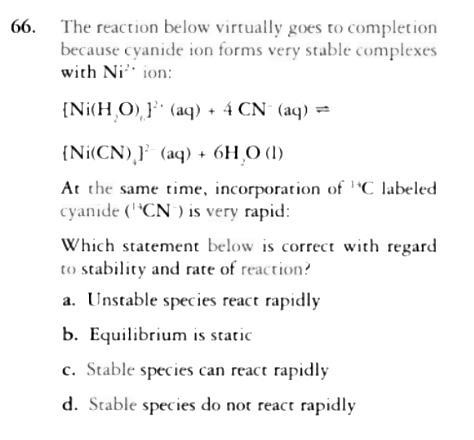
The reaction below virtually goes to completion because cyanide ion forms very stable complexes with Ni2+ ion:[Ni(H2O)6]2+(aq) +
NeX [460]

Answer:

Option A and D are correct.

Unstable species react rapidly.

Stable species do not react rapidly.

Explanation:

The complete question is attached to this solution.

The more stable a reactant is, the less reactive it will be. A stable reactant has a very stable structure in which it will avoid any perturbations. And for a reaction to occur, the bonds in the reactant must break down to form the products. A stable reactant has very strong bonds that aren't easy to break down, hence, reactions involving very stable reactants do not proceed rapidly.

And the more unstable a reactant specie is, the more rapidly it reacts. This is why the reaction involving the less stable isotope of carbon; Carbon-14 is very rapid. It is the same reason as explained above that is responsible for this. The bond between unstable species are not strong and are easily breakable, thereby leading to a quick reaction.

Hope this Helps!!!

6 0
2 years ago
For the reaction C(s)+H2O(g)→CO2(g)+H2(g) ΔH∘=131.3kJ/mol and ΔS∘=127.6J/K⋅mol at 298K. At temperatures greater than ________ ∘C
Solnce55 [7]

Answer : At temperatures greater than 755.9^oC this reaction is spontaneous under standard conditions.

Explanation : Given,

\Delta H = 131.3 KJ/mole = 131300 J/mole

\Delta S = 127.6 J/mole.K

Gibbs–Helmholtz equation is :

\Delta G=\Delta H-T\Delta S

As per question the reaction is spontaneous that means the value of \Delta G is negative or we can say that the value of \Delta G is less than zero.

\Delta G

The above expression will be:

0>\Delta H-T\Delta S

T\Delta S>\Delta H

T>\frac{\Delta H}{\Delta S}

Now put all the given values in this expression, we get :

T>\frac{131300J/mole}{127.6J/mole.K}

T>1028.99K

T>755.9^oC

Therefore, at temperatures greater than 755.9^oC this reaction is spontaneous under standard conditions.

8 0
2 years ago
Other questions:
  • Where in a data table should units of measurement be shown?
    10·2 answers
  • What is the stoichiometric ratio between BaCl2 and NaCl
    11·1 answer
  • Select the reagent(s) that would efficiently convert the starting material to the product for the following transformations (if
    11·1 answer
  • Convert 2.0 M of Phenobarbital sodium (MW: 254 g/mole) solution in water into % w/v and ratio strengths.
    9·1 answer
  • Yousef measured the height of each seedling on day 1 and day 7. These are his results.
    9·1 answer
  • If for a particular process, ΔH=308 kJmol and ΔS=439 Jmol K, in what temperature range will the process be spontaneous?
    10·1 answer
  • Which statement best describes the atoms of the gas neon? O They slide past each other. They move freely in all directions. O. T
    9·2 answers
  • This element has three fewer protons than oganesson 
    8·1 answer
  • Franklin was performing an experiment by combining hydrochloric acid and sodium hydroxide. He measured the mass of his reactant
    6·2 answers
  • If the oxygen isotope 20O has a half-life of 15 seconds, what fraction of a sample of pure 20O remains after 1.0 minute?
    12·1 answer
Add answer
Login
Not registered? Fast signup
Signup
Login Signup
Ask question!