answer.
Ask question
Login Signup
Ask question
All categories
  • English
  • Mathematics
  • Social Studies
  • Business
  • History
  • Health
  • Geography
  • Biology
  • Physics
  • Chemistry
  • Computers and Technology
  • Arts
  • World Languages
  • Spanish
  • French
  • German
  • Advanced Placement (AP)
  • SAT
  • Medicine
  • Law
  • Engineering
andre [41]
2 years ago
8

An archeologist finds a 1.62 kg goblet that she believes to be made of pure gold. She determines that the volume of the goblet i

s 205 mL. How to calculate the density?
Chemistry
2 answers:
Sveta_85 [38]2 years ago
6 0

Answer : The density of goblet is 7.902 g/mL

Explanation :

Density : It is defined as the mass contained per unit volume.

Formula used :

Density=\frac{Mass}{Volume}

Given :

Mass of goblet = 1.62 kg = 1620 g

conversion used : (1 kg = 1000 g)

Volume of goblet = 205 mL

Now put all the given values in the above formula, we get:

Density=\frac{1620g}{205mL}=7.902g/mL

Therefore, the density of goblet is 7.902 g/mL

maxonik [38]2 years ago
3 0
Density (d) which is the quotient when mass (m) is divided by volume (v) is usually reported in terms of g/mL. 
                                  d = m /v
Substituting the known values,
                                d = (1.62 kg) x (1000 g/ 1 kg) / (205 mL)
The answer would be approximately equal to 7.9 g/mL. 
You might be interested in
What is the pH of a solution made by mixing 15.00 mL of 0.100 M HCl with 50.00 mL of 0.100 M KOH? Assume that the volumes of the
denis23 [38]

Answer:

The correct answer is: pH = 12.73

Explanation:

The <em>neutralization reaction</em> between HCl and KOH is given by the following chemical equation:

HCl + KOH ⇒ KCl + H₂O

Since HCl is a strong acid and KOH is a strong base, HCl is completely dissociated into H⁺ and Cl⁻ ions, whereas KOH is dissociated completely into K⁺ and OH⁻ ions.

For acids, the number of equivalents is given by the moles of H⁺ ions (in this case: 1 equivalent per mol of HCl). For bases, the number of equivalents is given by the moles of OH⁻ ions (in this case: 1 equivalent per mol of KOH).

The H⁺ ions from HCl will react with OH⁻ ions of KOH to give H₂O. The pH is calculated from the difference between the equivalents of H⁺ and OH⁻:

equivalents of H⁺= volume HCl x Molarity HCl

                            = (15.0 mL x 1 L/1000 mL) x 0.100 mol/L

                            = 1.5 x 10⁻³ eq H⁺

equivalents of OH⁻= volume KOH x Molarity KOH

                               = (50.0 mL x 1 L/1000 mL) X 0.100 mol/L

                               = 5 x 10⁻³ eq OH⁻

There are more OH⁻ ions than H⁺ ions. The excess of OH⁻ (that did not react with H⁺ ions) is calculated as follows:

OH⁻ ions= (5 x 10⁻³ eq OH⁻) -  (1.5 x 10⁻³ eq H⁺) = 3.5 x 10⁻³ eq OH⁻= 3.5 x 10⁻³ moles OH⁻  

As the volumes of the solutions are additive, the total volume of the solution is:

V= 15.0 mL + 50.0 mL = 65.0 mL= 0.065 L

So, the concentration of OH⁻ ions in the solution is given by:

[OH⁻] = moles OH⁻/V= (3.5 x 10⁻³ moles OH⁻)/0.065 L = 0.054 mol/L = 0.054 M  

From  [OH⁻], we can calculate pOH:

pOH = -log [OH⁻] = -log (0.054) = 1.27

Finally, we know that pH + pOH= 14; so we calculate pH:

pH= 14 - pOH = 14 - 1,27 =  12.73                                                            

8 0
3 years ago
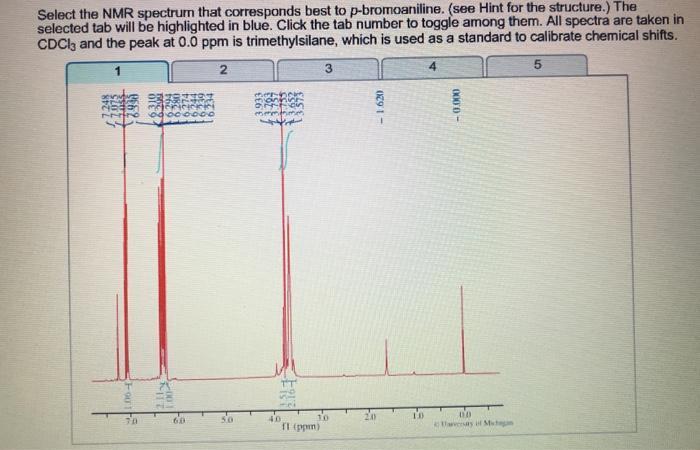
Select the NMR spectrum that corresponds best to p-bromoaniline. (see Hint for the structure.) The selected tab will be highligh
lana [24]

Answer:

The NMR spectrum that corresponds best to p-bromoaniline  is the one that is attached in the image below.

Explanation:

For the p-bromoaniline 3 types of hydrogen are observed. The first signal that appears at 3.7 ppm would be from the hydrogens of the NH2 group, the hydrogens in ortho position with respect to the NH2 group give a double at approximately 6.54 ppm, and finally the characteristic 7.21 ppm signal is observed for the hydrogens in meta position with with respect to the NH2 group.

7 0
2 years ago
Quinine, an antimalarial drug, is 8.63% nitrogen. There are two nitrogen atoms per molecule. What is the molecular weight of qui
Furkat [3]

Answer:

324.18 g/mol

Explanation:

Let the molecular mass of the antimalarial drug, Quinine is x g/mol

According to question,

Nitrogen present in the drug is 8.63% of x

So, mass of nitrogen = \frac {8.63}{100}\times x

Also, according to the question,

2 atoms are present in 1 molecule of the drug.

Mass of nitrogen = 14.01 amu = 14.01 g/mol (grams for 1 mole)

So, mass of nitrogen = 14.01×2 = 28.02

These 2 must be equal so,

\frac {8.63}{100}\times x=28.02

solving for x, we get:

<u>x = 324.18 g/mol</u>

6 0
2 years ago
The chlorination of methane occurs in a number of steps that results in the formation of chloromethane and hydrogen chloride. Th
kenny6666 [7]

Answer:

Total pressure = 0,806 atm

Partial pressure of CH₄: 0,037 atm

Partial pressure of Cl₂: 0,396 atm

Partial pressure of CH₃Cl: 0,125 atm

Partial pressure of HCl: 0,125 atm

Partial pressure of Cl⁻: 0,125 atm

Explanation:

For the reaction:

2CH₄(g)+3Cl₂(g)⟶2CH₃Cl(g)+2HCl(g)+2Cl⁻(g)

295 mL≡ 0,295L of methane at STP are:

n = PV/RT

P = 1 atm; V = 0,295L; R = 0,082atmL/molK; T = 273K.

moles of methane: 0,0132 moles

For 725 mL of chlorine ≡ 0,725L

moles of chlorine at STP are: ≡ 0,0324 moles

For a complete reaction of 0,0132 moles of CH₄:

0,0132 mol CH₄× \frac{3molCl_{2}}{2 molCH_{4}} = <em>0,0198 moles</em>

The reaction reaches 77%, moles of Cl₂ that react are: 0,0198×77% = 0,0153 mol

As you have 0,0324 moles of Cl₂, moles that will not react are:

0,0324 - 0,0153 = <em>0,0171 mol Cl₂</em>

As the reaction reaches 77% completion, moles of CH₄ that react are:

0,0132×77% =<em> 0,0102 moles of CH₄ And the moles that don't react are </em><em>0,00300 mol</em>

Thus, moles of each compound are:

0,0102 moles of CH₄×\frac{3Cl_{2}}{2 molCH_{4}}= <em>0,0153 mol  + 0,0171 mol = 0,0324 mol Cl₂</em>

0,0102 moles of CH₄×\frac{2CH_{3}Cl}{2 molCH_{4}}= <em>0,0102 mol CH₄</em>

0,0102 moles of CH₄×\frac{2HCl}{2 molCH_{4}}= <em>0,0102 mol HCl</em>

0,0102 moles of CH₄×\frac{2Cl^{-}}{2 molCH_{4}}= <em>0,0102 mol Cl⁻</em>

Total pressure using:

P = nRT/V

Where: n = 0,0102mol×3+0,0324mol + 0,0030mol = 0,0660mol; R = 0,082 atmL/molK; T = 298K; V = 2L

Total pressure = 0,806 atm

Partial pressure of CH₄: 0,037 atm

Partial pressure of Cl₂: 0,396 atm

Partial pressure of CH₃Cl: 0,125 atm

Partial pressure of HCl: 0,125 atm

Partial pressure of Cl⁻: 0,125 atm

<em>-To obtain partial pressure you change the moles for each compound-</em>

<em />

I hope it helps!

5 0
2 years ago
What is the overall balanced equation for the precipitation reaction occurring between silver nitrate and calcium bromide? hints
aleksklad [387]
The answer:

<span>the overall balanced equation for the precipitation reaction occurring between silver nitrate and calcium bromide:
</span>CaBr2 + AgNO3-----------> AgBr2 + CaNO3, so among the given choices, the
true answe is 
<span>agno3(aq)+cabr2(aq) (as reactants)</span>
4 0
2 years ago
Other questions:
  • If your lungs were filled with air containing this level of lead, how many lead atoms would be in your lungs? (Assume a total lu
    5·2 answers
  • Silver (ag) has a molar mass of 107.8682 g, nitrogen has a molar mass of 14.0067 g, and oxygen has a molar mass of 15.9994 g. wh
    13·2 answers
  • A pot of water is heated over a fire, and then frozen peas are added to the hot water. What happens to the energy in this situat
    9·2 answers
  • the electron affinity of nitrogen is lower (less negative) than that of both carbon and oxygen. This trend is best explained by
    6·1 answer
  • let 4 moles of methanol (liquid) combust in 3 moles of gaseous oxygen to form gaseous carbon dioxide and water vapor. Suppose th
    12·1 answer
  • A 2 L bottle containing only air is sealed at a temperature of 22°C and a pressure of 0.982 atm. The bottle is placed in a freez
    12·1 answer
  • For each of the described sets of data, choose the graph that best displays the data.
    8·2 answers
  • Two students are working together to build two models. Both models will represent the molecular structure of sodium bicarbonate,
    10·1 answer
  • The mass of an atom comes from _____. A. the nucleus B. the neutrons C. the electro​​​​ns D. the protons
    15·1 answer
  • What happens when carbon dioxide is cooled to 780C?<br>Where is carbon dioxide found in nature?​
    9·1 answer
Add answer
Login
Not registered? Fast signup
Signup
Login Signup
Ask question!