answer.
Ask question
Login Signup
Ask question
All categories
  • English
  • Mathematics
  • Social Studies
  • Business
  • History
  • Health
  • Geography
  • Biology
  • Physics
  • Chemistry
  • Computers and Technology
  • Arts
  • World Languages
  • Spanish
  • French
  • German
  • Advanced Placement (AP)
  • SAT
  • Medicine
  • Law
  • Engineering
SSSSS [86.1K]
2 years ago
6

A jewellery melts 500g of Silver to pour into a mould. Calculate how much energy was released as the silver solidified.

Physics
1 answer:
irga5000 [103]2 years ago
8 0

When silver is poured into the mould the it will solidify

In this process the phase of the Silver block will change from liquid to solid.

This phase change will lead to release in heat and this heat is known as latent heat of fusion.

The formula to find the latent heat of fusion is given as

Q = mL

here given that

m = mass = 500 g

L = 111 kJ/kg

now we can find the heat released

Q = 0.5 * 111 kJ

Q = 55.5 kJ

So it will release total heat of 55.5 kJ when it will solidify

You might be interested in
An electric eel (Electrophorus electricus) can produce a shock of up to 600 V and a current of 1 A for a duration of 2 ms, which
Irina-Kira [14]

Answer:

2\times 10^{-3}\ C

6000

1.2 J

3.33\times 10^{-6}\ F

Explanation:

I = Current = 1 A

t = Time = 2 ms

n = Number of electrocyte

V = Voltage = 100 mV

Charge is given by

Q=It\\\Rightarrow Q=1\times 2\times 10^{-3}\\\Rightarrow Q=2\times 10^{-3}\ C

The charge flowing through the electrocytes in that amount of time is 2\times 10^{-3}\ C

The maximum potential is given by

V_m=nV\\\Rightarrow n=\dfrac{V_m}{V}\\\Rightarrow n=\dfrac{600}{100\times 10^{-3}}\\\Rightarrow n=6000

The number of electrolytes is 6000

Energy is given by

E=Pt\\\Rightarrow E=V_mIt\\\Rightarrow E=600\times 1\times 2\times 10^{-3}\\\Rightarrow E=1.2\ J

The energy released when the electric eel delivers a shock is 1.2 J

Equivalent capacitance is given by

C_e=\dfrac{Q}{V_m}\\\Rightarrow C_e=\dfrac{2\times 10^{-3}}{600}\\\Rightarrow C_e=3.33\times 10^{-6}\ F

The equivalent capacitance of all the electrocyte cells in the electric eel is 3.33\times 10^{-6}\ F

8 0
2 years ago
Sandy is on a road trip. She leaves at 8:00 AM. It takes her 2 hours to drive 200 kilometers. She stops at a rest stop for half
lutik1710 [3]
The average velocity of Sandy is given by the total distance covered S divided by the total time taken t:
v= \frac{S}{t}

The total distance covered is
S=200 km+0+100 km=300 km
while the total time taken is 2 hours + half an hour (for the rest) + 1 hour and half, so
t=2h+0.5h+1.5 h=4 h
Therefore, the average velocity is 
v= \frac{S}{t}= \frac{300 km}{4 h}=75 km/h
0 0
2 years ago
I WIL A 2.00-kg object traveling east at 20.0 m/s collides with a 3.00-kg object traveling west at 10.0 m/s. After the collision
pishuonlain [190]
Using the following given values:

Object 1:
Mass = M1 = 2 kg
Velocity before collision = Vb1 = 20 m/s
Velocity after collision = Va1 = -5 m/s 

Object 2:
Mass = M2 = 3 kg
Velocity before collision = Vb2 = -10 m/s
Velocity after collision = Va2 = ? m/s<span> 
</span>
Obtaining Va2 via law of conservation of momentum:

total momentum after collision = total momentum before collision
M1 * Va1 + M2 * Va2 = M1 * Vb1 + M2 * Vb2
2*-5 + 3Va2 = 2*20 + 3*-10
Va2 = 6.67

Total kinetic energy before collision:

KE1 = (1/2)*M1*Vb1^2 + (1/2)*M2*Vb2^2
<span>KE1 = (1/2)*2*(20)^2 + (1/2)*3*(-10)^2
KE1 = 550 J

</span>Total kinetic energy after collision:

KE2 = (1/2)*M1*Va1^2 + (1/2)*M2*Va2^2
<span>KE2 = (1/2)*2*(-5)^2 + (1/2)*3*(6.67)^2
KE2 = 91.73 J
</span>
Total kinetic energy lost:

Energy lost = KE1 - KE2 = 550 - 91.73 = 458.27 J
4 0
2 years ago
A rock is placed in a graduated cylinder containing water, and the cylinder is covered to avoid evaporation. The next morning th
Zarrin [17]

Explanation:

The setup contains rock, cylinder, covering lid and atmosphere. One or a few may contribute to the loss of water.

They may be dry, so it might have absorbed water. The rock may be porous and absorb water due to gaps between its molecules.

The material used as lid to cover the cylinder may be not good enogh to stop water from evaporation. The cylinder you might have kept near a hot source and water may have converted water vapor.


6 0
2 years ago
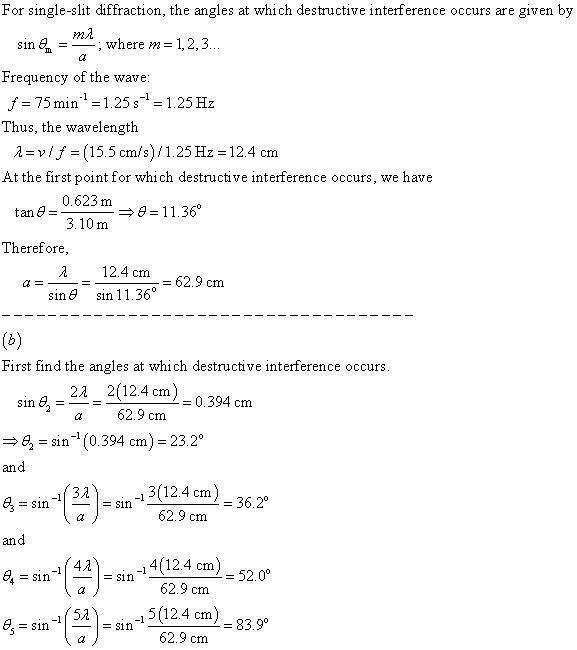
A series of parallel linear water wave fronts are traveling directly toward the shore at 15.5 cm/s on an otherwise placid lake.
nata0808 [166]

Find the given attachment

7 0
2 years ago
Other questions:
  • The pull of the moon on Earth's tidal bulge is causing _____. the earth to gradually rotate faster the earth to slowly expand in
    11·2 answers
  • Which part of a scientific argument must be supported by valid data? claim evidence reasoning theory
    8·2 answers
  • A man of mass 80kg stands next to a stationary ball of mass 4kg on a frictionless surface. He kicks the ball forward along the s
    10·1 answer
  • Match each label to the boundary it describes. convergent boundary new crust forms transform boundary crust submerges into the m
    5·2 answers
  • Compare the density, weight, mass, and volume of a pound of gold to a pound of iron on the surface of Earth.
    11·1 answer
  • Seema knows the mass of basketball. What other information is needed to find the balls potential energy
    5·2 answers
  • A 9.0-V battery moves 20 mC of charge through a circuit running from its positive terminal to its negative terminal. How much en
    7·1 answer
  • A heavy turntable, used for rotating large objects, is a solid cylindrical wheel that can rotate about its central axle with neg
    10·1 answer
  • Peter left Town A at 13:30 and travelled towards Town B at an
    11·1 answer
  • Write the equivalent formulas for velocity, acceleration, and force using the relationships covered for UCM, Newton’s Laws, and
    12·1 answer
Add answer
Login
Not registered? Fast signup
Signup
Login Signup
Ask question!