answer.
Ask question
Login Signup
Ask question
All categories
  • English
  • Mathematics
  • Social Studies
  • Business
  • History
  • Health
  • Geography
  • Biology
  • Physics
  • Chemistry
  • Computers and Technology
  • Arts
  • World Languages
  • Spanish
  • French
  • German
  • Advanced Placement (AP)
  • SAT
  • Medicine
  • Law
  • Engineering
ikadub [295]
2 years ago
7

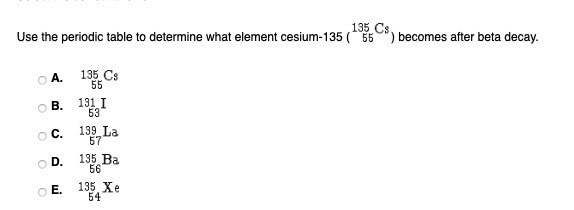
Use the periodic table to determine what element cesium-135 () becomes after beta decay.

Chemistry
2 answers:
Ne4ueva [31]2 years ago
5 0

This question is much trickier than it looks. There are two possible answers: D and E and both can happen in nature. The only thing you know for certain is that you can only create something that is one step on either side of the given atom. It's atomic number can go up one or down one, but it can only move 1 step in either direction.

If the cesium gives up an electron in from nucleus, then a proton is left behind and the Cs goes from 55 to 56. That means it becomes a Barium atom.

If the Cesium gives up a positron from the nucleus, then the atomic number goes down one and the atomic number goes down 1 from Cs to Xe. I cannot refine this any further without a hint about what kind of reaction took place.

All I can suggest is that you look at your notes to see what kind of example you were taught. When I was teaching this material we gave out only 1 example and that was the first one. It would be easier to detect the emission of an electron and the process has a longer time frame. Things may have changed since then.

So the olden days answer woud have been it becomes Ba and that's D.

bonufazy [111]2 years ago
4 0

Answer:

D. _{56}^{135}\text{Ba}

Explanation:

Your unbalanced nuclear equation is

_{55}^{135}\text{Cs} \longrightarrow ? + _{-1}^{0}\text{e}

It is convenient to replace the question mark by an atomic symbol, _{x}^{y}\text{Z}, where <em>x</em> = the atomic number, <em>y</em> = the mass number, and <em>Z</em> = the symbol of the element .

Then your equation becomes

_{55}^{135}\text{Cs} \longrightarrow _{x}^{y}\text{Z} + _{-1}^{0}\text {e}

The main point to remember in balancing nuclear equations is that the sums of the superscripts and the subscripts must be the same on each side of the equation.  

Then

55 = <em>x</em> - 1, so <em>x</em> = 55 + 1 = 56

135 = <em>y</em> + 0, so <em>y</em> = 135

Element 56 is barium, so the nuclear equation becomes

_{55}^{135}\text{Cs} \longrightarrow _{56}^{135}\text{Ba} + _{-1}^{0}\text{e}

You might be interested in
When sodium reacts with chlorine, sodium chloride is produced. Andrew represented this reaction with this equation: Na + Cl2 → 2
My name is Ann [436]
When sodium metal reacts with chlorine gas, the product would be sodium chloride or the table salt. The balanced chemical reaction would be:

2Na + Cl2 = 2NaCl

IN balancing reactions, it is important to remember that the number of atoms at each side should be equal. Hope this answers the question.
4 0
2 years ago
Read 2 more answers
A rod, X has a positive charge of 8. An otherwise identical rod, Y has a negative charge of 4. The rods are touched together, an
gtnhenbr [62]

Answer:

1.  electrons

2. From "Y" to "X"

Explanation:

1. Electrons move between the rod since the electrons are the only charge carriers which are free to move.

2. The particles move from from "Y" to "X"  since the electrons are the only charge carriers which are free to move. The positive charge on rod x is due to a deficit of electrons while the negative charge on rod Y is due to the excess of electrons. When the rods come together, the electrons move from "Y" to "X" since the electrons are the only charge carriers which are free to move.

4 0
1 year ago
What type of bond would form between two atoms of selenium?
siniylev [52]

Answer:

the correct answer is B

hope it helps !!!

8 0
2 years ago
Respirometers were set up that contained yeast and 2% glucose solution. Each respirometer was placed at a different temperature.
Kitty [74]

Temperature is the independent variable in this experiment

Explanation:

A respirometer is a tool used to calculate the rate of breathing of a living organism by calculating the amount of exchange of oxygen and/or carbon dioxide.

When the yeast cells are given sugar in an aerobic (oxygen-containing) environment, then the yeast.

There would be an air bubble at the tip of the respirometer, and our dependent variable is the difference in the duration of the bubble, i.e. incubate in a warm water bath at body temperature (37 ° C) for about 20 minutes.

3 0
2 years ago
Carbon and sodium chloride are both extended structures. What are the main differences between these two kinds of extended struc
Julli [10]
Carbon is what you breathe out and chloride is like somewhere in your immune system
4 0
2 years ago
Read 2 more answers
Other questions:
  • A hydrate of CoCl2 with a mass of 6.00 g is heated strongly. after cooling the mass the anhydrate is 3.27g
    14·2 answers
  • Match the correct properties and characteristics of each type of rock?
    11·2 answers
  • The molar mass of copper(II) chloride (CuCl2) is 134.45 g/mol. How many formula units of CuCl2 are present in 17.6 g of CuCl2? 7
    9·2 answers
  • Construct a flow chart to demonstrate how you could separate a mixture of 1,4- dichlorobenzene, 4-chlorobenzoic acid, and 4-chlo
    7·2 answers
  • After recrystallization, the final weight of biphenyl is found to be 0.02 g. Assume that all steps were carried out correctly, n
    7·1 answer
  • The Lewis structures of four compounds are given. In the first molecule sufur is the central atom. There are two oxygen atoms bo
    11·1 answer
  • The infrared spectrum above represents the absorption of certain wavelengths of radiation by molecules of CO2. Which of the foll
    9·1 answer
  • Which statement describes a chemical property of an object? A:The object is white in color.B:The object has a powdery texture.C:
    15·1 answer
  • Identify the true statements regarding alpha-1,6 linkages in glycogen.
    11·1 answer
  • Calcite is mineral that is found in limestone and marble. A model of the extended structure of calcite is
    5·1 answer
Add answer
Login
Not registered? Fast signup
Signup
Login Signup
Ask question!