answer.
Ask question
Login Signup
Ask question
All categories
  • English
  • Mathematics
  • Social Studies
  • Business
  • History
  • Health
  • Geography
  • Biology
  • Physics
  • Chemistry
  • Computers and Technology
  • Arts
  • World Languages
  • Spanish
  • French
  • German
  • Advanced Placement (AP)
  • SAT
  • Medicine
  • Law
  • Engineering
Svet_ta [14]
2 years ago
3

What is true about 1.0 mol Ca and 1.0 mol Mg

Chemistry
1 answer:
Ede4ka [16]2 years ago
8 0

Answer:- They contain the same number of atoms

Explanations:- Calcium and magnesium are two different elements and different elements have different atomic masses or molar masses. To calculate the mass we multiply the moles by the molar mass of the element. Since we have 1.0 mol of each but the molar masses are different, their masses will also be different.

1.0 mol of an element has atoms equals to Avogadro number that is 6.022*10^2^3 atoms. As we have 1.0 mol of each element, the number of atoms must also be same.

So, the only and only true statement is, "They contain the same number of atoms."

You might be interested in
Consider the following reaction (X = Cl or Br) which statement s is are correct?
statuscvo [17]

A.S OLOS kkkkkkkkkkkkkkkkkkkkkkkkkkkkkkkkkkkkkkkkkkkkkkkkkkkkkkkkll

5 0
2 years ago
Compound w , c6h13cl, undergoes base-promoted e2 elimination to give a single c6h12 alkene, y. compound x, c6h13br, undergoes a
CaHeK987 [17]
<span>Answer: W must be 5-chloro-2-methylpentane. It can give only 4-methy-1-pentene (Y) upon dehydrohalogenation: X must be 4-chloro-2-methylpentane. Dehydrohalogenation yields both Y and 4-methyl-2-pentene. (Z)</span>
5 0
2 years ago
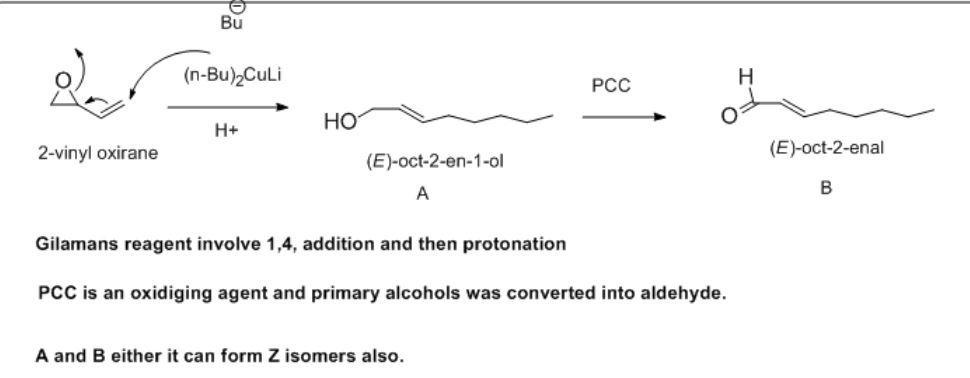
When the epoxide 2-vinyloxirane reacts with lithium dibutylcuprate, followed by protonolysis, a compound A is the major product
pshichka [43]

Answer:

A --- (E)-oct-2-en-1-o1

B ----(E)-oct-2-enal

Explanation:

See the attached file for the structure.

8 0
2 years ago
During an experiment water was heated in a container covered with a glass lid. The following observations were recorded.
Hitman42 [59]

It is a physical change because it only changed states

6 0
2 years ago
Read 2 more answers
What is the molarity of a solution that is made by adding 57.3 g of MgO to 500.0 mL of solution?
kifflom [539]

Answer:

2.843 M

Explanation:

Molarity = moles / volume

<u>Milliliters to liters:</u>

500 mL <u>= .500 L</u>

<u>Grams to moles:</u>

MgO molar mass = 16.00 + 24.31 = 40.31 g/mol

57.3 g x 1 mol / 40.31 g = <u>1.421 mol</u>

<u>Molarity:</u>

1.421 mol / .500 L =  2.843 M

0 0
2 years ago
Other questions:
  • A student does not observe a change when holding a test tube in a flame. However, a change is expected. What is the most likely
    15·2 answers
  • Describe how you could determine the specific heat of a sample of a solid substance. You may assume that the substance does not
    10·2 answers
  • The half life of a certain radioactive element is 1,250 years what percent of the atoms remain after 7500 years
    8·2 answers
  • A compound contains 81.1 boron with the remainder being hydrogen what is the empirical formula of the compound
    9·1 answer
  • A solution of SO2 in water contains 0.00023 g of SO2 per liter of solution. What is the concentration of SO2 in ppm? in ppb?
    7·2 answers
  • The seven most abundant ions in seawater make up more than 99% by mass of the dissolved compounds. Here are their abundances in
    5·1 answer
  • g Select the irreversible reactions of glycolysis. conversion of glucose to glucose 6‑phosphate by hexokinase conversion of gluc
    15·1 answer
  • Calculate the number of grams of carbon dioxide produced from complete combustion of one liter of octane by placing the conversi
    5·1 answer
  • How many molecules of PF5 are found in 39.5 grams of PF5?
    8·1 answer
  • Gamma rays are often used to kill microorganisms in food, in an attempt to make the food safer. Some people contend that this ir
    13·1 answer
Add answer
Login
Not registered? Fast signup
Signup
Login Signup
Ask question!