answer.
Ask question
Login Signup
Ask question
All categories
  • English
  • Mathematics
  • Social Studies
  • Business
  • History
  • Health
  • Geography
  • Biology
  • Physics
  • Chemistry
  • Computers and Technology
  • Arts
  • World Languages
  • Spanish
  • French
  • German
  • Advanced Placement (AP)
  • SAT
  • Medicine
  • Law
  • Engineering
Olenka [21]
2 years ago
12

HURRY PLEASE

Chemistry
2 answers:
katrin2010 [14]2 years ago
4 0

Answers:

Question 1:

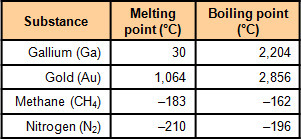
The diagram for gallium will have flat, horizontal lines at <u><em>30 and 2204</em></u><em> </em>°C.

Questoin 2:

The diagram for methane will have a <u><em>diagonal </em></u>line representing the <u><em>liquid phase</em></u> between -183°C and -162°C.

Question 3:

For gold, the boiling point corresponds to the y-value at <u><em>2856</em></u><u> </u>°C of <u><em>the top horizontal line</em></u>

Question 4.

For nitrogen, the line at -210°C will be<u><em> flat</em></u>, which represents <u><em>the change from a solid to a liquid</em></u>

Explanations:

Question 1:

The diagram for gallium will have flat, horizontal lines at <u><em>30 and 2204</em></u><em> </em>°C.

The table shows that the melting point of gallium is 30°C and its boiling point is 2204°C.

<em>Melting point</em> is the temperature at which the substace changes its state from<em> solid to liquid</em>. During that change, <em>the temperature</em> of the substance <em>does not change</em>, because the heat supplied is used to accomplish the phase change. So, the temperature is constant and that means <em>that portion of the diagram is flat</em>.

The same is valid during<em> boiling</em>: the temperature remains constant while the substance is passing<em> from liquid to gas</em> at the boiling point.

Questoin 2:

The diagram for methane will have a <u><em>diagonal </em></u>line representing the <u><em>liquid phase</em></u> between -183°C and -162°C.

Between the <em>melting</em> (-183°C) and<em> boiling</em> (-162°C) points of methane, its temperature will increase more or less linearly, which is represented with a <em>diagonal</em> (slant) <em>line</em> between those points. During this interval the heat is used to <em>increase the temperature</em> and no phase of change happens.

Question 3:

For gold, the boiling point corresponds to the y-value at <u><em>2856</em></u><u> </u>°C of <u><em>the top horizontal line</em></u>

<u><em></em></u>

The table shows that the<em> boiling point</em> of gold is 2,856°C.

In a <em>temperature-vs.-time diagram</em> the<em> temperature is represented on the vertical axis (y-value)</em> and the time is represented on the horizontal axis.

Since, the temperature of the substance does not change during <em>boiling,</em> the line during the time that this change of phase is happening is flat. And since this temperatue is higher than the melting temperature, this is the <em>top horizontal line in the diagram</em>.

Question 4.

For nitrogen, the line at -210°C will be<u><em> flat</em></u>, which represents <u><em>the change from a solid to a liquid</em></u>

<u><em></em></u>

The table shows that the <em>melting point </em>of nitrogen is -210°C, that means that the temperature will remain constant at -210°C while the substance is absorbing heat to pass from solid to liquid.

<u>In conclusion, you must remember that all the phase changes, melting (from solid to liquid), freezing (from liquid to solid), boilng (from liquid to gas), and condensing (from gas to liquid) happens at constant temperature, and so the </u><em><u>temperature - vs. - time diagrams </u></em><u>show flat lines (constant y-values) during those intervals of time.</u>

LenaWriter [7]2 years ago
4 0

Answer:

At 30 and 2,204.

Diagonal and liquid phase.

2,856 and top horizontal line.

Flat and the change from a solid to a liquid.

Explanation:

You might be interested in
A scientist is at the hospital visiting a friend's young daughter, who has been
slava [35]

Answer:

D

Explanation:

The scientist identifies the need to make a drug to cure the respiratory illnesses.

5 0
2 years ago
A tanker truck carrying 6.05×10³ kg of concentrated sulfuric acid solution tips over and spills its load. The sulfuric acid solu
irinina [24]

Answer:

6,216.684 kilograms of sodium carbonate must be added to neutralize 6.05\times 10^3 kg of sulfuric acid solution.

Explanation:

Mass of sulfuric acid solution = 6.05\times 10^3 kg=6.05\times 10^6 g

1 kg = 10^3 g

Percentage mass of sulfuric acid = 95.0%

Mass of sulfuric acid = \frac{95.0}{100}\times 6.05\times 10^6 g

=5,747,500 g

Moles of sulfuric acid = \frac{5,747,500 g}{98 g/mol}=58,647.96 mol

H_2SO_4+Na_2CO_3\rightarrow Na_2SO_4+CO_2+H_2O

According to reaction , 1 mole of sulfuric acid is neutralized by 1 mole of sodium carbonate.

Then 58,647.96 moles of sulfuric acisd will be neutralized by :

\frac{1}{1}\times 58,647.96 mol=58,647.96 mol of sodium carbonate

Mass of 58,647.96 moles of sodium carbonate :

106 g/mol\times 58,647.96 mol=6,216,683.76 g

6,216,683.76 g = 6,216,683.76 × 0.001 kg = 6,216.684 kg

6,216.684 kilograms of sodium carbonate must be added to neutralize 6.05\times 10^3 kg of sulfuric acid solution.

3 0
2 years ago
A sample of a compound of Cl and O reacts with an excess of H2 to give 0.233g of HCl and 0.403g of H2O. Determine the empirical
Vsevolod [243]

Answer:

Cl₂O₇

Explanation:

For the reaction:

ClₓOₙ + H₂ → HCl + H₂O

Moles of HCl and moles of H₂O are:

HCl: 0.233g HCl ₓ (1mol / 36.46g) = 6.39x10⁻³ mol HCl

H₂O: 0.403g H₂O ₓ (1mol / 18.02g) = 2.236x10⁻² mol H₂O

As you can see, moles of HCl are equivalent to moles of Cl in the compound and moles of H₂O are equivalent to moles of O in the compound, that means:

6.39x10⁻³ mol Cl

2.236x10⁻² mol O

Empirical formula is the simplest ratio of atoms presents in a molecule. If Cl is <em>1</em>, Oxygen will be:

2.236x10⁻² mol / 6.39x10⁻³ = <em>3.5</em>

As empirical formula must be given in natural numbers, the empirical formula is:

<em>Cl₂O₇</em>

<em></em>

4 0
2 years ago
Read 2 more answers
Liquid Q is a polar solvent and liquid R is a nonpolar solvent. On the basis of this information, you would expect:
bearhunter [10]
4) is correct
This is because water is polar and it will mix with a polar solvent. A good rule for remembering the behavior of non-polar and polar compounds when it comes to being miscible is that "like dissolves like."
6 0
2 years ago
Daphne is a pilot for a package delivery service. As her plane takes off and travels away from the Earth’s surface, its gravitat
Lubov Fominskaja [6]

Answer:

its height relative to some reference point, its mass, and the strength of the gravitational field

Explanation:

Gravitational energy is the potential energy associated with gravitational force, such as elevating objects against the Earth’s gravity. The potential energy due to elevated positions is called gravitational potential energy.

The factors that affect an object’s gravitational potential energy are the following; its height relative to some reference point, its mass, and the strength of the gravitational field it is in. For instance, consider a wallet lying on a table, it has less gravitational potential energy than the same wallet lying on top of a taller cupboard, and yet lesser gravitational potential energy than a heavier wallet lying on the same table.

If an object lies at a certain height above the Moon’s surface, it has less gravitational potential energy than the same object lying at the same height above the Earth’s surface because the Moon’s gravitational force is weaker.

5 0
2 years ago
Other questions:
  • Jim takes 45 seconds to walk 180 meters north to a store what is jims meters per second
    9·2 answers
  • One mole of h2s gas escapes from a container by effusion in 77 seconds how long would it take one mole of nh3 gas to escape from
    10·2 answers
  • How can chemistry help you make wiser decisions and be a better consumer?
    6·1 answer
  • How do moss leaves and fish differ? How are they the same?
    11·1 answer
  • 50 POINTSSSSS PLZ HELPPPPPP NEED TO SHOW WORK!!!!
    5·1 answer
  • If 8.00 g NH4NO3 is dissolved in 1000 g of water, the water decreases in temperature from 21.00 degrees Celsius to 20.39 degrees
    7·1 answer
  • Insert the values from the question above for x, y, z, &amp; n into KxFey(C2O4)z·nH2O and provide the correct coefficients to ba
    9·1 answer
  • A 2 L bottle containing only air is sealed at a temperature of 22°C and a pressure of 0.982 atm. The bottle is placed in a freez
    12·1 answer
  • What volume of 0.500 M HNO₃(aq) must completely react to neutralize 100.0 milliliters of 0.100 M KOH(aq)?
    8·1 answer
  • An atom of 120In has a mass of 119.907890 amu. Calculate the mass defect (deficit) in amu/atom. Use the masses: mass of 1H atom
    5·1 answer
Add answer
Login
Not registered? Fast signup
Signup
Login Signup
Ask question!