answer.
Ask question
Login Signup
Ask question
All categories
  • English
  • Mathematics
  • Social Studies
  • Business
  • History
  • Health
  • Geography
  • Biology
  • Physics
  • Chemistry
  • Computers and Technology
  • Arts
  • World Languages
  • Spanish
  • French
  • German
  • Advanced Placement (AP)
  • SAT
  • Medicine
  • Law
  • Engineering
Mashutka [201]
2 years ago
8

Two gas jars are connected to each other, but they are separated by a closed valve. One gas jar contains oxygen, and the other c

ontains hydrogen. What will happen when the valve is opened?
Oxygen and hydrogen molecules will mix because of random movement of their molecules.

Oxygen and hydrogen molecules will remain in separate jars because of different partial pressures.

Oxygen and hydrogen molecules will remain in separate jars because of different rates of expansion.

Oxygen and hydrogen molecules will mix because the molecules have a much lower volume than the volume of the jars.

I think its A or D
Chemistry
2 answers:
baherus [9]2 years ago
7 0

It is most likely A since gas particles do not have a fixed volume.

Strike441 [17]2 years ago
4 0

Answer:

A) Oxygen and hydrogen molecules will mix because of random movement of their molecules.

I took the test and A Is correct

You might be interested in
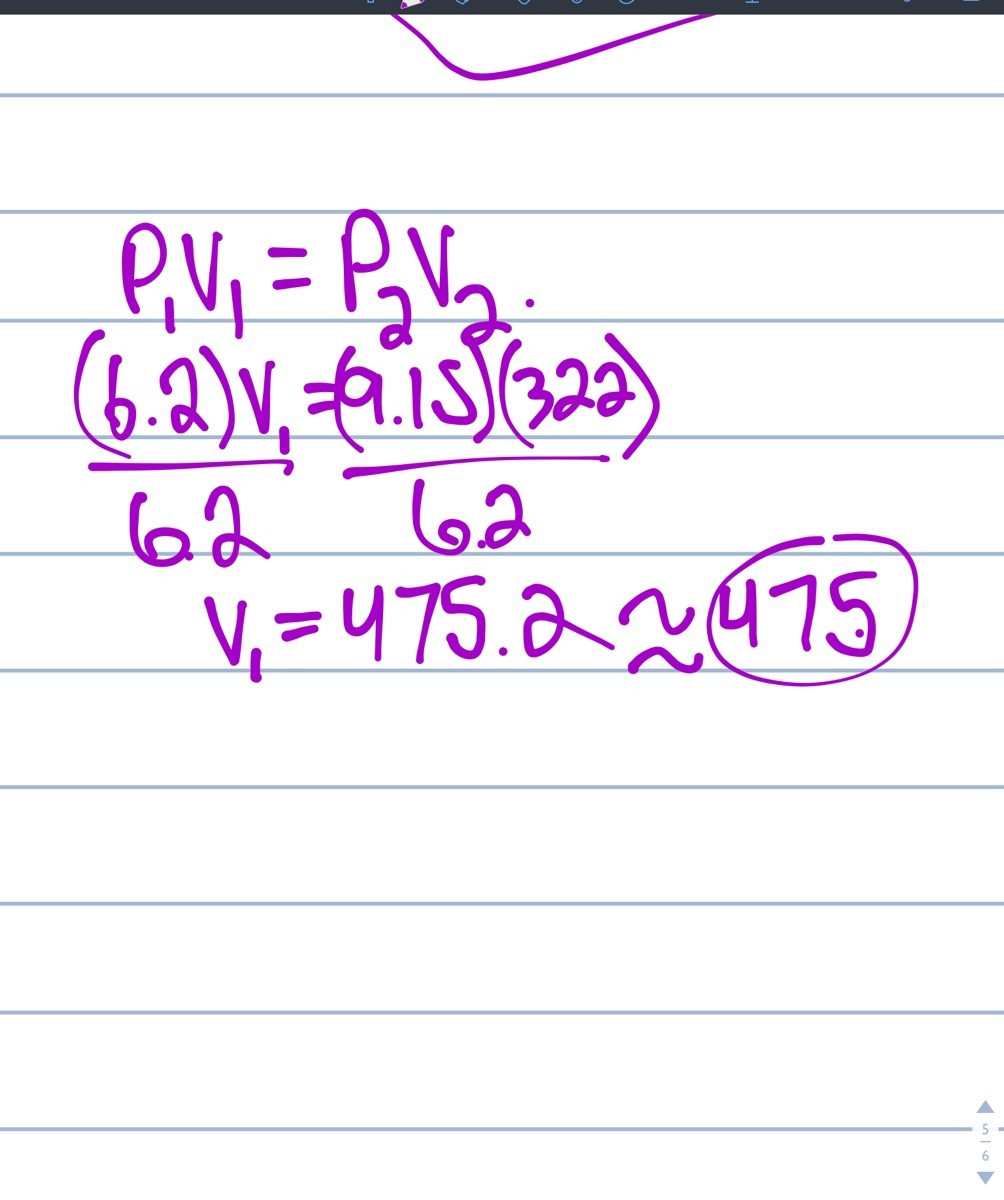
a gas that exerts a pressure of 6.20 atm in a container with a volume of ____ mL will exert a pressure of 9.150 atm when transfe
leonid [27]
The answer is 475 mL

7 0
2 years ago
Read 2 more answers
A solution has a hydroxide-ion concentration of 0.0040 M. What is the pOH of the solution? A solution has a pH value of 3.66. Wh
hodyreva [135]

Answer:

1. pOH = 2.4

2. pOH = 10.34

3. pH = 2.14

Explanation:

1. Determination of the pOH.

Concentration of Hydroxide ion, [OH-] = 0.004 M

pOH =?

pOH = - log [OH-]

pOH = - log (0.004)

pOH = 2.4

Therefore, the pOH of the solution is 2.4

2. Determination of the pOH.

pH = 3.66

pOH =?

pH and pOH are related by the following equation:

pH + pOH = 14

With the above formula, we can obtain the pOH of the solution as follow:

pH = 3.66

pOH =?

pH + pOH = 14

3.66 + pOH = 14

Collect like terms

pOH = 14 - 3.66

pOH = 10.34

Therefore, the pOH of the solution is 10.34

3. Determination of the pH.

Molarity of HCl = 0.0072 M

Concentration of Hydrogen ion, [H+] =?

Thus, we can obtain the concentration of Hydrogen ion, [H+] as follow:

HCl(aq) —> H+(aq) + Cl-(aq)

From the balanced equation above,

1 mole of HCl produced 1 mole of H+.

Therefore, 0.0072 M HCl will also produce 0.0072 M H+.

Therefore, the concentration of Hydrogen ion, [H+] in the solution is 0.0072 M.

Finally, we shall determine the pH of the solution as follow:

Concentration of Hydrogen ion, [H+] = 0.0072 M.

pH =?

pH = - log [H+]

pH = - log (0.0072)

pH = 2.14

Therefore, the pH of the solution is 2.14

3 0
2 years ago
Which is the correct statement regarding the relative Rf values of the starting methyl benzoate vs the product, methyl m-nitrobe
Marianna [84]

Answer:

1. The product has a higher Rf value on a silica gel TLC plate because it is more polar than the starting methyl benzoate.

2. False

3. True

Explanation:

In chromatography, there is a stationary phase and a mobile phase. The ratio of the distance moved by a component and the distance moved by the solvent gives the retention factor (Rf).

Since silica gel is a polar solvent, it will retain the more polar product methyl m-nitrobenzoate compared to the methyl benzoate starting material.

In comparing the electrophillic aromatic substitution of m-nitrobenzoate  and methyl benzoate, we must remember that the presence of electron withdrawing groups (such as -NO2 and -CHO) on the aromatic compound deactivates the compound towards electrophillic aromatic substitution hence, methyl m-nitrobenzoate is less reactive than methyl benzoate in Electrophilic Aromatic Substition and Methyl benzoate is less reactive than benzene in Electrophilic Aromatic Substition

5 0
2 years ago
What do you think life on earth would be like if chemistry had not been put to practical use?​
tatyana61 [14]

Answer:

if chemistry hadn't been put up to practical use, we wouldn't truly understand the reason why humans are humans like makes up humans (including other understandings of biology, etc) and we wouldn't be able to have the advancements we have today (vaccines, etc).

Explanation:

5 0
1 year ago
Many classic experiments have given us indirect evidence of the nature of the atom. Which of the experiments listed below did no
uranmaximum [27]

Answer:

Option A, The Rutherford experiment proved the Thomson "plum-pudding" model of the atom to be essentially correct.

Explanation:

Thomson's plum pudding model:

Plum pudding model was proposed by J.J Thomson. In Thomson's model, atoms are proposed as sea of positively charge in which electrons are distributed through out.

Result of Rutherford experiment:

As per Rutherford's experiment:

Most of the space inside the atom is empty.

Positively charge of the atom are concentrated in the centre of the atom known as nucleus.

Electrons are present outside the nucleus and revolve around it.

As it is clear that, result of Rutherford experiment did not supported the Thomson model.

4 0
2 years ago
Other questions:
  • 24 how many moles are in 2.04 × 1024 molecules of h2o?
    14·1 answer
  • Which isolated gaseous atom has a total of five electrons occupying spherically shaped orbitals?
    7·1 answer
  • A 1.25 g gas sample occupies 663 ml at 25∘ c and 1.00 atm. what is the molar mass of the gas?
    15·1 answer
  • A sample of 508.4 grams of copper completely reacted with oxygen to form 572.4 grams of a copper oxide product. how many grams o
    10·1 answer
  • In 1980,the US produced 18.4 billion(10to the power of 9)pounds of phosphoric acid to be used in the manufacture of fertilizer.t
    11·2 answers
  • Is utensils a substance homogeneous mixture or heterogeneous mixture
    15·1 answer
  • Two containers hold the same radioactive isotope. Container A contains 1000 atoms, and container B contains 500 atoms. Which of
    5·2 answers
  • 1‑propanol ( n ‑propanol) and 2‑propanol (isopropanol) form ideal solutions in all proportions. Calculate the partial pressure a
    12·1 answer
  • A car uses 12.5 L of gasoline to travel a distance of 275 km. Convert this into units of miles per gallon (mi/gal).
    14·1 answer
  • At 800 K, the equilibrium constant, Kp, for the following reaction is 3.2 × 10⁻⁷. 2 H2S(g) ⇌ 2 H2(g) + S2(g) A reaction vessel a
    9·1 answer
Add answer
Login
Not registered? Fast signup
Signup
Login Signup
Ask question!