answer.
Ask question
Login Signup
Ask question
All categories
  • English
  • Mathematics
  • Social Studies
  • Business
  • History
  • Health
  • Geography
  • Biology
  • Physics
  • Chemistry
  • Computers and Technology
  • Arts
  • World Languages
  • Spanish
  • French
  • German
  • Advanced Placement (AP)
  • SAT
  • Medicine
  • Law
  • Engineering
rewona [7]
2 years ago
13

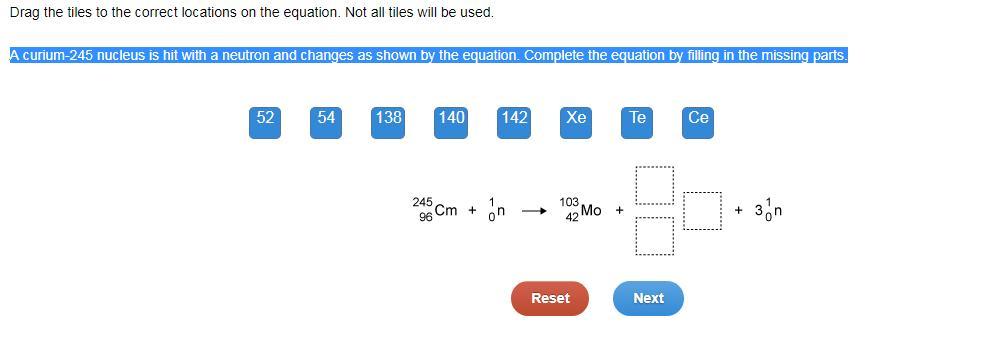
A curium-245 nucleus is hit with a neutron and changes as shown by the equation. Complete the equation by filling in the missing

parts.

Chemistry
2 answers:
Lera25 [3.4K]2 years ago
8 0

Try this option:

^{245}_{96}Cm+^1_0n=^{103}_{42}Mo+^{245+1-103-3*1}_{96+0-42-3*0}(X)+3^1_0n;

^{245}_{96}Cm+^1_0n=> ^{103}_{42}Mo+^{140}_{54}(X)+3^1_0n;

^{245}_{96}Cm+^1_0n=> ^{103}_{42}Mo+^{140}_{54}Xe+3^1_0n;

Answer:

^{140}_{54}Xe

Katarina [22]2 years ago
3 0

Answer:

24296Cm + 42α => 24598Cf+1on.

Explanation:

You might be interested in
Movement of the ___<br> creates the London dispersion forces.
Tanzania [10]

Answer: electrons

Explanation: moving electrons cause momentarily charge

Distribution on molecule. This distribution induces similar distribution to

Adjacent molecule.

7 0
2 years ago
Explain one way the water cycle affects climate. Use complete sentences.
ladessa [460]

Answer:

The water cycle will affect the climate by causing rain and snow.

Explanation:

if tempatures increase more rain fall will occur because more water evaporates in the air.

4 0
1 year ago
What are the answers to these questions
Virty [35]

Answer:

Explanation:

So basically it just asking you question about that surtain subject .

5 0
2 years ago
Which of the compounds above are strong enough acids to react almost completely with a hydroxide ion (pka of h2o = 15.74) or wit
luda_lava [24]

The compounds can react with OH⁻ and HCO₃⁻ only C₅H₆N pyridinium

<h3><em>Further explanation </em></h3>

In an acid-base reaction, it can be determined whether or not a reaction occurs by knowing the value of pKa or Ka from acid and conjugate acid (acid from the reaction)

Acids and bases according to Bronsted-Lowry

Acid = donor (donor) proton (H + ion)

Base = proton (receiver) acceptor (H + ion)

If the acid gives (H +), then the remaining acid is a conjugate base because it accepts protons. Conversely, if a base receives (H +), then the base formed can release protons and is called the conjugate acid from the original base.

From this, it can be seen whether the acid in the product can give its proton to a base (or acid which has a lower Ka value) so that the reaction can go to the right to produce the product.

The step that needs to be done is to know the pKa value of the two acids (one on the left side and one on the right side of the arrow), then just determine the value of the equilibrium constant

Can be formulated:

K acid-base reaction = Ka acid on the left : K acid on the right.

or:

pK = acid pKa on the left - pKa acid on the right

K = equilibrium constant for acid-base reactions

pK = -log K;

K~=~10^{-pK}

K value> 1 indicates the reaction can take place, or the position of equilibrium to the right.

There is some data that we need to complete from the problem above, which is the pKa value of some compounds that will react, namely:

pyridinium pKa = 5.25

acetone pKa = 19.3

butan-2-one pKa = 19

Let's look at the K value of each possible reaction:

pka H₂O = 15.74, pka of H₂CO₃ = 6.37)

  • 1. C₅H₆N pyridinium

* with OH⁻

C₅H₆N + OH- ---> C₅H₅N- + H₂O

pK = pKa pyridinium - pKa H₂O

pK = 5.25 - 15.74

pK = -10.49

K~=~10^{4.9}

K values> 1 indicate the reaction can take place

* with HCO3⁻

C₅H₆N + HCO₃⁻-- ---> C₅H₅N⁻ + H₂CO₃

pK = 5.25 - 6.37

pK = -1.12

K`=~10^{1.12]

Reaction can take place

  • 2. Acetone C₃H₆O

* with OH-

C₃H₆O + OH⁻ ---> C₃H₅O- + H₂O

pK = 19.3 - 15.74

pK = 3.56

K~=~10^{ -3.56}

Reaction does not happen

* with HCO₃-

C₃H₆O + HCO₃⁻ ----> C₃H₅O⁻ + H₂CO₃

pK = 19.3 - 6.37

pK = 12.93

K`=~10 ^{-12.93}

Reaction does not happen

  • 3. butan-2-one C₄H₇O

* with OH-

C₄H₇O + OH- ---> C₄H₆O- + H₂O

pK = 19 - 15.74

pK = 3.26

K~=~10^{-3.26}

Reaction does not happen

* with HCO₃⁻

C₄H₇O + HCO₃⁻ ---> C₄H₆O⁻ + H₂CO₃

pK = 19 - 6.37

pK = 12.63

K~=~ 10^{-12.63}

Reaction does not happen

So that can react with OH⁻ and HCO₃⁻ only C₅H₆N pyridinium

<h3><em>Learn more </em></h3>

the lowest ph

brainly.com/question/9875355

the concentrations at equilibrium.

brainly.com/question/8918040

the ph of a solution

brainly.com/question/9560687

Keywords : acid base reaction, the equilibrium constant

5 0
2 years ago
Read 2 more answers
With the help of balanced chemical equation explain what happens when:(1)Zinc is put in dilute hydrochloric acid (2)Zinc is put
UkoKoshka [18]
Find the attached document.

6 0
2 years ago
Read 2 more answers
Other questions:
  • A sample weighing 30.0 grams contains 1.5g of salt/ determine the percent salt found in the sample
    15·1 answer
  • A particular sheet of paper measures 8.5 × 6.5 inches. What is the surface area of one side of the paper in cm2? (2.54 cm = 1 in
    11·1 answer
  • The volume of a gas is 36.0 ml at 10.0°c and 4.50 atm. at what temperature (°c) will the gas have a pressure of 3.50 atm and a v
    7·1 answer
  • An unknown compound with a molar mass of 223.94 g/mol consists of 32.18% c, 4.50% h, and 63.32% cl. find the molecular formula f
    7·1 answer
  • Copper(II) sulfide, CuS, is used in the development of aniline black dye in textile printing. What is the maximum mass of CuS wh
    14·1 answer
  • The weight percent of concentrated HClO4(aq) is 70.5% and its density is 1.67 g/mL. What is the molarity of concentrated HClO4
    6·1 answer
  • Sodium acetate spontaneously crystallizes out of a supersaturated solution upon standing or upon the addition of a seed crystal.
    14·1 answer
  • Rubbing alcohol contains 615g of isopropanol (C3H7OH) per liter (aqueous solution). Calculate the molality of this solution. Giv
    12·1 answer
  • Every single-celled organism is able to survive because it carries out *
    5·1 answer
  • When the following equation is balanced, the coefficients are __________. Al(NO3)3 + Na2S → Al2S3 + Na(NO3)
    11·1 answer
Add answer
Login
Not registered? Fast signup
Signup
Login Signup
Ask question!