answer.
Ask question
Login Signup
Ask question
All categories
  • English
  • Mathematics
  • Social Studies
  • Business
  • History
  • Health
  • Geography
  • Biology
  • Physics
  • Chemistry
  • Computers and Technology
  • Arts
  • World Languages
  • Spanish
  • French
  • German
  • Advanced Placement (AP)
  • SAT
  • Medicine
  • Law
  • Engineering
Ierofanga [76]
2 years ago
6

on a piece of paper, graph this system of equations. y = - x - 10 y = x^2 - 2x - 3 then determine which answer choice matches th

e graph you drew and identify the solution(s) to the system.

Mathematics
1 answer:
olasank [31]2 years ago
8 0

Answer:

Option D. No solution

Step-by-step explanation:

<u>We have the equation of a line: </u>

y = - x - 10

We find their cut points.

<em>Cut point with the y axis. (x = 0) </em>

y = -(0) -10\\y = -10

<em>Cut point with the x axis. (y = 0) </em>

0 = -x -10\\x = -10.

The line cuts to the x-axis at x = -10 and cuts the y-axis at y = -10

<u>We have a parabola </u>

y = x ^ 2 - 2x - 3

We can factor this quadratic equation by looking for 2 numbers that when multiplied give as result -3 and that when adding these numbers as a result -2. These numbers are -3 and 1.

Then the factors are:

(x-3)(x + 1) = 0

The zeros are 3 and -1. So <em>the parabola cuts to the x axis at points </em><em>3</em><em> and</em><em> -1</em><em>. </em>

<em>Now we find the cut points with the y axis. (x = 0) </em>

y = (0-3)(0 + 1)\\y = -3.

<em>The parabola cuts to the axis y in y = -3. </em>

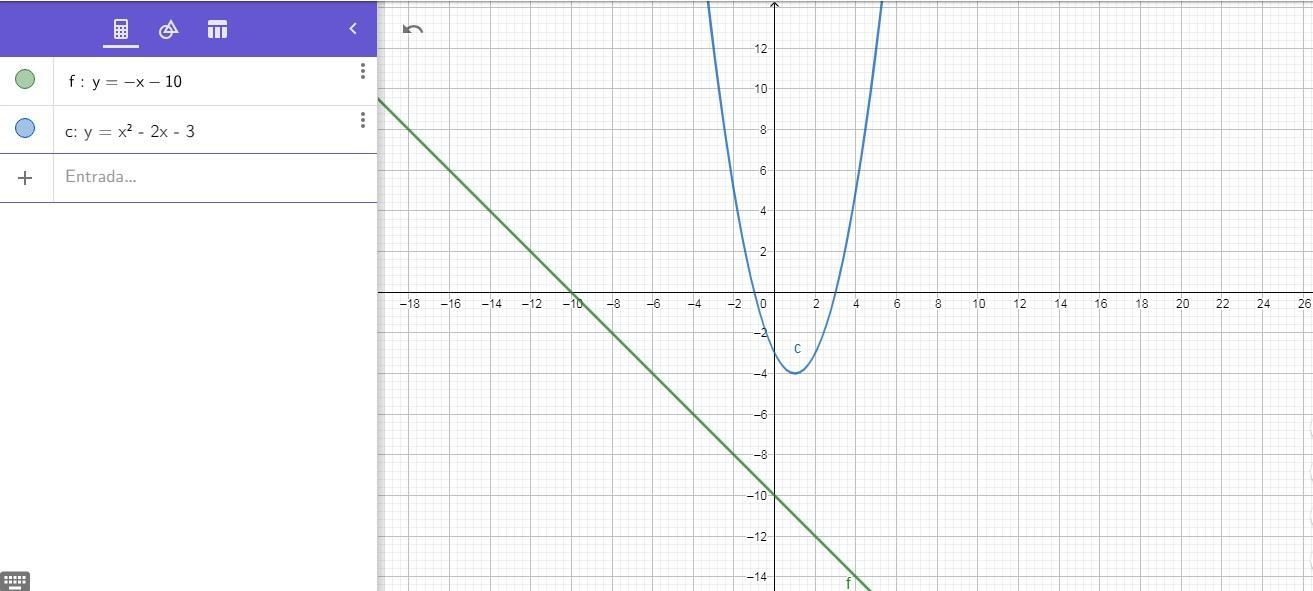
Now we can graph the line and the parabola. Observe the attached image.

<em>The system has no solution because the line and the parabola never intersect or touch each other. The answer is the option D</em>

You might be interested in
an artist is arranging tiles in rows to decorate a wall. each new row has 2 fewer tiles than the row below it. if the first row
valentinak56 [21]

we know that

In an Arithmetic Sequence the difference between one term and the next is a constant

This problem is an Arithmetic Sequence

where

the first term is 23

and

the common difference is -2

In general we can write an Arithmetic Sequence as a rule

an=a1+d*(n-1)

where

a1 is the first term

d is the common difference

so

a1=23\\\\  d=-2

<u>Find the term a7</u>

an=a1+d*(n-1)\\ \\  a7=23+(-2)*[7-1]\\ \\\\ a7=23-12\\ \\\\    a7=11

therefore

<u>the answer is</u>

11\ tiles


7 0
2 years ago
Read 2 more answers
Pentagon ABCDE was enlarged:
enot [183]

Answer/Step-by-step explanation:

The ratio of the enlargement to the original = A'E' to AE = A'E':AE = A'E'/AE

AE = 2.5

A'E' = 4

Ratio of the enlargement to the original = 4:2.5 = 1.6:1

To convert to percentage, divide 4 by 2.5 and multiply by 100.

= \frac{4}{2.5}*100

= 1.6*100

= 160 percent

7 0
2 years ago
The batting Wang Xiu Ying uses to fill quilts has a thermal conductivity rate of 0.030.030, point, 03 watts (\text{W})(W)left pa
alexgriva [62]

Answer:

0.0003W/cm°C

Step-by-step explanation:

The question is not properly written. Here is the correct question.

The batting wang xiu ying uses to fill quilts has a thermal conductivity rate of 0.03 watts (W) per meter(m) per degree celsius. what is the batting thermal conductivity when w/cm•c

Given the thermal conductivity in W/m°C to be 0.03W/m°C

We are to rewrite the value in W/cm°C

The difference is the unit. The only thing we need to do is to simply convert the unit (metres) in W/m°C to centimeters (cm)

Since 100cm = 1m, 0.03W/m°C can be expressed as shown below;

= 0.03W/m°C

= 0.03 × W/1m×°C

Note that 1m = 100cm, substituting this conversion into the expression, it will become;

= 0.03 × W/100cm × °C

= 0.03/100 × W/cm°C

= 0.0003W/cm°C

Hence the battling thermal conductivity in W/cm°C is 0.0003W/cm°C

4 0
2 years ago
A village was founded four hundred years ago by a group of 20 people. In this village, the population triples every one hundred
Paha777 [63]

Answer:

Step-by-step explanation:

Treat this like compound interest:  Use A = P(1 + r)^t.

Here, P is the initial population and A is 3 times that, or 3P.  Since P = 20 people, 3P = 60 people,

and this population is reached after 100 years.

We need to determine r, substitute its value into the formula A = P(1 + r)^t, and then determine the population of the village after 400 years.

60 = 20(1 + r)^100

Simplifying, 3 = (1 + r)^100.

Taking the natural log of both sides,

ln 3 = 100 ln (1 + r), or

                   ln 3

ln (1 + r) = ---------------

                    100

              = 1.0986 / 100 = 0.01986

We must solve this for r.  Raising e to the power ln (1 + r), on the left side of an equation, and raising e to the power 0. 01986 on the right side, we get:

1 + r = 3, so r must = 2.

Now find the pop of the village today.  Use the same equation:  A = P (1+r)^t.

A = 20(1 +2)^4 (hundreds),

or

A = 20(3)^4, or

A = 81

The population after 400 years is 81.
8 0
2 years ago
Supervisor: "Last week, you spoke with 800 customers in 40 hours."
algol13

Answer:12

Step-by-step explanation:

0 0
2 years ago
Other questions:
  • Ally has 30 quaters. The ratio if her quarters to dimes is 2:3 and the ratio of her dimes to nickels is 5:3. How many nickles do
    13·1 answer
  • Premier Bank is planning to have a new building constructed. They would like the length of the building to be 40 feet longer tha
    11·2 answers
  • The exterior angle of a regular polygon is one-fifth of its interior angle. How many sides does the polygon have? please answer
    9·1 answer
  • One leg of an isosceles right triangle measures 5 inches. Rounded to the nearest tenth, what is the approximate length of
    9·1 answer
  • 3 For the compensation D(s) = 25 s + 1 s + 15 use Euler’s forward rectangular method to determine the difference equations for a
    9·1 answer
  • Show all work. <br> URGENT
    7·2 answers
  • A study was designed to compare the attitudes of two groups of nursing students towards computers. Group 1 had previously taken
    10·1 answer
  • A certain spring has a resting length of 0.08 m (8 cm) when it is not stretched. The spring is stretched to a length of 0.10 m (
    10·1 answer
  • Michael started a savings account with $300. After 4 weeks, he had $350 dollars. And after 8 weeks, he had $400. What is the rat
    6·2 answers
  • How many solutions exist for the mixed-degree system graphed below?
    7·2 answers
Add answer
Login
Not registered? Fast signup
Signup
Login Signup
Ask question!