answer.
Ask question
Login Signup
Ask question
All categories
  • English
  • Mathematics
  • Social Studies
  • Business
  • History
  • Health
  • Geography
  • Biology
  • Physics
  • Chemistry
  • Computers and Technology
  • Arts
  • World Languages
  • Spanish
  • French
  • German
  • Advanced Placement (AP)
  • SAT
  • Medicine
  • Law
  • Engineering
allsm [11]
2 years ago
5

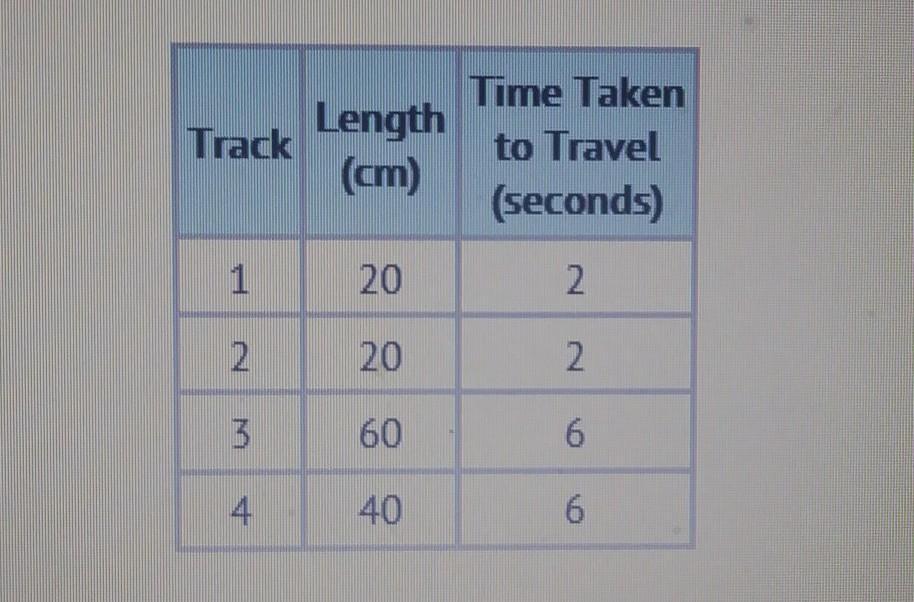
Carol and Juan were playing with Carol's new train set. They pushed the trains around the track. They tried four different

Chemistry
1 answer:
Bumek [7]2 years ago
6 0

Speed (m/s) = distance (metres) ÷ time (seconds)

For Track 1: 0.2 ÷ 2 = 0.1m/s

For Track 2: 0.2 ÷ 2 = 0.1m/s

For Track 3: 0.6 ÷ 6 = 0.1m/s

For Track 4: 0.4 ÷ 6 = 0.07m/s

The train on Track 4 had the slowest speed because it's got the shortest speed and it's covering less distance per second therefore it is slower.

You might be interested in
Adding one proton to the nucleus of an atom
Sonbull [250]
Adding or removing protons from the nucleus changes the charge of the nucleus and changes that atom's atomic number. So, adding or removing protons from the nucleus changes what element that atom is! For example, adding a proton to the nucleus of an atom of hydrogen creates an atom of helium.
7 0
2 years ago
A turtle moves at a speed of 1.0km/h. How fast is the turtle moving in meter per second (m/s)?
ahrayia [7]

Answer:

0.28m/s

Explanation:

Speed is defined as the distance travelled per unit of time. The speed of the turtle is 1.0km/h. Thus, to find the speed in m/s, we need to convert km to m (1km is 1000m), and h to s (1h = 3600s).

<em>Converting units:</em>

1.0km/h * (1000m / 1km) * (1h / 3600s) = 0.28m/s.

The speed of the turtle in meter per second is 0.28m/s

7 0
2 years ago
Which contain covalent bonds?
Ilia_Sergeevich [38]
The only compound that contains covalent bonds would be A. BCl4-.
3 0
2 years ago
How many grams of CaF2 are present in 1.25 L of a 0.15 M solution of CaF2? How do I find the grams I am confused on that part?
dybincka [34]

Answer:

Mass = 14.64 g

Explanation:

Given data:

Volume of solution = 1.25 L

Molarity of Solution = 0.15 M

Mass of CaF₂ = ?

Solution:

Molarity is used to describe the concentration of solution. It tells how many moles are dissolve in per litter of solution.

Formula:

Molarity = number of moles of solute / L of solution

We will calculate the number of moles of CaF₂ and then determine the mass by using number of moles.

0.15 M =  number of moles of solute / 1.25 L

number of moles of solute = 0.15 M ×  1.25 L

number of moles of solute = 0.1875 mol/L × L

number of moles of solute = 0.1875 mol

Mass in gram:

Mass = number of moles × molar mass

Mass = 0.1875 mol ×78.07 g/mol

Mass = 14.64 g

7 0
2 years ago
Consider a 20.0 % (m/v) solution. how can this be written as a conversion factor?
White raven [17]
A conversion factor is a fraction or a ratio representing a relationship of two different measurement values. To write 20% m/v to a conversion factor, we need to remember that a percent is a value that represents the amount of a part per 100 units of the whole. M/v in the given value represents that the percentage is by mass per volume. So, to write it as a conversion factor, we do as follows:

20% m/v = 20 mass units / 100 volume units = 1 mass units / 5 volume units

Usually units of this are in g per L. So, it is equivalent to 1 g / 5 L

4 0
2 years ago
Other questions:
  • why is it less effective to wash an insoluble precipitate with 15 ml of water once than it is to wash the precipitate with 3 ml
    5·1 answer
  • Match the element or group to the rule assigning its oxidation state.
    10·2 answers
  • Select the most acidic solution from these options. select the most basic (alkaline) solution from these options. select the lea
    9·2 answers
  • A gas occupies 2.22 l at 3.67 atm. what is the volume at 1.94 atm?
    8·1 answer
  • the air pressure was 101.3 kPa, but the weatherman said it was 1001.3 kPa. What is the percentage error​
    15·1 answer
  • Given these reactions, where X represents a generic metal or metalloid 1) H2(g)+12O2(g)⟶H2O(g)ΔH1=−241.8 kJ 1) H2(g)+12O2(g)⟶H2O
    7·1 answer
  • Write a half-reaction for the oxidation of the manganese in MnCO3(s) to MnO2(s) in neutral groundwater where the carbonate-conta
    6·1 answer
  • A solution is prepared by dissolving 91.7 g fructose in 545 g of water. Determine the mole fraction of fructose if the final vol
    12·1 answer
  • Determine the percent yield for the reaction
    5·1 answer
  • (a) At what substrate concentration would an enzyme with a kcat of 30.0 s−1 and a Km of 0.0050 M operate at one-quarter of its m
    13·1 answer
Add answer
Login
Not registered? Fast signup
Signup
Login Signup
Ask question!