answer.
Ask question
Login Signup
Ask question
All categories
  • English
  • Mathematics
  • Social Studies
  • Business
  • History
  • Health
  • Geography
  • Biology
  • Physics
  • Chemistry
  • Computers and Technology
  • Arts
  • World Languages
  • Spanish
  • French
  • German
  • Advanced Placement (AP)
  • SAT
  • Medicine
  • Law
  • Engineering
kow [346]
2 years ago
4

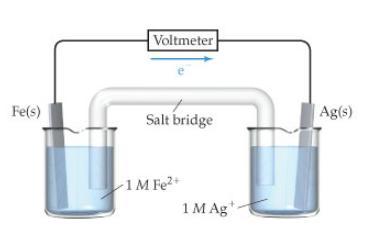
a) What is the change in the cell voltage when the ion concentrations in the cathode half-cell are increased by a factor of 10?b

) What is the change in the cell voltage when the ion concentrations in the anode half-cell are increased by a factor of 10?

Chemistry
2 answers:
Lena [83]2 years ago
5 0

Answer:

(a) The change in cell voltage is 0.05V

(b) The change in cell voltage is 0.03V

Explanation:

Redox reaction : It is defined as the reaction in which the oxidation and reduction reaction takes place simultaneously.

Oxidation reaction : It is defined as the reaction in which a substance looses its electrons. In this, oxidation state of an element increases.

Reduction reaction : It is defined as the reaction in which a substance gains electrons. In this, oxidation state of an element decreases.

Further explanation:

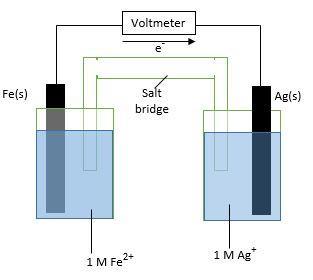
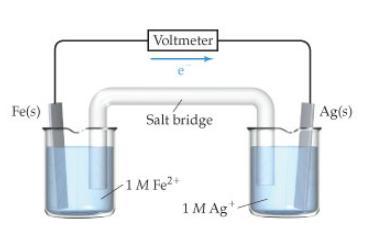
The image taken in context is attached below.

The standard reduction potentials for iron and silver are:

E^o_{(Fe^{2+}/Fe)}=-0.44V\\E^o_{(Ag^{+}/Ag)}=+0.80V

In the given cell, the oxidation occurs at an anode which is a negative electrode and the reduction occurs at the cathode which is a positive electrode.

From the standard reduction potentials we conclude that, the substance having highest positive E^o potential will always get reduced and will undergo reduction reaction.

So, silver will undergo reduction reaction will get reduced. Iron will undergo oxidation reaction and will get oxidized.

The given cell reactions are:

Oxidation half reaction (anode): Fe\rightarrow Fe^{2+}+2e^-

Reduction half reaction (cathode): Ag^{+}+e^-\rightarrow Ag

Thus, the anode and cathode will be E^o_{(Fe^{2+}/Fe)}

and E^o_{(Ag^{+}/Ag)} respectively.

The overall cell reaction will be,

2Ag^{+}+Fe\rightarrow Fe^{2+}+2Ag

To calculate the E^o_{cell} of the reaction, we use the equation:

E^o_{cell}=E^o_{cathode}-E^o_{anode}

E^o=E^o_{(Ag^{+}/Ag)}-E^o_{(Fe^{2+}/Fe)}

E^o=(+0.80V)-(-0.44V)=1.24V

Now we have to calculate the cell potential.

Using Nernst equation :

E_{cell}=E^o_{cell}-\frac{0.0592}{n}\log \frac{[Fe^{2+}]}{[Ag^{+}]^2}

where,

n = number of electrons in oxidation-reduction reaction = 2

E_{cell} = emf of the cell = ?

Now put all the given values in the above equation, we get:

E_{cell}=1.24-\frac{0.0592}{2}\log \frac{(1M)}{(1M)^2}

E_{cell}=1.24V

Thus, the emf of cell potential is 1.24 V

Part (a):

The ion concentrations in the cathode half-cell (Ag^+/Ag) are increased by a factor of 10 from 1 M to 10 M.

The emf of the cell potential will be,

Using Nernst equation :

E_{cell}=E^o_{cell}-\frac{0.0592}{n}\log \frac{[Fe^{2+}]}{[Ag^{+}]^2}

where,

n = number of electrons in oxidation-reduction reaction = 2

E_{cell} = emf of the cell = ?

Now put all the given values in the above equation, we get:

E_{cell}=1.24-\frac{0.0592}{2}\log \frac{(1M)}{(10M)^2}

E_{cell}=1.29V

The change in cell voltage will be,

E_{cell}=1.29V-1.24V=0.05V

Thus, the change in cell voltage is 0.05V

Part (b):

The ion concentrations in the anode half-cell (Fe^{2+}/Fe) are increased by a factor of 10 from 1 M to 10 M.

The emf of the cell potential will be,

Using Nernst equation :

E_{cell}=E^o_{cell}-\frac{0.0592}{n}\log \frac{[Fe^{2+}]}{[Ag^{+}]^2}

where,

n = number of electrons in oxidation-reduction reaction = 2

E_{cell} = emf of the cell = ?

Now put all the given values in the above equation, we get:

E_{cell}=1.24-\frac{0.0592}{2}\log \frac{(10M)}{(1M)^2}

E_{cell}=1.27V

The change in cell voltage will be,

E_{cell}=1.27V-1.24V=0.03V

Thus, the change in cell voltage is 0.03V

Learn more:

Spontaneity of reaction; brainly.com/question/13151873 (answer by Kobenhavn)

Standard reduction potential;  brainly.com/question/8739272 (answer by RomeliaThurston)

Keywords:

Nernst equation, standard reduction potential, spontaneity of the reaction.
MissTica2 years ago
3 0

The change in the cell voltage when the ion concentrations in the ANODE half-cell are increased by a factor of 10 is 0.030  V

<h3>Further explanation </h3>

What is the change in the cell voltage when the ion concentrations in the ANODE half-cell are increased by a factor of 10?

The Nernst equation

E=E^o - \frac{RT}{nF} lnQ

  • E ∘  is the cell potential at standard conditions
  • R  is the ideal gas constant
  • T  is the absolute temperature
  • n  is the number of electrons transferred per mole of reaction  
  • F  is the Faraday constant
  • Q  is the reaction quotient of the reaction

The given electrochemical cell has both aqueous species Fe 2 +  and  Ag +  at  1  M  concentration

If the anode concentration is increased by a factor of  10 , the cell potential will change by the correction term:  

\Delta E = -\frac{RT}{nF} lnQ

Now we determine the overall reaction

Fe(s) -> Fe^{2+}(aq)+2e [anode]\\2*(Ag^+(aq)+e -> Ag(s)) [cathode]\\Fe(s)+2Ag^+(aq)->Fe^{2+}(aq)+2Ag(s)  [overall]

n=2 electrons were transferred

Q=\frac{[Fe^{2+}]}{[Ag^+]^2}

The change in cell potential is

\Delta E = - \frac{RT}{nF} ln \frac{[Fe^{2+}]}{[Ag^+]^2}

Note that [Fe^{2+}]=10M and assume that T=298.15 K

\Delta E = - \frac{8.314J/molK*298.15K}{2*96485C/mol} ln \frac{10M}{1M^2}\\\Delta E = -0.030 V

Therefore the cell potential will decrease by 0.030 V

<h3>Learn more</h3>
  1. Learn more about the cell voltage brainly.com/question/2326679
  2. Learn more about the ion concentrations brainly.com/question/11480712
  3. Learn more       about the cathode half-cell brainly.com/question/9502656

<h3>Answer details</h3>

Grade:        9

Subject:  chemistry

Chapter:   the ion concentrations

Keywords:  the cell voltage, the ion concentrations, the cathode half-cell,   the anode, factor

You might be interested in
A 0.89% (w/v) sodium chloride solution is referred to as physiological saline solution because it has the same concentration of
maks197457 [2]
1) 0.89% m/v = 0.89 grams of NaCl / 100 ml of solution

=> 8.9 grams of NaCl in 1000 ml of solution = 8.9 grams of NaCl in 1 liter of solution

2) Molarity = M = number of moles of solute / liters of solution

=> calculate the number of moles of 8.9 grams of NaCl

3) molar mass of NaCl = 23.0 g /mol + 35.5 g/mol = 58.5 g / mol

4) number of moles of NaCl = mass / molar mass = 8.9 g / 58.5 g / mol = 0.152 mol

5) M = 0.152 mol NaCl / 1 liter solution = 0.152 M

Answer: 0.152 M
4 0
2 years ago
The average distance between nitrogen and oxygen atoms is 115 pm in a compound called nitric oxide. what is this distance in cen
e-lub [12.9K]
<span>pm stands for picometer and picometers are units which can be used to measure really tiny distances. One picometer is equal to 10^{-12} meters. We know that one centimeter is equal to 10^{-2} m so there are 10^2 cm per meter. We can change the distance d = 115 pm to units of centimeters. d = (115 pm) x (10^{-12}m / pm) x (10^2 cm / m) d = 115 x 10^{-10} cm = 1.15 x 10^{-8} cm The distance in centimeters is 1.15 x 10^{-8} cm</span>
7 0
2 years ago
In a container containing co, h2, and o2, what is the mole fraction of co if the h2 mole fraction is 0.22 and the o2 mole fracti
almond37 [142]
Thank you for posting your question here at brainly. The <span>mole fraction of co if the h2 mole fraction is 0.22 and the o2 mole fraction is 0.58 is 0.20, below is the solution:
</span>
mole fraction CO + mole fraction H2 + mole fraction O2 = 1 

mole fraction CO = 1 - ( 0.22 + 0.58)=0.20
6 0
2 years ago
What features of this model will help Armando answer the question?
Scrat [10]

Answer:

The adjustable legs and the table of sand.

<em>Note:The question is incomplete. The complete question is given below.</em>

Using Models to Answer Questions About Systems

Armando’s class was looking at images of rivers formed by flowing water. Most of the rivers were wide and shallow, but one river was narrow and deep. Armando’s class thinks that this river is narrow and deep because:

  • the hill that the water flowed down was very steep, or
  • the sand grains that the water flowed through were very small.

Armando designed the model below to try to answer the question: Why is this river so narrow and deep?

Explanation:

The model designed by Armando will be helpful to answer the question because of the following features it possesses:

1. An adjustable leg- since one of the hypotheses put forward by the class to explain why the river was narrow and deep was that the hill that the water flowed down was very steep, the adjustable legs can be lowered or raised in order to make the slope shallower or steeper so that their hypothesis can be tested.

2. A table of sand- the table of sand serves as the streambed. By adjusting the size of the sand grains to be larger or smaller, the students will be able to to test their second hypothesis that the small size sand grains that the water flowed through was the reason for the river to be narrow and deep.

The results of their experiments will enable them to come to a conclusion.

5 0
2 years ago
Read 2 more answers
To save time you can approximate the initial volume of water to ±1 mL and the initial mass of the solid to ±1 g. For example, if
WARRIOR [948]

Answer:

20.2 g silver placed in 21.6 mL of water and 20.2 g copper placed in 21.6 mL of water

Explanation:

Since the density formula is mass divided volume, you can calculate the density of each of the components of the group and see which of all the groups are equal

In the group

density Ag=20.2 g silver/21.6ml H2O=0.9352g/ml

density Cu=20.2 g copper/21.6ml H2O=0.9352 g/ml

6 0
2 years ago
Read 2 more answers
Other questions:
  • Lewis structure XeH4? The hydrogen atom is not actually electronegative enough to form bonds to xenon. Were the xenon-hydrogen b
    6·2 answers
  • What is the total amount of heat required to completely melt 347 grams of ice at its melting point
    13·2 answers
  • The ph of a solution that contains 0.818 m acetic acid (ka = 1.76 x 10⁻⁵) and 0.172 m sodium acetate is __________.
    11·1 answer
  • At 73.0 ∘c , what is the maximum value of the reaction quotient, q, needed to produce a non-negative e value for the reaction so
    11·1 answer
  • What mass of ni2+ is produced in solution by passing a current of 67.0 a for a period of 14.0 h , assuming the cell is 90.0 % ef
    15·1 answer
  • A sample of gas initially occupies 3.35 L at a pressure of 0.950 atm at 13.0oC. What will the volume (in L) be if the temperatur
    15·1 answer
  • Question 4 (1 point)
    12·1 answer
  • Which of the following solutions is a buffer?A) A solution made by mixing 100 mL of 0.100 M HClO and 50 mL of 0.100 M HCl.B) A s
    8·1 answer
  • Eugenol is a molecule that contains the phenolic functional group. Which option properly identifies the phenol in eugenol
    8·1 answer
  • What is the concentration in %m/v of a 0.617 M aqueous solution of methanol (MM = 32.04 g/mol)?
    11·1 answer
Add answer
Login
Not registered? Fast signup
Signup
Login Signup
Ask question!