answer.
Ask question
Login Signup
Ask question
All categories
  • English
  • Mathematics
  • Social Studies
  • Business
  • History
  • Health
  • Geography
  • Biology
  • Physics
  • Chemistry
  • Computers and Technology
  • Arts
  • World Languages
  • Spanish
  • French
  • German
  • Advanced Placement (AP)
  • SAT
  • Medicine
  • Law
  • Engineering
pochemuha
2 years ago
9

A two-fluid heat exchanger has inlet and outlet temperatures of 65 and 40 degree C for the hot fluid and 15 and 30 degree C for

the cold fluid. Can you tell whether this exchanger is operating under counterflow or parallel-flow conditions? Determine the effectiveness of the heat exchanger.
Engineering
1 answer:
Darya [45]2 years ago
5 0

Answer:

 Parallel flow

\epsilon =0.5

Explanation:

Given that

For hot fluid

Inlet temperature=65 C

Outlet temperature=40 C

For cold fluid

Inlet temperature=15 C

Outlet temperature=30 C

Here is only temperature is given and did not provide the information about heat capacity of fluids so by only seeing temperature we can not predict the types of heat exchanger. But there is not too much difference in temperature of exits fluids so we can say that this is parallel flow heat exchanger.  

Effectiveness of heat exchanger given as

\epsilon =\dfrac{\Delta T}{\Delta T_{max}}

\epsilon =\dfrac{65-40}{65-15}

 \epsilon =0.5

You might be interested in
Universal Containers has a junction object called "Job Production Facility". With 2 master-detail relationships to the Job and P
alexdok [17]

Answer:

C. The user will not be able to see the junction object records or the field values.

Explanation:

For the profile of the user to give access permission such as create and read to the job without granting access permission to the production facility object, the value of the field or records of the junction object will not be seen by the user. This is one of the necessary criteria or principle for the universal container with a junction object.

3 0
2 years ago
Fly thermostat, an automatic temperature controller for homes, learns the patterns for raising and lowering the temperature in a
Lubov Fominskaja [6]

Answer:

The Internet of things

Explanation:

When devices embedded with a network connectivity, software or sensors, are able to exchange data with the manufacturer through the network of physical things, then we say the Internet of things (IoT) has been defined.

Internet of things is when devices like smartphones, sensors and other smart devices are connected together which allows them to exchange data through the network of physical things. By exchanging data, these devices learn new patterns of adaptation.

In this case, the fly thermostat, learns the patterns for raising and lowering the temperature in a house through the Internet of things beacause the sensor has made it possible by automatically observing the temperature pattern of the house.

4 0
2 years ago
Read 2 more answers
An adiabatic gas turbine expands air at 1300 kPa and 500◦C to 100 kPa and 127◦C. Air enters the turbine through a 0.2-m2 opening
Viktor [21]

Given:

Pressure, P_{1} = 1300 kPa

Temperature,  T_{1} = 500^{\circ}

P_{2} = 100 kPa

T_{2} = 127^{\circ}  

velocity, v = 40 m/s

A = 1m^{2}

Solution:

For air propertiess at

P_{1} = 1300 kPa

T_{1} = 500^{\circ}

h_{1} = 793kJ/K

v_{1} = 0.172\frac{m^{3}}{kg}

and also at

P_{2} = 100 kPa

T_{2} = 127^{\circ}  

h_{2} = 401 KJ/K

v_{2} =  1.15\frac{m^{3}}{kg}

a) Mass flow rate is given by:

m' = \frac{Av}{v_{1}}

Now,

m = \frac{0.2\times 40}{0.172} = 46.51 kg/s

b) for the power produced by turbine, P = m'(h_{1} - h_{2})

P = 46.51\times(793 - 401) = 18.231 MW

5 0
2 years ago
3.24 Program: Drawing a half arrow (Java) This program outputs a downwards facing arrow composed of a rectangle and a right tria
eimsori [14]

Answer:

Here is the JAVA program:

import java.util.Scanner; // to get input from user

public class DrawHalfArrow{ // start of the class half arrow

public static void main(String[] args) { // starts of main() function body

    Scanner scnr = new Scanner(System.in); //reads input

int arrowBaseHeight = 0; // stores the height of arrow base

int arrowBaseWidth  = 0; // holds width of arrow base

int arrowHeadWidth = 0; // contains the width of arrow head

// prompts the user to enter arrow base height, width and arrow head width

System.out.println("Enter arrow base height: ");

arrowBaseHeight = scnr.nextInt(); // scans and reads the input as int

System.out.println("Enter arrow base width: ");

arrowBaseWidth = scnr.nextInt();

/* while loop to continue asking user for an arrow head width until the value entered is greater than the value of arrow base width */

while (arrowHeadWidth <= arrowBaseWidth) {

    System.out.println("Enter arrow head width: ");

    arrowHeadWidth = scnr.nextInt(); }

//start of the nested loop

//outer loop iterates a number of times equal to the height of the arrow base

 for (int i = 0; i < arrowBaseHeight; i++) {

//inner loop prints the stars asterisks

      for (int j = 0; j <arrowBaseWidth; j++) {

          System.out.print("*");        } //displays stars

          System.out.println();          }

//temporary variable to hold arrowhead width value

int k = arrowHeadWidth;

//outer loop to iterate no of times equal to the height of the arrow head

for (int i = 1; i <= arrowHeadWidth; i++)

{     for(int j = k; j > 0; j--)     {//inner loop to print stars

       System.out.print("*");    } //displays stars

   k = k - 1;

   System.out.println(); } } } // continues to add more asterisks for new line

Explanation:

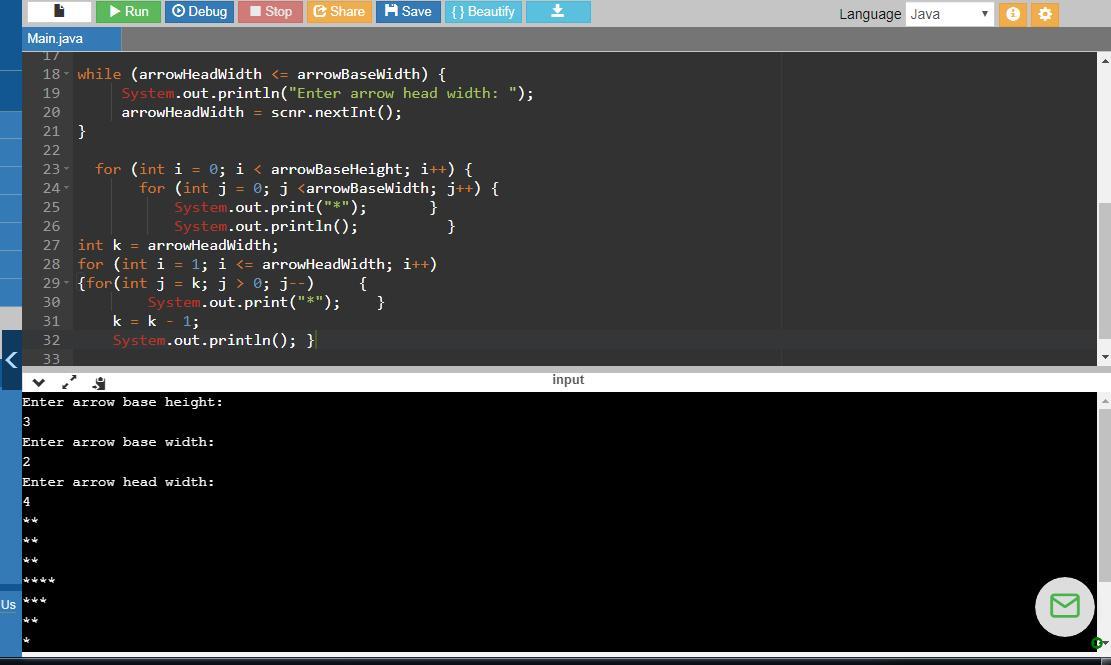
The program asks to enter the height of the arrow base, width of the arrow base and the width of arrow head. When asking to enter the width of the arrow head, a condition is checked that the arrow head width arrowHeadWidth should be less than or equal to width of arrow base arrowBaseWidth. The while loop keeps iterating until the user enters the arrow head width larger than the value of arrow base width.

The loop is used to output an arrow base of height arrowBaseHeight. So point (1) is satisfied.

The nested loop is being used which as a whole outputs an arrow base of width arrowBaseWidth. The inner loop draws the stars and forms the base width of the arrow, and the outer loop iterates a number of times equal to the height of the arrow. So (2) is satisfied.

A temporary variable k is used to hold the original value of arrowHeadWidth so that it keeps safe when modification is done.

The last nested loop is used to output an arrow head of width arrowHeadWidth. The inner loop forms the arrow head and prints the stars needed to form an arrow head. So (3) is satisfied.

The value of temporary variable k is decreased by 1 so the next time it enters  the nested for loop it will be one asterisk lesser.

The screenshot of output is attached.

3 0
2 years ago
Bananas are to be cooled from 28°C to 12°C at a rate of 1140 kg/h by a refrigerator that operates on a vapor-compression refrige
Lera25 [3.4K]

Answer:

A) COP = \frac{16.97}{9.8} = 1.731

B) P_{IN} = 0.4763

C) Second law efficiency 4.85%

exergy destruction for the cycle = 9.3237 kW

Explanation:

Given data:

T_1 = 28 degree celcius

T_2 = 12 degree celcius

\dot m = 1140 kg/h

Power to refrigerator = 9.8 kW

Cp = 3.35 kJ/kg degree C

A) Q = \dot m Cp \Delta T

        = 1140 \times 3.35\times (28-12) = 61,104 kJ/h

Q_{abs} = 61,104 kJ/h = 16.97 kJ/sec

COP = \frac{16.97}{9.8} = 1.731

b)

COP ∝ \frac{1}{P_{in}}

P_{in} wil be max when COP maximum

taking surrounding temperature T_H = 20 degree celcius

COP_{max} = \frac{T_L}{T_H- T_L} = \frac{285}{293 - 285} = 35.625

we know that

COP = \frac{heat\ obsorbed}{P_{in}}

P_{IN} = \frac{16.97}{35.62} = 0.4763

c) second law efficiency

\eta_{11} = \frac{COP_R}{(COP)_max} = \frac{1.731}{35.625} = 4.85\%

exergy destruction os given as X = W_{IN} - X_{Q2}

                                                         = 9.8 - 0.473 = 9.3237 kW

8 0
2 years ago
Other questions:
  • A system consisting of 3 lb of water vapor in a piston–cylinder assembly, initially at 350°F and a volume of 71.7 ft3, is expand
    11·1 answer
  • Steam flows at steady state through a converging, insulated nozzle, 25 cm long and with an inlet diameter of 5 cm. At the nozzle
    11·1 answer
  • 1. Saturated steam at 4 bars absolute pressure with a mean velocity of 3 m/s flows through a horizontal SS304 stainless-steel pi
    6·1 answer
  • Vehicles arrive at a single toll booth beginning at 8:00 A.M. They arrive and depart according to a uniform deterministic distri
    9·1 answer
  • Reconsider Couette flow between two parallel plates as derived in class, but with the top plate moving with a known velocity +i
    13·1 answer
  • A dc shunt generator rated at 85 kW produces a voltage of 280 V. The brush voltage drop is 2.5 V, and the armature and field res
    6·1 answer
  • In this module you learned about searching, sorting and algorithms in C++ and how to implement these elements in your C++ progra
    6·1 answer
  • Water enters a circular tube whose walls are maintained at constant temperature at specified flow rate and temperature. For full
    8·1 answer
  • "From the earth to the moon". In Jules Verne’s 1865 story with this title, three men went to the moon in a shell fired from a gi
    5·1 answer
  • According to the EWR specifications, ___ is responsible for picking up and disposing of debris or rubbish from
    15·1 answer
Add answer
Login
Not registered? Fast signup
Signup
Login Signup
Ask question!