answer.
Ask question
Login Signup
Ask question
All categories
  • English
  • Mathematics
  • Social Studies
  • Business
  • History
  • Health
  • Geography
  • Biology
  • Physics
  • Chemistry
  • Computers and Technology
  • Arts
  • World Languages
  • Spanish
  • French
  • German
  • Advanced Placement (AP)
  • SAT
  • Medicine
  • Law
  • Engineering
luda_lava [24]
2 years ago
3

How do trans fats complicate the previous description of saturated and unsaturated fats?

Chemistry
1 answer:
Lady bird [3.3K]2 years ago
3 0

Answer:

C)

Explanation:

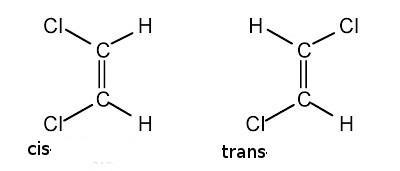
The fats can be saturated or unsaturated. Saturated fats have only simple bonds between atoms of carbon. The unsaturated fats have one or more double bonds between atoms of carbon.

When there are double bonds in the carbon chain, the molecule can have geometric isometric, if the carbons of the double bond have different binders. The isomers are named cis and trans. The cis molecule has the equivalent atoms or structures (the same or mass equivalent) on the same side of the plan of the molecule. The trans molecule has this equivalent atoms or structures in the opposite side of the plan of the molecule (see figure below)

It happens in a way to stabilize the molecule. So, the trans fat, because of its disposition, has straightened the hydrocarbon chain, almost like the saturated molecule, then, they have similar characteristics.

You might be interested in
Before the fire, the forest consists of large trees. After the fire, there is only ash. Explain what the law of conservation of
Tasya [4]

Answer: explained below

Explanation:

Matter can change form through physical and chemical changes, but through any of these changes, matter is conserved. The same amount of matter exists before and after the change—none is created or destroyed.

5 0
2 years ago
An isotope undergoes radioactive decay by emitting radiation that has no mass. What other characteristic does the radiation have
Advocard [28]

Answer : Option D) No charge

Explanation : An isotope undergoes radioactive decay by emitting radiation that has no mass. The radiation will not have any charge as it does not has any mass it will not emit a radiative charge.

It is known that there are some unstable radioactive isotopes which has no mass and the radiation thus has no charge in it.

7 0
2 years ago
Read 2 more answers
Jesse travels 3.0 meters east and then turns and travels 4.0 meters north. The trip requires 35 seconds. What is his velocity? 0
melisa1 [442]
Displacement = √(3² + 4²)
Displacement = 5 meters north east

Velocity = displacement / time
Velocity = 5 / 35
Velocity = 0.14 m/s northeast
6 0
2 years ago
Read 2 more answers
A vessel contained N2, Ar, He, and Ne. The total pressure in the vessel was 987 torr. The partial pressures of nitrogen, argon,
xz_007 [3.2K]

Answer:

The partial pressure of neon in the vessel was 239 torr.

Explanation:

In all cases involving gas mixtures, the total gas pressure is related to the partial pressures, that is, the pressures of the individual gaseous components of the mixture. Put simply, the partial pressure of a gas is the pressure it exerts on a mixture of gases.

Dalton's law states that the total pressure of a mixture of gases is equal to the sum of the pressures that each gas would exert if it were alone. Then:

PT= P1 + P2 + P3 + P4…+ Pn

where n is the amount of gases present in the mixture.

In this case:

PT=PN₂ + PAr + PHe + PNe

where:

  • PT= 987 torr
  • PN₂= 44 torr
  • PAr= 486 torr
  • PHe= 218 torr
  • PNe= ?

Replacing:

987 torr= 44 torr + 486 torr + 218 torr + PNe

Solving:

987 torr= 748 torr + PNe

PNe= 987 torr - 748 torr

PNe= 239 torr

<u><em>The partial pressure of neon in the vessel was 239 torr.</em></u>

4 0
2 years ago
2.00 g of an unknown gas at STP fills a 500. mL flask. What is the molar mass of the gas?
otez555 [7]

Answer:

100g/mol

Explanation:

Given parameters:

Mass of unknown gas  = 2g

Volume of gas in flask  = 500mL  = 0.5dm³

Unknown:

Molar mass of gas = ?

Solution:

Since we know the gas is at STP;  

        1 mole of substance occupies 22.4dm³ of space at STP

    Therefore,

            0.5dm³ will have  0.02mole at STP


Now;

   Number of moles  = \frac{mass}{molar mass}  

      Molar mass  = \frac{mass}{number of moles}   = \frac{2}{0.02}   = 100g/mol

4 0
2 years ago
Other questions:
  • Are the particles in a solid motionless ?
    9·1 answer
  • In which of these statements are protons, electrons, and neutrons correctly compared?
    6·2 answers
  • Why does it help to keep the distillation head warm?
    15·1 answer
  • If the following elements were to form ions, they would attain the same number of electrons as which noble gas? As , Be , O , S
    6·2 answers
  • In the preceding information section there is a "bohr's diagram" of an atom. Which atom is it?
    9·1 answer
  • Explain why c6h5ch2ch2br is not formed during the radical bromination of c6h5ch2ch3. select the single best answer.
    8·1 answer
  • A mixture of 60 mol % n-propylcyclohexane and 40 mol % n-propylbenzene is distilled through a simple distillation apparatus; ass
    7·1 answer
  • Bella wants to know which mode of transportation is the fastest for getting from her home to the grocery store. She cans drive h
    6·1 answer
  • You are given a sample resembling silver. Which of the following properties could be used to help determine whether the sample i
    13·1 answer
  • Which of the following statements concerning the attraction of ions to polar molecules is/are CORRECT? 1. The force of attractio
    14·1 answer
Add answer
Login
Not registered? Fast signup
Signup
Login Signup
Ask question!