answer.
Ask question
Login Signup
Ask question
All categories
  • English
  • Mathematics
  • Social Studies
  • Business
  • History
  • Health
  • Geography
  • Biology
  • Physics
  • Chemistry
  • Computers and Technology
  • Arts
  • World Languages
  • Spanish
  • French
  • German
  • Advanced Placement (AP)
  • SAT
  • Medicine
  • Law
  • Engineering
mrs_skeptik [129]
2 years ago
6

If the following elements were to form ions, they would attain the same number of electrons as which noble gas? As , Be , O , S

, Ca , Mg , Sr
Chemistry
2 answers:
Verdich [7]2 years ago
4 0
<h3><u>Answer;</u></h3>

As, & Sr --------[Kr]

Be ------------------- [He]

O, & Mg ----------[Ne]

S, & Ca -------------[Ar]

<h3><u>Explanation</u></h3>
  • <u>The Be+ ion has 2 electrons, just like He. The ions Mg2+ and O2− each has 10 electrons like Ne. </u>
  • <u>The S2− and Ca2+ each has 18 electrons like Ar. The ions As3− and Sr+ each have 36 electrons like Kr.</u>
  • <u>Atoms of elements lose or gain electrons to attain a stable configuration which is equivalent to the configuration of noble gases.</u>
  • When atoms lose or gain electrons they form ions, which are either positively charged or negatively charged. When atoms lose electrons they form positively charged ions while if they gain electrons the form negatively charged ions

victus00 [196]2 years ago
3 0

As would attain same electrons as that of Kr after formation of ion.

Be would attain same electrons as that of He after formation of ion.

O would attain same electrons as that of Ne after formation of ion.

S would attain same electrons as that of Ar after formation of ion.

Ca would attain same electrons as that of Ar after formation of ion.

Mg would attain same electrons as that of Ne after formation of ion.

Sr would attain same electrons as that of Kr after formation of ion.

Further explanation:

Electrons are distributed in various atomic orbitals of an atom in accordance with certain rules and principles. These are described below:

1. Aufbau principle

“Aufbau” is a German word that implies “build up”. So this principle states that the electrons are filled in various orbitals in the increasing order of their energies. The atomic orbitals have the following energy order:

1s < 2s < 2p < 3s < 3p < 4s < 3d < 4p < 5s < 4d < 5p < 6s < 4f < 5d < 6p < 7s < 5f < 6d < 7p  

2. Hund’s rule

This rule states that electron pairing will never begin until each orbital is singly occupied.

3. Pauli’s exclusion principle

According to this principle, no two electrons in the same orbital can have all the four quantum numbers same. The value of spin quantum number for both electrons in the same orbital must always be different.

Ions are formed by the addition or removal of electrons from the neutral atom. Anions are produced when there is gain of electrons by the neutral atom whereas cation formation takes place by the removal of electrons from the neutral atom.

The atomic number of As is 33 so its configuration is \left[ {{\text{Ar}}} \right]3{d^{10}}4{s^2}4{p^3}. It gains three electrons to form {\text{B}}{{\text{e}}^{2 + }} whose configuration becomes 1{s^2}. This configuration is similar to that of krypton. So As would attain same electrons as that of Kr after formation of ion.

The atomic number of Be is 4 so its configuration is 1{s^2}2{s^2}. It loses two of its 2s electrons to form {\text{B}}{{\text{e}}^{2 + }} whose configuration becomes 1{s^2}. This configuration is similar to that of helium. So Be would attain same electrons as that of He after formation of ion.

The atomic number of O is 8 so its configuration is 1{s^2}2{s^2}2{p^4}. It gains two electrons to form {{\text{O}}^{2 - }} whose configuration becomes 1{s^2}2{s^2}2{p^6}. This configuration is similar to that of neon. So O would attain same electrons as that of Ne after formation of ion.

The atomic number of S is 16 so its configuration is 1{s^2}2{s^2}2{p^6}3{s^2}3{p^4}. It gains two electrons to form {{\text{S}}^{2 - }} whose configuration becomes 1{s^2}2{s^2}2{p^6}3{s^2}3{p^6}. This configuration is similar to that of argon. So S would attain same electrons as that of Ar after formation of ion.

The atomic number of Ca is 20 so its configuration is 1{s^2}2{s^2}2{p^6}3{s^2}3{p^6}4{s^2}. It loses two of its 4s electrons to form {\text{C}}{{\text{a}}^{2 + }} whose configuration becomes 1{s^2}2{s^2}2{p^6}3{s^2}3{p^6}. This configuration is similar to that of argon. So Ca would attain same electrons as that of Ar after formation of ion.

The atomic number of Mg is 12 so its configuration is1{s^2}2{s^2}2{p^6}3{s^2}. It loses two of its 3s electrons to form   whose configuration becomes {\text{M}}{{\text{g}}^{2 + }}. This configuration is similar to that of neon. So Mg would attain same electrons as that of Ne after formation of ion.

The atomic number of Sr is 38 so its configuration is 1{s^2}2{s^2}2{p^6}3{s^2}3{p^6}3{d^{10}}4{s^2}4{p^6}5{s^2}. It loses of its 5s electrons to form   whose configuration becomes 1{s^2}2{s^2}2{p^6}3{s^2}3{p^6}3{d^{10}}4{s^2}4{p^6}. This configuration is similar to that of krypton. So Sr would attain same electrons as that of Kr after formation of ion.

Learn more:

  1. Determine the ion with configuration \left[ {{\text{Ar}}} \right]\;3{d^2}: brainly.com/question/7599542
  2. Identification of element which has electron configuration  :brainly.com/question/9616334

Answer details:

Grade: High School

Subject: Chemistry

Chapter: Electronic configuration of the elements

Keywords: Ca, Mg, Sr, Be, O, As, Kr, He, Ne, 8, 20, 33, 38, 12, 4, configuration, Aufbau principle, Hund’s rule, Pauli’s exclusion principle, distribution of electrons.


You might be interested in
In what situation do we use a volumetric flask, conical flask, pipette and graduated cylinder? Explain your answer from accuracy
Ad libitum [116K]
A volumetric flask is used to contain a predetermined volume of substance and only measures that volume, for example 250 ml.
Conical flasks can be used to measure the volume of substances but the accuracy they provide is usually up to 10ml. Conical flasks are used in titrations, reactions where the liquid may boil, and reactions which involve stirring. 
Pippettes are of two types, volumetric and graduated. Pippettes are used where high accuracy is required and volumetric pippettes come in as little as 1 ml. Pippettes are usually used in titrations.
Graduated cylinders come in a wide variety of sizes and their accuracy can be down to as much as 1 ml. They are used to contain liquids.
3 0
2 years ago
The combustion of propane (c3h8) produces co2 and h2o: c3h8 (g) + 5o2 (g) → 3co2 (g) + 4h2o (g) the reaction of 2.5 mol of o2 wi
Andrews [41]
The answer is 2 mol of H₂O will be produced.
The balanced equation for the chemical reaction is:

<span>c3h8 (g) + 5o2 (g) → 3co2 (g) + 4h2o (g) 
5 moles of O</span>₂ produces 4 moles of H₂O, and when there is 2.5 mol of O₂, moles of H₂O will be:
2.5 x 4/5 = 2 mol of H₂O
8 0
2 years ago
14) The central iodine atom in the ICl4- ion has __________ nonbonded electron pairs and __________ bonded electron pairs in its
masha68 [24]

Answer:

Two non bonded electron pairs and four bonded electron pairs

Explanation:

An image of the compound as obtained from chemlibretext is attached to this answer.

The ion ICl4- ion, is an AX4E2 ion. This implies that there are four bond pairs and two lone pairs of electrons. As expected, the shape of the ion is square planar since the lone pairs are found above and below the plane of the square. This is clear from the image attached.

7 0
2 years ago
A chemist mixes 75.0 g of an unknown substance at 96.5C w/ 1,150 g of water at 25.0C . if the final temperature of the system is
vichka [17]
Remember: heat lost = heat gained 

When calculating heat loss or gain, remember 

mass*(spec heat cap)*(change in T) 

The unknown loses heat- we don't know the spec heat cap, so we'll call it x.

The water gains. I've omitted the units, but always use when solving problems on your own. 

75*x*(96.5-37.1) = 1150*4.184*(37.1-25) 
<span>
Now it's all set up- use algebra to get x, the spec heat cap of the unk in J/g*degC

I hope my answer has come to your help. Thank you for posting your question here in Brainly. We hope to answer more of your questions and inquiries soon. Have a nice day ahead!
</span>
3 0
2 years ago
A mysterious white powder could be powdered sugar (C12H22O11), cocaine (C17H21NO4), codeine (C18H21NO3), norfenefrine (C8H11NO2)
rodikova [14]

Norfenefrine (C₈H₁₁NO₂).

<h3>Further explanation</h3>

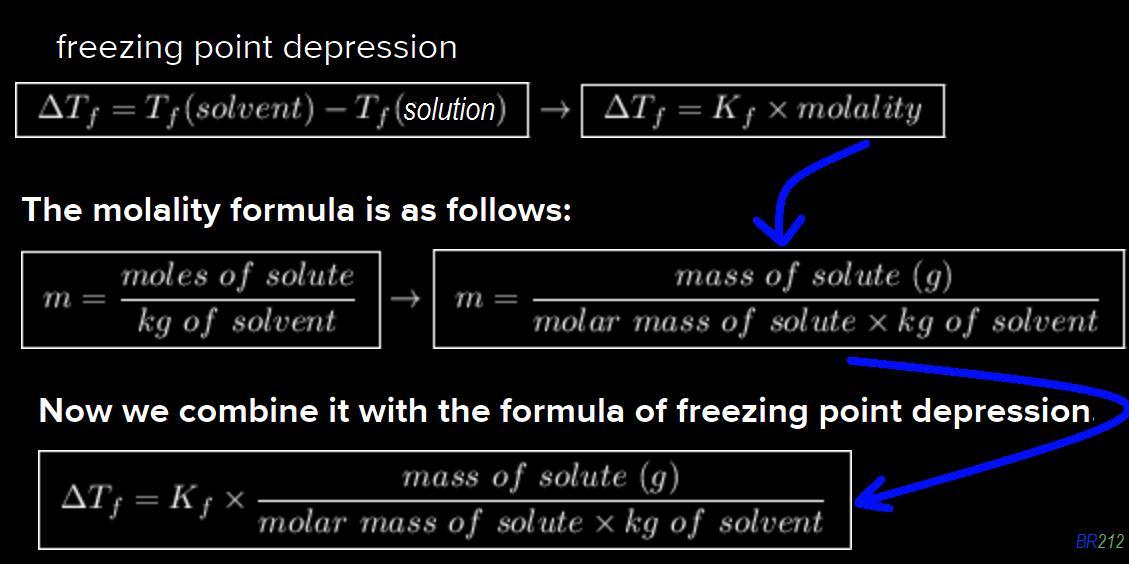
We will solve a case related to one of the colligative properties, namely freezing point depression.

The freezing point of the solution is the temperature at which the solution begins to freeze. The difference between the freezing point of the solvent and the freezing point of the solution is called freezing point depression.

\boxed{ \ \Delta T_f = T_f(solvent) - T_f(solution) \ } \rightarrow \boxed{ \ \Delta T_f = K_f \times molality \ }

<u>Given:</u>

A mysterious white powder could be,

  • powdered sugar (C₁₂H₂₂O₁₁) with a molar mass of 342.30 g/moles,
  • cocaine (C₁₇H₂₁NO₄) with a molar mass of 303.35 g/moles,
  • codeine (C₁₈H₂₁NO₃) with a molar mass of 299.36 g/moles,
  • norfenefrine (C₈H₁₁NO₂) with a molar mass of 153.18 g/moles, or
  • fructose (C₆H₁₂O₆) with a molar mass of 180.16 g/moles.

When 82 mg of the powder is dissolved in 1.50 mL of ethanol (density = 0.789 g/cm³, normal freezing point −114.6°C, Kf = 1.99°C/m), the freezing point is lowered to −115.5°C.

<u>Question: </u>What is the identity of the white powder?

<u>The Process:</u>

Let us identify the solute, the solvent, initial, and final temperatures.

  • The solute = the powder
  • The solvent = ethanol
  • The freezing point of the solvent = −114.6°C
  • The freezing point of the solution = −115.5°C

Prepare masses of solutes and solvents.

  • Mass of solute = 82 mg = 0.082 g
  • Mass of solvent = density x volume, i.e., \boxed{ \ 0.789 \ \frac{g}{cm^3} \times 1.50 \ cm^3 = 1.1835 \ g = 0.00118 \ kg  \ }

We must prepare the solvent mass unit in kg because the unit of molality is the mole of the solute divided by the mass of the solvent in kg.

The molality formula is as follows:

\boxed{ \ m = \frac{moles \ of \ solute}{kg \ of \ solvent} \ } \rightarrow \boxed{ \ m = \frac{mass \ of \ solute \ (g)}{molar \ mass \ of \ solute \times kg \ of \ solvent} \ }

Now we combine it with the formula of freezing point depression.

\boxed{ \ \Delta T_f =  K_f \times \frac{mass \ of \ solute \ (g)}{molar \ mass \ of \ solute \times kg \ of \ solvent} \ }

It is clear that we will determine the molar mass of the solute (denoted by Mr).

We enter all data into the formula.

\boxed{ \ -114.6^0C - (-115.5^0C) = 1.99 \frac{^0C}{m} \times \frac{0.082 \ g}{Mr \times 0.00118 \ kg} \ }

\boxed{ \ 0.9 = \frac{1.99 \times 0.082}{Mr \times 0.00118} \ }

\boxed{ \ Mr = \frac{0.16318}{0.9 \times 0.00118} \ }

We get \boxed{ \ Mr = 153.65 \ }

These results are very close to the molar mass of norfenefrine which is 153.18 g/mol. Thus the white powder is norfenefrine.

<h3>Learn more</h3>
  1. The molality and mole fraction of water brainly.com/question/10861444
  2. About the mass and density of ethylene glycol as an  antifreeze brainly.com/question/4053884
  3. About the solution as a homogeneous mixture  brainly.com/question/637791

Keywords: a mysterious white powder, sugar, cocaine, codeine, norfenefrine, fructose, the solute, the solvent, dissolved, ethanol, normal freezing point, the freezing point depression, the identity

7 0
2 years ago
Read 2 more answers
Other questions:
  • Which statement is true concerning the reaction N(g) + N(g) → N2(g) + energy?
    12·1 answer
  • Oxides of nitrogen are pollutant gases which are emitted from car exhausts.
    14·2 answers
  • If a large marshmallow has a volume of 2.75 in3 and density of 0.242 g/cm3, how much would it weigh in grams? 1 in3=16.39 cm3.
    9·1 answer
  • The first step in the Ostwald process for producing nitric acid is 4NH3(g) + 5O2(g) --&gt; 4NO(g) + 6H2O(g). If the reaction of
    9·2 answers
  • 1. Complete the following Data Table as you conduct the lab
    13·2 answers
  • The enthalpy change for the explosion of ammonium nitrate with fuel oil is –7198 kJ for every 3 moles of NH4NO3. What is the ent
    13·1 answer
  • Which of the following organisms are carnivores?
    12·1 answer
  • A gas of 3.4 moles occupies a volume of 0.046 L at 298 K. What is the pressure in kPa?
    11·1 answer
  • The density of honey is 1.42 g/mL. If you poured honey into a glass of water, would it sink to the bottom or float on top? Expla
    11·1 answer
  • How are oxygen and<br> water molecules different<br> from argon and neon<br> molecules?
    10·1 answer
Add answer
Login
Not registered? Fast signup
Signup
Login Signup
Ask question!