answer.
Ask question
Login Signup
Ask question
All categories
  • English
  • Mathematics
  • Social Studies
  • Business
  • History
  • Health
  • Geography
  • Biology
  • Physics
  • Chemistry
  • Computers and Technology
  • Arts
  • World Languages
  • Spanish
  • French
  • German
  • Advanced Placement (AP)
  • SAT
  • Medicine
  • Law
  • Engineering
Vera_Pavlovna [14]
2 years ago
11

The manufacturer of a 1.5 V D flashlight battery says that the battery will deliver 9 mA for 40 continuous hours. During that ti

me, the voltage will drop from 1.5 V to 1.0 V. Assume the drop in voltage is linear with time. (2 points) How many seconds is 40 hrs? (5 points) Plot the battery voltage as a function of time. Each axis needs a label (what is being plotted), scale (the values along the axis), and units. (7 points) Plot the battery power as a function of time. Write an equation for the power from 0 hours to 40 hours. (6 points) Remember that power is the derivative of energy with respect to time so energy is the integral of power over a given time period. There are two ways to find the energy. One is to calculate the area under the power curve from 0 hours to 40 hours. The second is to perform the integration of the power function from 0 to 40 hours. Find how much energy does the battery delivers in this 40 hour interval using both methods. The numerical answer is 1620 J. You must show the correct method to get credit.

Engineering
1 answer:
Jet001 [13]2 years ago
4 0

Answer:

a) 144.000 s

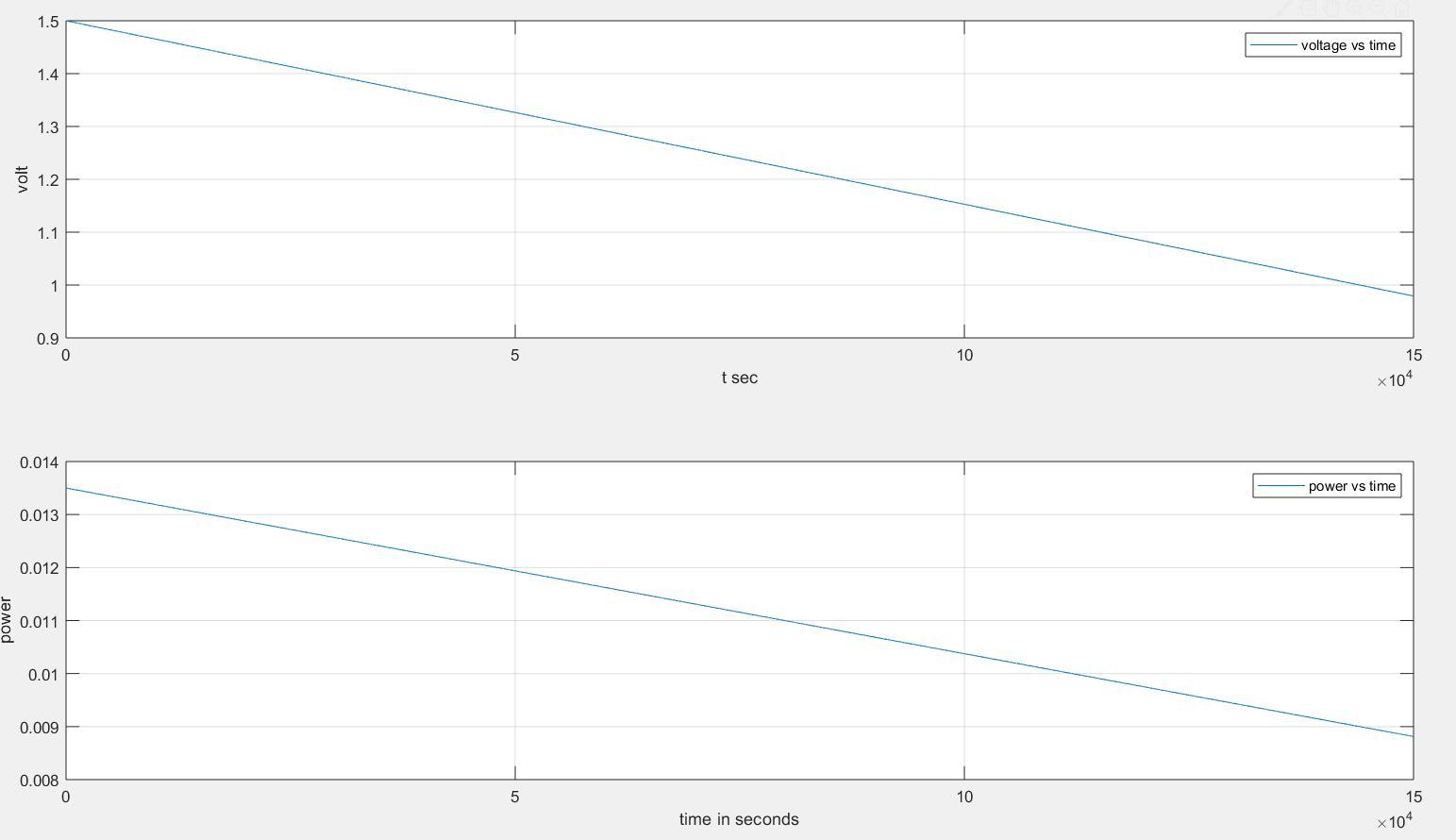
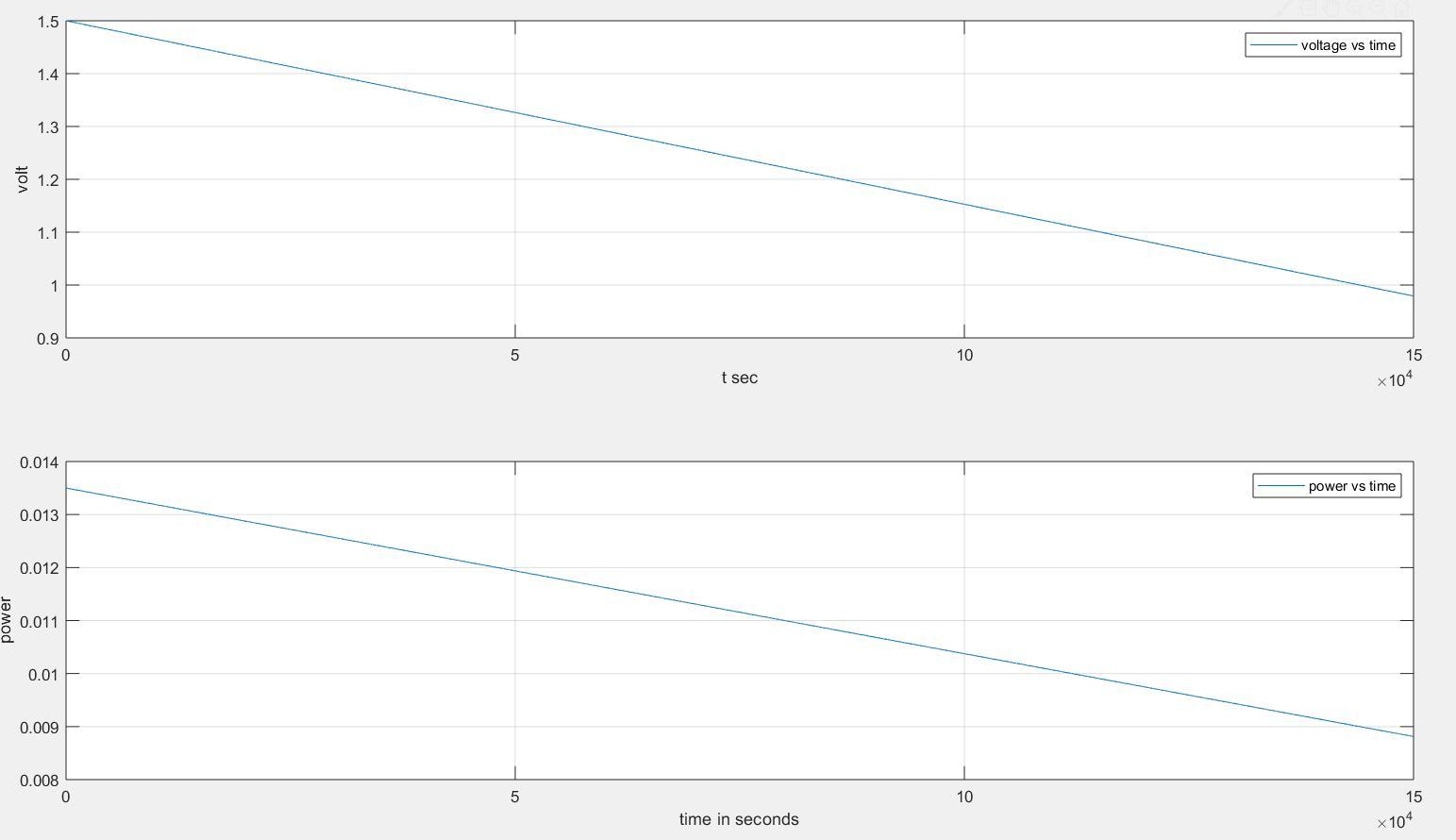
b) and c)Battery voltage and power plots in attached image.

   V=-\frac{0.5}{144000} t + 1.5 V[tex]    [tex]P(t)=-(31.25X10^{-9}) t+0.0135  where D:{0<t<40} h

d) 1620 J

Explanation:  

a) The first answer is a rule of three

s=\frac{3600s * 40h}{1h} = 144000s

b) Using the line equation with initial point (0 seconds, 1.5 V)

m=\frac{1-1.5}{144000-0} = \frac{-0.5}{144000}

where m is the slope.

V-V_{1}=m(x-x_{1})

where V is voltage in V, and t is time in seconds

V=m(t-t_{1}) + V_{1} and using P and m.

V=-\frac{0.5}{144000} t + 1.5 V[tex] c) Using the equation VPOWER IS DEFINED AS:[tex] P(t) = v(t) * i(t) [tex]so.[tex] P(t) = 9mA * (-\frac{0.5}{144000} t + 1.5) [tex][tex]P(t) = - (31.25X10^{-9}) t + 0.0135

d) Having a count that.

E = \int\limits^{144000}_{0} {P(t)} \, dt  = \int\limits^{144000}_{0} {v(t)*i(t)} \, dt

E = \int\limits^{144000}_{0} {-\frac{0.5}{144000} t + 1.5*0.009} \, dt = 1620 J

You might be interested in
A single crystal of a metal that has the FCC crystal structure is oriented such that a tensile stress is applied parallel to the
morpeh [17]

The magnitude of applied stress in the direction of 101 is 12.25 MPA and in the direction of 011, it is not defined.                                          

<u>Explanation</u>:        

<u>Given</u>:

tensile stress is applied parallel to the [100] direction

Shear stress is 0.5 MPA.

<u>To calculate</u>:

The magnitude of applied stress in the direction of [101] and [011].

<u>Formula</u>:

zcr=σ cosФ cosλ

<u>Solution</u>:

For in the direction of 101

cosλ = (1)(1)+(0)(0)+(0)(1)/√(1)(2)

cos λ = 1/√2

The magnitude of stress in the direction of 101 is 12.25 MPA

In the direction of 011

We have an angle between 100 and 011

cosλ = (1)(0)+(0)(-1)+(0)(1)/√(1)(2)

cosλ  = 0

Therefore the magnitude of stress to cause a slip in the direction of 011 is not defined.                                                                                                                                                                      


5 0
2 years ago
During normal operation, an electrical component experiences a constant rate of ohmic dissipation ini g = 0.01 W that causes the
Llana [10]

Answer:

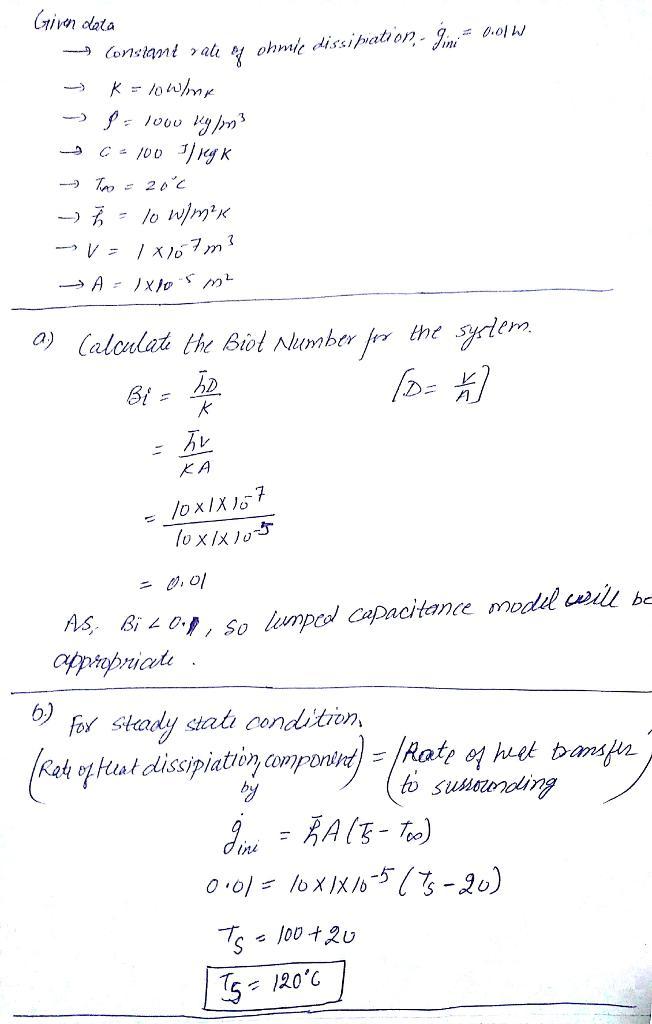
Check the explanation

Explanation:

Kindly check the attached image below for the step by step explanation to your answer.

4 0
2 years ago
The 8-mm-thick bottom of a 220-mm-diameter pan may be made from aluminum (k = 240 W/m ⋅ K) or copper (k = 390 W/m ⋅ K). When use
Artemon [7]

Answer:

For aluminum 110.53 C

For copper 110.32 C

Explanation:

Heat transmission through a plate (considering it as an infinite plate, as in omitting the effects at the borders) follows this equation:

q = \frac{k * A * (th - tc)}{d}

Where

q: heat transferred

k: conduction coeficient

A: surface area

th: hot temperature

tc: cold temperature

d: thickness of the plate

Rearranging the terms:

d * q = k * A * (th - tc)

\frac{d * q}{k * A} = th - tc

th = \frac{d * q}{k * A} + tc

The surface area is:

A = \frac{\pi * d^2}{4}

A = \frac{\pi * 0.22^2}{4} = 0.038 m^2

If the pan is aluminum:

th = \frac{0.008 * 600}{240 * 0.038} + 110 = 110.53 C

If the pan is copper:

th = \frac{0.008 * 600}{390 * 0.038} + 110 = 110.32 C

7 0
2 years ago
3.24 Program: Drawing a half arrow (Java) This program outputs a downwards facing arrow composed of a rectangle and a right tria
eimsori [14]

Answer:

Here is the JAVA program:

import java.util.Scanner; // to get input from user

public class DrawHalfArrow{ // start of the class half arrow

public static void main(String[] args) { // starts of main() function body

    Scanner scnr = new Scanner(System.in); //reads input

int arrowBaseHeight = 0; // stores the height of arrow base

int arrowBaseWidth  = 0; // holds width of arrow base

int arrowHeadWidth = 0; // contains the width of arrow head

// prompts the user to enter arrow base height, width and arrow head width

System.out.println("Enter arrow base height: ");

arrowBaseHeight = scnr.nextInt(); // scans and reads the input as int

System.out.println("Enter arrow base width: ");

arrowBaseWidth = scnr.nextInt();

/* while loop to continue asking user for an arrow head width until the value entered is greater than the value of arrow base width */

while (arrowHeadWidth <= arrowBaseWidth) {

    System.out.println("Enter arrow head width: ");

    arrowHeadWidth = scnr.nextInt(); }

//start of the nested loop

//outer loop iterates a number of times equal to the height of the arrow base

 for (int i = 0; i < arrowBaseHeight; i++) {

//inner loop prints the stars asterisks

      for (int j = 0; j <arrowBaseWidth; j++) {

          System.out.print("*");        } //displays stars

          System.out.println();          }

//temporary variable to hold arrowhead width value

int k = arrowHeadWidth;

//outer loop to iterate no of times equal to the height of the arrow head

for (int i = 1; i <= arrowHeadWidth; i++)

{     for(int j = k; j > 0; j--)     {//inner loop to print stars

       System.out.print("*");    } //displays stars

   k = k - 1;

   System.out.println(); } } } // continues to add more asterisks for new line

Explanation:

The program asks to enter the height of the arrow base, width of the arrow base and the width of arrow head. When asking to enter the width of the arrow head, a condition is checked that the arrow head width arrowHeadWidth should be less than or equal to width of arrow base arrowBaseWidth. The while loop keeps iterating until the user enters the arrow head width larger than the value of arrow base width.

The loop is used to output an arrow base of height arrowBaseHeight. So point (1) is satisfied.

The nested loop is being used which as a whole outputs an arrow base of width arrowBaseWidth. The inner loop draws the stars and forms the base width of the arrow, and the outer loop iterates a number of times equal to the height of the arrow. So (2) is satisfied.

A temporary variable k is used to hold the original value of arrowHeadWidth so that it keeps safe when modification is done.

The last nested loop is used to output an arrow head of width arrowHeadWidth. The inner loop forms the arrow head and prints the stars needed to form an arrow head. So (3) is satisfied.

The value of temporary variable k is decreased by 1 so the next time it enters  the nested for loop it will be one asterisk lesser.

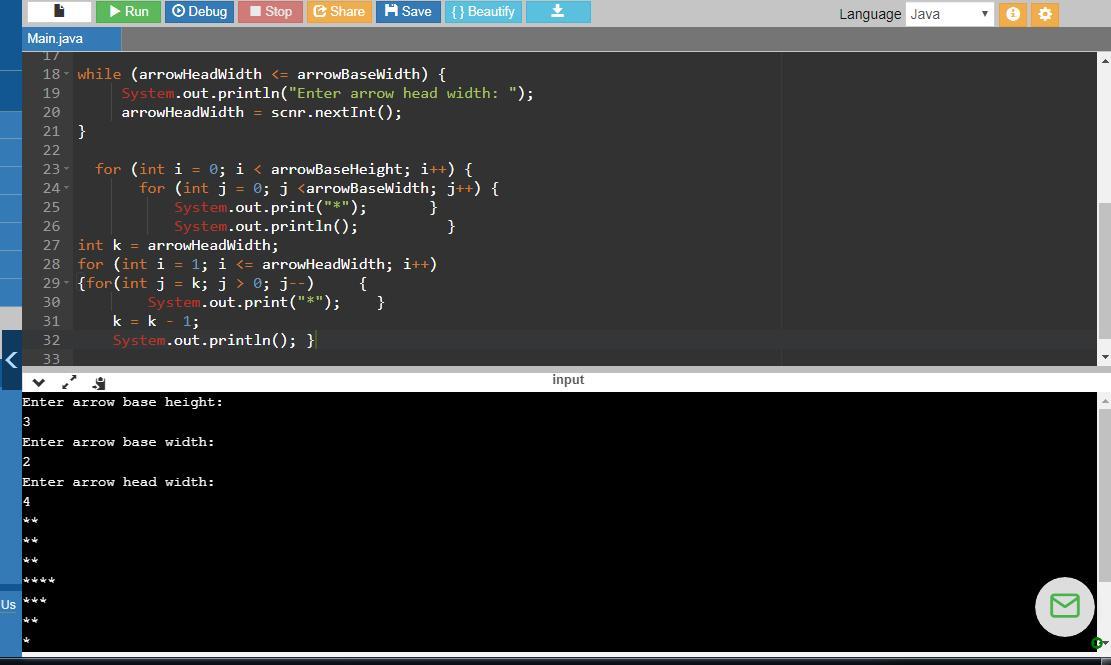
The screenshot of output is attached.
3 0
2 years ago
Given the following code, what indexes must be passed to the substring method to produce the new String with the value "SCORE"?
Ierofanga [76]

Answer:

For expr1 = index 5, length 5

For expr2 = index 0, length 4 and index 21, length 5

string quote = "Four score and seven years ago";

           string expr1 = quote.Substring(5, 5).ToUpper(); // "SCORE"  

           string expr2 = quote.Substring(0, 4) + quote.Substring(21, 5).ToLower(); // "fouryears"

           Console.WriteLine(expr1);

           Console.WriteLine(expr2);

Explanation:

Then code is written in c# and it produces SCORE and f

ouryears

Substring takes 2 arguments, the start of the specific character and the length

6 0
2 years ago
Other questions:
  • Consider insulation on a circular pipe For the same thickness and type of insulation, the thermal resistance of the insulation i
    8·1 answer
  • You are working in a lab where RC circuits are used to delay the initiation of a process. One particular experiment involves an
    13·1 answer
  • The hot water needs of an office are met by heating tab water by a heat pump from 16 C to 50 C at an average rate of 0.2 kg/min.
    5·1 answer
  • PDAs with two stacks are strictly more powerful than PDAs with one stack. Prove that 2-stack PDAs are not a valid model for CFLs
    12·1 answer
  • We are undergoing a period of rapid technology change with cloud computing, artificial intelligence, robotics, mobile devices, w
    12·1 answer
  • Problem 5) Water is pumped through a 60 m long, 0.3 m diameter pipe from a lower reservoir to a higher reservoir whose surface i
    13·1 answer
  • Pipe (2) is supported by a pin at bracket C and by tie rod (1). The structure supports a load P at pin B. Tie rod (1) has a diam
    15·1 answer
  • Consider an infinitely thin flat plate of chord c at an angle of attack α in a supersonic flow. The pressure on the upper and lo
    10·1 answer
  • Link BD consists of a single bar 36 mm wide and 18 mm thick. Knowing that each pin has a 12-mm diameter, determine the maximum v
    7·1 answer
  • What are some goals of NYFEA? Select three options.
    9·2 answers
Add answer
Login
Not registered? Fast signup
Signup
Login Signup
Ask question!