answer.
Ask question
Login Signup
Ask question
All categories
  • English
  • Mathematics
  • Social Studies
  • Business
  • History
  • Health
  • Geography
  • Biology
  • Physics
  • Chemistry
  • Computers and Technology
  • Arts
  • World Languages
  • Spanish
  • French
  • German
  • Advanced Placement (AP)
  • SAT
  • Medicine
  • Law
  • Engineering
Ivenika [448]
2 years ago
15

The rate of flow of water in a pump installation is 60.6 kg/s. The intake static gage is 1.22 m below the pump centreline and re

ads 68.95 kPa gage;the discharge static gage is 0.61 m below the pump centre line and reads 344.75 kPagage. The gages are located close to the pump as much as possible. The area of the intake and discharge pipes are; 0.093 m2 and 0.069 m2 respectively. The pump efficiency is 74%. Take density of water equals 1000 kg/m3. What is the hydraulic power in kW
Engineering
1 answer:
Valentin [98]2 years ago
6 0

Answer:

Pump power is 23.09 kW

Explanation:

Data

gravitational constant, g = 9.81 m/s^2

mass flow, \dot{m} = 60.6 kg/s

flow density, \rho = 1000 kg/m^3

pump efficiency, \eta = 0.74

output gage pressure, p_o = 344.75 kPa

input gage pressure, p_i = 68.95 kPa

output pipe area, A_o = 0.069 m^2

input pipe area, A_i = 0.093 m^2

output height, z_o = 1.22 m - 0.61 m = 0.61 m (considering that pump is at the maximum height, i.e., 1.22 m)

input height, z_i = 0 m

pump hydraulic power,P = ? kW

First of all, volumetric flow (Q) must be computed

Q = \frac{\dot{m}}{\rho}

Q = \frac{60.6 kg/s}{1000 kg/m^3}

Q = 0.0606 m^3/s

Then, velocity (v) must be computed for both input and output

v_o = \frac{Q}{A_o}

v_o = \frac{0.0606 m^3/s}{0.069 m^2}

v_o = 0.88 m/s

v_i = \frac{Q}{A_i}

v_i = \frac{0.0606 m^3/s}{0.093 m^2}

v_i = 0.65 m/s

Now, total head (H) can be calculated

H = (z_o - z_i) + \frac{v_o^2 - v_i^2}{2 \, g} + \frac{p_o - p_i}{\rho \, g}

H = (0.61 m - 0 m) + \frac{{0.88 m/s}^2 - {0.65 m/s}^2}{2 \, 9.81 m/s^2} + \frac{(344.75 Pa-68.95 Pa)\times 10^3}{1000 kg/m^3 \, 9.81 m/s^2}

H = 28.74m

Finally, pump power is computed as

P = \frac{Q \, \rho \, g \, H}{\eta}

P = \frac{0.0606 m^3/s \, 1000 kg/m^3 \, 9.81 m/s^2 \, 28.74m}{0.74}

P = 23.09 kW

You might be interested in
If you have power steering and you are able to __________, you should have your vehicle checked out by a qualified technician.
svp [43]

Answer: drive

Explanation:

The best word that would fit this sentence is drive. A vehicle owner should know how to drive, and they can get their vehicle checked by a qualified technician. The best word that would fit this sentence is drive. If you have power steering and you are able to <u>drive</u>, you should have your vehicle checked by a qualified technician.

8 0
2 years ago
The ingredient weights for making 1 yd (cyd) of concrete by assuming aggregates in SSD state are given below. The volume of air
Pachacha [2.7K]

Answer:

Explanation:

Ans) Given batch weight of each component :

Cement = 700 lb

Water = 315 lb

Coarse aggregate = 1575 lb

Fine aggregate = 1100 lb

Part 1) Amount of water = 328.5 lb

Amount of water is needed to be increased if the aggregates has absorption capacity, To maintain constant water cement ratio, the mixing water is increased because some of the water is absorbed by aggregates.

Amount of water absorbed = 328.5 lb - 315 lb = 13.5 lb

Total amount of aggregates = 1575 + 1100 = 2675 lb

=> % Absorption capacity = 13.5 x 100 / 2675 = 0.5 %

Hence, new amount of Coarse aggregate = (1 - 0.005) x 1575 lb = 1567.125 lb

New amount of fine aggregate = (1 - 0.005) x 1100 = 1094.5 lb

Since, water cement ratio is maintained constant , amount of cement remains unchanged

=> Volume of water = 328.5 / 62.4 = 5.26 ft3

=> Volume of cement = 700 / (3.15 x 62.4) = 3.56 ft3

=> Volume of coarse aggregate = 1567.125 / (2.4 x 62.4) = 10.46 ft3

=> Volume of fine aggregate = 1100 / (2.4 x 62.4) = 7.34 ft3

Volume of air = 2% = 0.02 x 27 = 0.54 ft3

Total concrete volume = 5.26 + 3.56 + 10.46 + 7.34 + 0.54 \approx 27 ft3 = 1 yd3

Hence, calculated amount of each component is correct

Part 2) We know, minus sign indicated that the aggregate will absorb some moisture from concrete, hence mixing water amount needed to be corrected .

=> Amount of water absorbed by coarse aggregate = 0.01 x 1567.125 lb = 15.67 lb

=> Amount of water absorbed by fine aggregate = 0.02 x 1094.50 lb = 21.89 lb

Total amount of water absorbed = 15.67 + 21.89 = 37.56 lb

To maintain same water cement ratio, amount of mixing water is needed to be increased

=> Corrected amount of mixing water = 328.5 lb + 37.56 lb = 366 lb

=> Corrected amount of coarse aggregate = (1 - 0.01) x 1567.125 = 1551.45 lb

=> Corrected amount of fine aggregate = (1 - 0.02) x 1094.5 = 1072.6 lb

Part 3) We know,

Unit weight = Sum of weight of each material / Total volume

=> Sum of weight = 366 + 700 + 1551.45 + 1072.6 = 3690.05 lb

Total volume = 1 yd3 or 27 ft3

=> Expected Unit Weight = 3690.05 lb / 27 ft3 = 136.67 lb/ft3

Also, Concrete Yield = Weight of all components / Unit weight of concrete

=> Yield = 3690.05 / 136.67 = 27 ft3 or 1 yd3

4 0
2 years ago
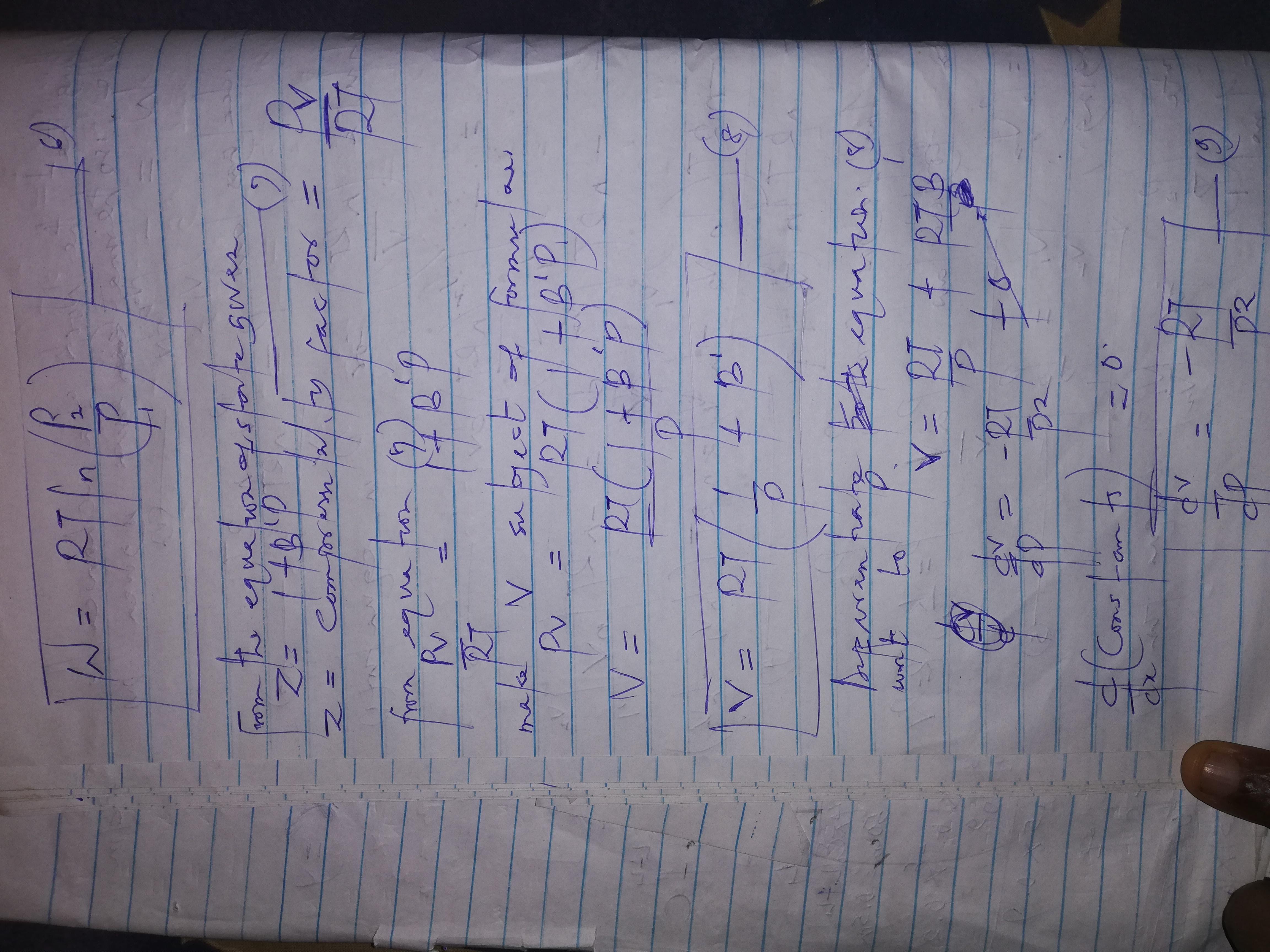
Derive an equation for the work of a mechanically reversible, isothermal compression of 1 mol of a gas from an initial pressure
Lyrx [107]

Answer:

The long derivation for work of a mechanically reversible, isothermal compression was done with detailed steps as shown in the attachment.

Explanation:

what is applied here is a long derivation from Work done in an isobaric process, the expression for the compressibility factor (Z) and the equation of state that was given. The requisite knowledge of Differentiation and Integration was used.

The detailed derivation from firs principle is as shown in the attachment.

5 0
2 years ago
If water molecules pass through a membrane with a steady state flux of 220 mole/(m2 day), how long will it take, in hours, for 0
goblinko [34]

Answer:

<em>0.0386 hr</em>

<em></em>

Explanation:

Area = 565 cm^2 = 0.0565 m^2  (1 cm^2 = 0.0001 m^2)

flux state rate = 220 mole/m^2-day

<em>There are 24 hrs in a day,</em> therefore rate in hrs will be

220/24 = 9.17 mole/m^2-hr

mass of water = 0.4 kg

molar mass of water = (1 x 2) + 16 = 18 kg/mole

therefore,

<em>mole of water = mass of water/molar mass of water</em>

mole of water = 0.4/18 = 0.02 mole

<em>mole flux = mole/area</em> = 0.02/0.0565 = 0.354 mol/m^2

<em>time that will be taken will be for water to pass = mole flux/mole flux rate</em>

time = 0.354/9.17 = <em>0.0386 hr</em>

7 0
2 years ago
6.28 A six-lane freeway (three lanes in each direction) in rolling terrain has 10-ft lanes and obstructions 4 ft from the right
dimulka [17.4K]

Answer:

Assume Base free flow speed (BFFS) = 70 mph

Lane width = 10 ft

Reduction in speed corresponding to lane width, fLW = 6.6 mph

Lateral Clearance = 4 ft

Reduction in speed corresponding to lateral clearance, fLC = 0.8 mph

Interchanges/Ramps = 9/ 6 miles = 1.5 /mile

Reduction in speed corresponding to Interchanges/ramps, fID = 5 mph

No. of lanes = 3

Reduction in speed corresponding to number of lanes, fN = 3 mph

Free Flow Speed (FFS) = BFFS – fLW – fLC – fN – fID = 70 – 6.6 – 0.8 – 3 – 5 = 54.6 mph

Peak Flow, V = 2000 veh/hr

Peak 15-min flow = 600 veh

Peak-hour factor = 2000/ (4*600) = 0.83

Trucks and Buses = 12 %

RVs = 6 %

Rolling Terrain

fHV = 1/ (1 + 0.12 (2.5-1) + 0.06 (2.0-1)) = 1/1.24 = 0.806

fP = 1.0

Peak Flow Rate, Vp = V / (PHV*n*fHV*fP) = 2000/ (0.83*3*0.806*1.0) = 996.54 ~ 997 veh/hr/ln

Vp < (3400 – 30 FFS)

S = FFS

S = 54.6 mph

Density = Vp/S = (997) / (54.6) = 18.26 veh/mi/ln

7 0
2 years ago
Other questions:
  • 1. Which type of sketch most accurately represents what the finished product will look like?
    11·1 answer
  • Air in a 10 ft3 cylinder is initially at a pressure of 10 atm and a temperature of 330 K. The cylinder is to be emptied by openi
    10·2 answers
  • . Were you able to observe ???? = 0 in the circuit you constructed during lab? Why or why not? Hint: What value of resistance wo
    6·1 answer
  • 4.9 Given that I 4 amps when Vs 40 volts and Is 4 amps and I 1 amp when Vs 20 volts and Is 0, use superposition and linearity to
    5·1 answer
  • Refrigerant-134a at 400 psia has a specific volume of 0.1384 ft3/lbm. Determine the temperature of the refrigerant based on (a)
    6·1 answer
  • A gas pressure difference is applied to the legs of a U-tube manometer filled with a liquid with specific gravity of 1.7. The ma
    15·2 answers
  • A 2-m3 rigid tank initially contains air at 100 kPa and 22oC. The tank is connected to a supply line through a valve. Air is flo
    9·1 answer
  • 7. Implement a function factorial in RISC-V that has a single integer parameter n and returns n!. A stub of this function can be
    9·1 answer
  • or a metal pipe used to pump tomato paste, the overall heat- transfer coefficient based on internal area is 2 W/(m2 K). The insi
    14·1 answer
  • A rectification column is fed 100 kg mol/h of a mixture of 50 mol % benzene and 50 mol % toluene at 101.32 kPa abs pressure. The
    5·1 answer
Add answer
Login
Not registered? Fast signup
Signup
Login Signup
Ask question!