answer.
Ask question
Login Signup
Ask question
All categories
  • English
  • Mathematics
  • Social Studies
  • Business
  • History
  • Health
  • Geography
  • Biology
  • Physics
  • Chemistry
  • Computers and Technology
  • Arts
  • World Languages
  • Spanish
  • French
  • German
  • Advanced Placement (AP)
  • SAT
  • Medicine
  • Law
  • Engineering
White raven [17]
2 years ago
13

Estimate the electric field at a point 2.40 cm perpendicular to the midpoint of a uniformly charged 2.00-m-long thin wire carryi

ng a total charge of 4.95 μC .

Physics
1 answer:
nadya68 [22]2 years ago
6 0

Answer:

E = 1.85*10^{12}\frac{N}{C}

Explanation:

Hi!

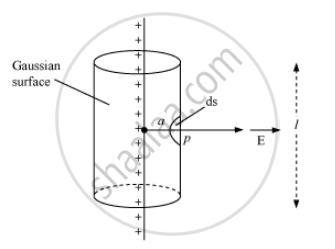
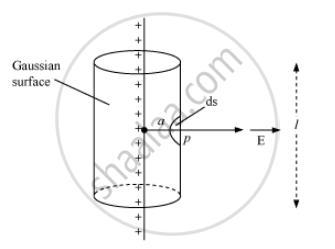
The perpendicular distance 2.4cm, is much less than the distance to both endpoints of the wire, which is aprox 1m. Then the edge effect is negligible at this field point, and we can aproximate the wire as infinitely long.

The electric filed of an infinitely long wire is easy to calculate. Let's call z the axis along the wire. Because of its simmetry (translational and rotational), the electric field E must point in the radial direction,  and it cannot depende on coordinate z. To calculate the field Gauss law is used, as seen in the image, with a cylindrical gaussian surface. The result is:

E = \frac{\lambda}{2\pi \epsilon_0 r}\\\lambda=\text{charge per unit length}=\frac{4.95 \mu C}{2 m} = 2.475 \frac{C}{m}\\r=\text{perpendicular distance to wire}\\\epsilon_0=8.85*10^{-12}\frac{C^2}{Nm^2}

Then the electric field at the point of interest is estimated as:

E = \frac{\22.475}{2\pi*( 8.85*10^{-12})*(2.4*10^{-2})}\frac{N}{C}=1.85*10^{12}\frac{N}{C}

You might be interested in
Given three different locations on Earth's surface, where will the weight of a person be greatest? in New York City, which is ab
zhenek [66]

Answer:

B. South Pole.

Explanation:

In order to answer this question, we simply have to refer to the laws of the equations of gravitational mechanics.

The equation given by Newton tells us that

F = \frac {Gm_1m_2} {r^2}

In the case where we compare a specific place where the Force of Gravity is greater or lesser, we focus on the term assigned to the Planet's Radius.

In the case of G, m_1, m_2, we understand that they are constant.

We can easily notice that the more the Radius (Height seen from a viewer on the ground), the lower the force will be.

<em>In other words, the smaller the radius in which the measurement is made with respect to the center of the earth, the greater the gravitational force.</em>

In that order of ideas the smallest radio has South Pole, which is about 6356 km from the center of the Earth on the Equator line

3 0
2 years ago
Look at the two question marks between zinc (Zn) and arsenic (As). At the time, no elements were known
marissa [1.9K]

Answer:

Mendeleev predicted the atomic mass of each element along with compounds they each should form.

Explanation:

Based on other elements in the same group he predicted the existence of eka-aluminum and eka-silicon, later to be named gallium (Ga) and germanium (Ge).

6 0
2 years ago
A negative charge of -0.550 μC exerts an upward 0.900-N force on an unknown charge that is located 0.300 m directly below the fi
allochka39001 [22]

Answer:

a.   q2 = 16.4μC, positive charge

b.   F = 0.900N

c.   downward

Explanation:

a. In order to calculate the charge of the unknown charge you use the following formula, for the electric force between two charges:

F_e=k\frac{q_1q_2}{r^2}            (1)

k: Coulomb's constant = 8.98*10^9Nm^2/C^2

r: distance between the charges = 0.300m

q1: charge 1 = -0.550 μC = 0.550*10^-6C

q2: charge 2 = ?

Fe: electric force = 0.900N

The force exerted in the second charge points upward, then, the sign of the second charge is positive because this charge is getting closer to the first one.

You solve the equation (1) for the second charge ans replace the values of the other parameters:

q_2=\frac{r^2F_e}{kq_1}=\frac{(0.300m)^2(0.900N)}{(8.98*10^9Nm^2/C^2)(0.550*10^{-6}C)}\\\\q_2=1.64*10^{-5}C\\\\q_2=16.4*10^{-6}C=16.4*10\mu C

The values of the second charge is 1.64 μC

b. By the third Newton Law, you have that the force exerted in the second charge is equal to the force exerted by the first charge on the second one.

The force exerted on the first charge is 0.900N

c. The charges are attracting between them, then, the force exerted on the first charge is pointing downward.

3 0
2 years ago
if a torque of 55.0 N/m is required and the largest force that can be exerted by you is 135 N what is th e length of the lever a
Whitepunk [10]

Answer:

r=0.41m

Explanation:

Torque is defined as the cross product between the position vector ( the lever arm vector connecting the origin to the point of force application) and the force vector.

\tau=r\times F

Due to the definition of cross product, the magnitude of the torque is given by:

\tau=rFsin\theta

Where \theta is the angle between the force and lever arm vectors. So, the length of the lever arm (r) is minimun when sin\theta is equal to one, solving for r:

r=\frac{\tau}{F}\\r=\frac{55\frac{N}{m}}{135N}\\r=0.41m

7 0
2 years ago
A 3.45-kg centrifuge takes 100 s to spin up from rest to its final angular speed with constant angular acceleration. A point loc
Dafna11 [192]

Answer:

(a) 18.75 rad/s²

(b) 14920.78 rev

Explanation:

(a)

First we find the acceleration of the centrifuge using,

a = (v-u)/t......................... Equation 1

Where v = final velocity, u = initial velocity, t = time.

Given: v = 150 m/s,  u = 0 m/s ( from rest), t = 100 s

Substitute into equation 1

a = (150-0)/100

a = 1.5 m/s²

Secondly we calculate for the angular acceleration using

α = a/r..................... Equation 2

Where α = angular acceleration, r = radius of the centrifuge

Given: a = 1.5 m/s², r = 8 cm = 0.08 m

substitute into equation 2

α = 1.5/0.08

α = 18.75 rad/s²

(b)

Using,

Ф = (ω'+ω).t/2........................... Equation 3

Where Ф = number of revolution of the centrifuge, ω' = initial angular velocity, ω = Final angular velocity.

But,

ω = v/r and ω' = u/r

therefore,

Ф = (u/r+v/r).t/2

where u = 0 m/s (at rest),  = 150 m/s, r = 0.08 m, t = 100 s

Ф = [(0/0.08)+(150/0.08)].100/2

Ф = 93750 rad

If,

1 rad = 0.159155 rev,

Ф = (93750×0.159155) rev

Ф = 14920.78 rev
6 0
2 years ago
Other questions:
  • A stone tumbles into a mine shaft strikes bottom after falling for 4.2 seconds. How deep is the mine shaft
    5·1 answer
  • You decide it is time to clean your pool since summer is quickly approaching. Your pool maintenance guide specifies that the chl
    6·1 answer
  • A11) A solenoid of length 18 cm consists of closely spaced coils of wire wrapped tightly around a wooden core. The magnetic fiel
    5·1 answer
  • A child pushes a 75 N toy car across the floor. What is the mass of the car?
    6·1 answer
  • an ice skater, standing at rest, uses her hands to push off against a wall. she exerts an average force on the wall of 120 N and
    14·1 answer
  • If an irregularly shaped object (such as a wrench) is dropped from rest in a classroom and feels no air resistance, it will:
    6·1 answer
  • While playing basketball in PE class, Logan lost his balance after making a lay-up and colliding with the padded wall behind the
    11·1 answer
  • A typical machine tests the tensile strength of a sheet of material cut into a standard size of 5.00 centimeters wide by 10.0 ce
    12·1 answer
  • Select all the correct answers.
    10·1 answer
  • An artificial satellite orbits Earth at a speed of 7800 m/s and a height of 200 km above Earth's surface. The satellite experien
    14·1 answer
Add answer
Login
Not registered? Fast signup
Signup
Login Signup
Ask question!