answer.
Ask question
Login Signup
Ask question
All categories
  • English
  • Mathematics
  • Social Studies
  • Business
  • History
  • Health
  • Geography
  • Biology
  • Physics
  • Chemistry
  • Computers and Technology
  • Arts
  • World Languages
  • Spanish
  • French
  • German
  • Advanced Placement (AP)
  • SAT
  • Medicine
  • Law
  • Engineering
sukhopar [10]
2 years ago
7

Two tiny particles having charges of +5.00 μC and +7.00 μC are placed along the x-axis. The +5.00-µC particle is at x = 0.00 cm,

and the other particle is at x = 100.00 cm. Where on the x-axis must a third charged particle be placed so that it does not experience any net electrostatic force due to the other two particles? Two tiny particles having charges of +5.00 μC and +7.00 μC are placed along the x-axis. The +5.00-µC particle is at x = 0.00 cm, and the other particle is at x = 100.00 cm. Where on the x-axis must a third charged particle be placed so that it does not experience any net electrostatic force due to the other two particles? 4.58 cm 50 cm 9.12 cm 91.2 cm 45.8 cm

Physics
1 answer:
Liula [17]2 years ago
8 0

Answer:

The third charged particle must be placed at x = 0.458 m = 45.8 cm

Explanation:

To solve this problem we apply Coulomb's law:  

Two point charges (q₁, q₂) separated by a distance (d) exert a mutual force (F) whose magnitude is determined by the following formula:  

F = \frac{k*q_1*q_2}{d^2} Formula (1)  

F: Electric force in Newtons (N)

K : Coulomb constant in N*m²/C²

q₁, q₂: Charges in Coulombs (C)  

d: distance between the charges in meters (m)

Equivalence  

1μC= 10⁻⁶C

1m = 100 cm

Data

K = 8.99 * 10⁹ N*m²/C²

q₁ = +5.00 μC = +5.00 * 10⁻⁶ C

q₂= +7.00 μC = +7.00 * 10⁻⁶ C

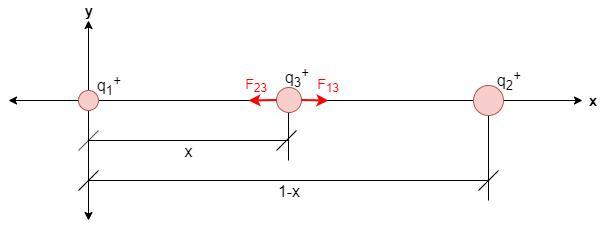
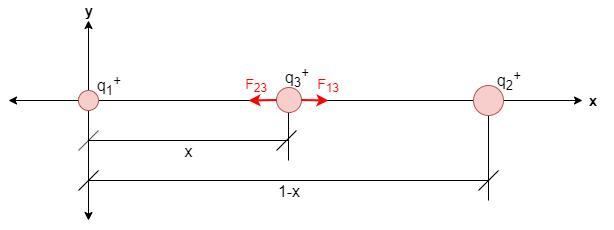
d₁ = x (m)

d₂ = 1-x (m)

Problem development

Look at the attached graphic.

We assume a positive charge q₃ so F₁₃ and F₂₃ are repulsive forces and must be equal so that the net force is zero:

We use formula (1) to calculate the forces F₁₃ and F₂₃

F_{13} = \frac{k*q_1*q_3}{d_1^2}

F_{23} = \frac{k*q_2*q_3}{d_2^2}

F₁₃ = F₂₃

\frac{k*q_1*q_3}{d_1^2} = \frac{k*q_2*q_3}{d_2^2} We eliminate k and q₃ on both sides

\frac{q_1}{d_1^2}= \frac{q_2}{d_2^2}

\frac{q_1}{x^2}=\frac{q_2}{(1-x)^2}

\frac{5*10^{-6}}{x^2}=\frac{7*10^{-6}}{(1-x)^2} We eliminate 10⁻⁶ on both sides

(1-x)^2 = \frac{7}{5} x^2

1-2x+x^2=\frac{7}{5} x^2

5-10x+5x^2=7 x^2

2x^2+10x-5=0

We solve the quadratic equation:

x_1 = \frac{-b+\sqrt{b^2-4ac} }{2a} = \frac{-10+\sqrt{10^2-4*2*(-5)} }{2*2} = 0.458m

x_2 = \frac{-b-\sqrt{b^2-4ac} }{2a} = \frac{-10-\sqrt{10^2-4*2*(-5)} }{2*2} = -5.458m

In the option x₂, F₁₃ and F₂₃ will go in the same direction and will not be canceled, therefore we take x₁ as the correct option since at that point the forces are in  opposite way .

x = 0.458m = 45.8cm
You might be interested in
Heat engines were first envisioned and built during the industrial revolution. Explain the thermodynamics of a heat engine comme
Artyom0805 [142]

Heat engines were developed during industrial revolution.

Generally a heat engine contains three parts i.e source, sink and working substance.

The source of a heat engine is present at a higher temperature as compared to the sink. Due to the temperature difference, the heat will flow from source to sink through working substance.

Let us consider  T_{1}\ and\ T_{2} are the temperature of source and sink.

As the source is at higher temperature as compared to sink, heat will flow from source to sink.

Let\ Q_{1}\ and\ Q_{2} are the heat provided by source and heat rejected to sink.

Hence, the work done by the working substance will be -

                                                W\ =\ Q_{1}-Q_{2}

The efficiency of a heat engine is defined as the ratio of output to the input energy.

Here output = workdone [W]

Hence, the efficiency of a heat engine is calculated as -

                     Efficiency\ [\eta]=\frac{W}{Q_{1}}

                                        \eta\ =\frac{Q_{1}- Q_{2}} {Q_{1}}

                                               =\ 1-\frac{Q_{2}} {Q_{1}}

This is the expression for the efficiency of heat engine.

Here, all the heat absorbed by the working substance can not be converted to desired output. The efficiency of a heat engine can not be 100 percent. Some amount of heat is lost in the form of sound and heat due to the friction which is produced due to the relative motion between various parts of the machine.

6 0
2 years ago
Read 2 more answers
Given a triangle with sides X = 6.35 cm and Y = 12.25 cm with an angle of 90 degrees between them, find the length of the hypote
never [62]

Answer:

the hypotenuse = 13.78 cm

Ф = 27.44°

θ = 62.56°

explanation:

4 0
2 years ago
A physics student shoves a 0.50-kg block from the bottom of a frictionless 30.0° inclined plane. The student performs 4.0 j of w
Musya8 [376]

Answer:1.63 m

Explanation:

Given

mass of block m=0.5 kg

inclination \theta =30^{\circ}

Amount of work done W=4 J

block slides a distance s along the Plane

Work done =change in Potential Energy

Increase in height of block is s\sin \theta

Change in Potential Energy =mg(\sin \theta -0)

\Delta P.E.=0.5\times 9.8\times s\sin 30

4=0.5\times 9.8\times s\sin 30

s=\frac{4}{2.45}      

s=1.63 m

5 0
2 years ago
An electron and a proton are held on an x axis, with the electron at x = + 1.000 m and the proton at x = - 1.000 m. Part A How m
r-ruslan [8.4K]

PART A)

Electrostatic potential at the position of origin is given by

V = \frac{kq_1}{r_1} + \frac{kq_2}{r_2}

here we have

q_1 = 1.6 \times 10^{-19} C

q_2 = -1.6 \times 10^{-19} C

r_1 = r_2 = 1 m

now we have

V = \frac{Ke}{r} - \frac{Ke}{r}

V = 0

Now work done to move another charge from infinite to origin is given by

W = q(V_f - V_i)

here we will have

W = e(0 - 0) = 0

so there is no work required to move an electron from infinite to origin

PART B)

Initial potential energy of electron

U = \frac{Kq_1e}{r_1} + \frac{kq_2e}{r_2}

U = \frac{9\times 10^9(-1.6\times 10^{-19}(-1.6 \times 10^{-19})}{19} + \frac{9\times 10^9(1.6\times 10^{-19}(-1.6 \times 10^{-19})}{21}

U = (2.3\times 10^{-28})(\frac{1}{19} - \frac{1}{21})

U = 1.15\times 10^{-30}

Now we know

KE = \frac{1}{2}mv^2

KE = \frac{1}{2}(9.1\times 10^{-31}(100)^2

KE = 4.55 \times 10^{-27} kg

now by energy conservation we will have

So here initial total energy is sufficient high to reach the origin

PART C)

It will reach the origin

4 0
2 years ago
750 million years ago, there was enough Uranium-235 present in Oklo, Gabon to have a natural fission reactor occur and generate
Komok [63]
<span>With a half-life of 700 million years, U-235 would have had twice as much mass at a time 700 MYA. This would have put the mass at 100kg at that time. Going back another 50 million years would be (50/700) or 1/14 of the half-life, or (1/2 * 1/14), or 1/28 of the total mass. 1/28 of 100kg is 3.57kg, so the amount present at the 750MYA mark would be approximately 103.57kg of U-235.</span>
3 0
2 years ago
Read 2 more answers
Other questions:
  • A 2.50 × 10⁵ W motor is used for 26.4 s to pull a boat straight toward shore. How far does the boat move toward shore if a force
    15·1 answer
  • Two oppositely charged but otherwise identical conducting plates of area 2.50 square centimeters are separated by a dielectric 1
    12·1 answer
  • Sophia is planning on going down an 8-m water slide. Her weight is 50 N. She knows that she has gravitational potential energy (
    9·1 answer
  • A 1.47-newton baseball is dropped from a height of 10.0 meters and falls through the air to the ground. The kinetic energy of th
    15·2 answers
  • Calculate the length of a simple pendulum that oscillates with a frequency of 0.4Hz g=10m/s2 , ^=3.142
    12·1 answer
  • A rigid tank A of volume 0.6 m3 contains 5 kg air at 320K and the rigid tank B is 0.4 m3 with air at 600 kPa, 360 K. They are co
    9·1 answer
  • If the ac peak voltage across a 100-ohm resistor is 120 V, then the average power dissipated by the resistor is ________
    12·1 answer
  • The Problems: 1. Xavier starts at a position of 0 m and moves with an average speed of 0.50 m/s for 3.0 seconds. He normally mov
    7·1 answer
  • Adam takes a bus on a school field trip. The bus route is split into the five legs listed in the table. Find the average velocit
    10·1 answer
  • The velocity of a passenger relative to a boat is -vpb. The velocity of the boat relative to the river it is moving on is vbr. T
    7·1 answer
Add answer
Login
Not registered? Fast signup
Signup
Login Signup
Ask question!