answer.
Ask question
Login Signup
Ask question
All categories
  • English
  • Mathematics
  • Social Studies
  • Business
  • History
  • Health
  • Geography
  • Biology
  • Physics
  • Chemistry
  • Computers and Technology
  • Arts
  • World Languages
  • Spanish
  • French
  • German
  • Advanced Placement (AP)
  • SAT
  • Medicine
  • Law
  • Engineering
gladu [14]
2 years ago
11

Alyssa works for an engineering firm that has been hired to design and supervise the construction of a highway bridge over a maj

or river. The bridge will be a unique design, incorporating complex designs that will likely never be duplicated. How should Alyssa deal with designing and overseeing the building of the bridge?
Engineering
1 answer:
Colt1911 [192]2 years ago
3 0

Answer:

I'm going to make a list of everything you need to consider for the supervision and design of the bridge.

1. the materials with which you are going to build it.

2. the length of the bridge.

3. The dynamic and static load to which the bridge will be subjected.

4. How corrosive is the environment where it will be built.

5.wind forces

6. The force due to possible earthquakes.

7. If it is going to be built in an environment where snow falls.

8. The bridge is unique,so   the shape has a geometry that resists loads?.

9. bridge costs.

10. Personal and necessary machines.

11. how much the river grows

You might be interested in
A sign erected on uneven ground is guyed by cables EF and EG. If the force exerted by cable EF at E is 46 lb, determine the mome
Vikki [24]

Answer:

M_AD = 1359.17 lb-in

Explanation:

Given:

- T_ef = 46 lb

Find:

- Moment of that force T_ef about the line joining points A and D.

Solution:

- Find the position of point E:

                           mag(BC) = sqrt ( 48^2 + 36^2) = 60 in

                           BE / BC = 45 / 60 = 0.75

Hence,                E = < 0.75*48 , 96 , 36*0.75> = < 36 , 96 , 27 > in

- Find unit vector EF:

                           mag(EF) = sqrt ( (21-36)^2 + (96+14)^2 + (57-27)^2 ) = 115 in

                           vec(EF) = < -15 , -110 , 30 >

                           unit(EF) = (1/115) * < -15 , -110 , 30 >

- Tension            T_EF = (46/115) * < -15 , -110 , 30 > = < -6 , -44 , 12 > lb

- Find unit vector AD:

                           mag(AD) = sqrt ( (48)^2 + (-12)^2 + (36)^2 ) = 12*sqrt(26) in

                           vec(AD) = < 48 , -12 , 36 >

                           unit(AD) = (1/12*sqrt(26)) * < 48 , -12 , 36 >

                           unit (AD) = <0.7845 , -0.19612 , 0.58835 >

Next:

                           M_AD = unit(AD) . ( E x T_EF)

                           M_d = \left[\begin{array}{ccc}0.7845&-0.19612&0.58835\\36&96&27\\-6&-44&12\end{array}\right]

                            M_AD = 1835.73 + 116.49528 - 593.0568

                            M_AD = 1359.17 lb-in

3 0
2 years ago
A bankrupt chemical firm has been taken over by new management. On the property they found a 20,000-m3 brine pond containing 25,
Liula [17]

Answer:

Flow-rate = 0.0025 m^3/s

Explanation:

We need to assume that the flow-rate of pure water entering the pond is the same as the flow-rate of brine leaving the pond, in other words, the volume of liquid in the pond stays constant at 20,000 m^3. Using the previous assumption we can calculate the flow rate entering or leaving the tank (they are the same) building a separable differential equation dQ/dt, where Q is the milligrams (mg) of salt in a given time t, to find a solution to our problem we build a differential equation as follow:

dQ/dt = -(Q/20,000)*r  where r is the flow rate in m^3/s

what we pose with this equation is that the variable rate at which the salt leaves the pond (salt leaving over time) is equal to the concentration (amount of salt per unit of volume of liquid at a given time) times the constant rate at which the liquid leaves the tank, the minus sign in the equation is because this is the rate at which salt leaves the pond.

Rearranging the equation we get dQ/Q = -(r/20000) dt then integrating in both sides ∫dQ/Q = -∫(r/20000) dt and solving ln(Q) = -(r/20000)*t + C where C is a constant (initial value) result of solving the integrals. Please note that the integral of dQ/Q is ln(Q) and r/20000 is a constant, therefore, the integral of dt is t.

To find the initial value (C) we evaluate the integrated equation for t = 0, therefore, ln(Q) = C, because at time zero we have a concentration of 25000 mg/L = 250000000 mg/m^3 and Q is equal to the concentration of salt (mg/m^3) by the amount of liquid (always 20000 m^3) -> Q = 250000000 mg/m^3 * 20000 m^3 = 5*10^11 mg -> C = ln(5*10^11) = 26.9378. Now the equation is ln(Q) = -(r/20000)*t + 26.9378, the only thing missing is to find the constant flow rate (r) required to reduce the salt concentration in the pond to 500 mg/L = 500000 mg/m^3 within one year (equivalent to 31536000 seconds), to do so we need to find the Q we want in one year, that is Q = 500000 mg/m^3 * 20000 m^3 = 1*10^10 mg, therefore, ln(1*10^10) = -(r/20000)*31536000 + 26.9378 solving for r -> r = 0.002481 m^3/s that is approximately 0.0025 m^3/s.

Note:

  • ln() refer to natural logarithm
  • The amount of liquid in the tank never changes because the flow-rate-in is the same as the flow-rate-out
  • When solving the differential equation we calculated the flow-rate-out and we were asked for the flow-rate-in but because they are the same we could solve the problem
  • During the solving process, we always converted units to m^3 and seconds because we were asked to give the answer in m^3/seg
7 0
2 years ago
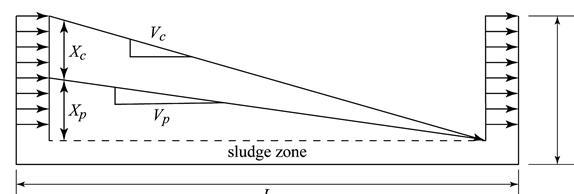
The rate of flow through an ideal clarifier is 8000m3 /d, the detention time is 1h and the depth is 3m. If a full-length movable
Fittoniya [83]

Answer:

a) 35%

b) yes it can be improved by moving the tray near the top

   Tray should be located ( 1 to 2 meters below surface )

   max removal efficiency ≈ 70%

c) The maximum removal will drop as the particle settling velocity = 0.5 m/h

Explanation:

Given data:

flow rate = 8000 m^3/d

Detention time = 1h

depth = 3m

Full length movable horizontal tray :  1m below surface

<u>a) Determine percent removal of particles having a settling velocity of 1m/h</u>

velocity of critical sized particle to be removed = Depth / Detention time

= 3 / 1 = 3m/h

The percent removal of particles having a settling velocity of 1m/h ≈ 35%

<u>b) Determine if  the removal efficiency of the clarifier can be improved by moving the tray, the location of the tray  and the maximum removal efficiency</u>

The tray should be located near the top of the tray ( i.e. 1 to 2 meters below surface ) because here the removal efficiency above the tray will be 100% but since the tank is quite small hence the

Total Maximum removal efficiency

=  percent removal_{above} + percent removal_{below}

= ( d_{a},v_{p} ) . \frac{d_{a} }{depth}  + ( d_{a},v_{p} ) . \frac{depth - d_{a} }{depth}  = 100

hence max removal efficiency ≈ 70%

<u>c) what is the effect of moving the tray would be if the particle settling velocity were equal to 0.5m/h?</u>

The maximum removal will drop as the particle settling velocity = 0.5 m/h

7 0
2 years ago
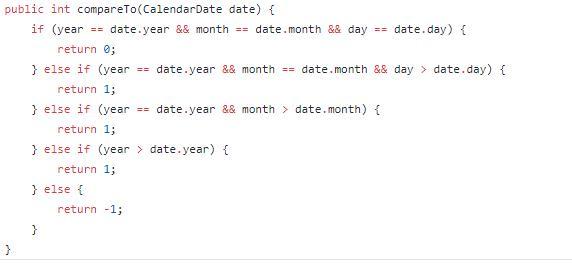
Suppose that a class CalendarDate has been defined for storing a calendar date with month, day and year components. (In our sect
laiz [17]

Answer:

note:

find the attachment

7 0
2 years ago
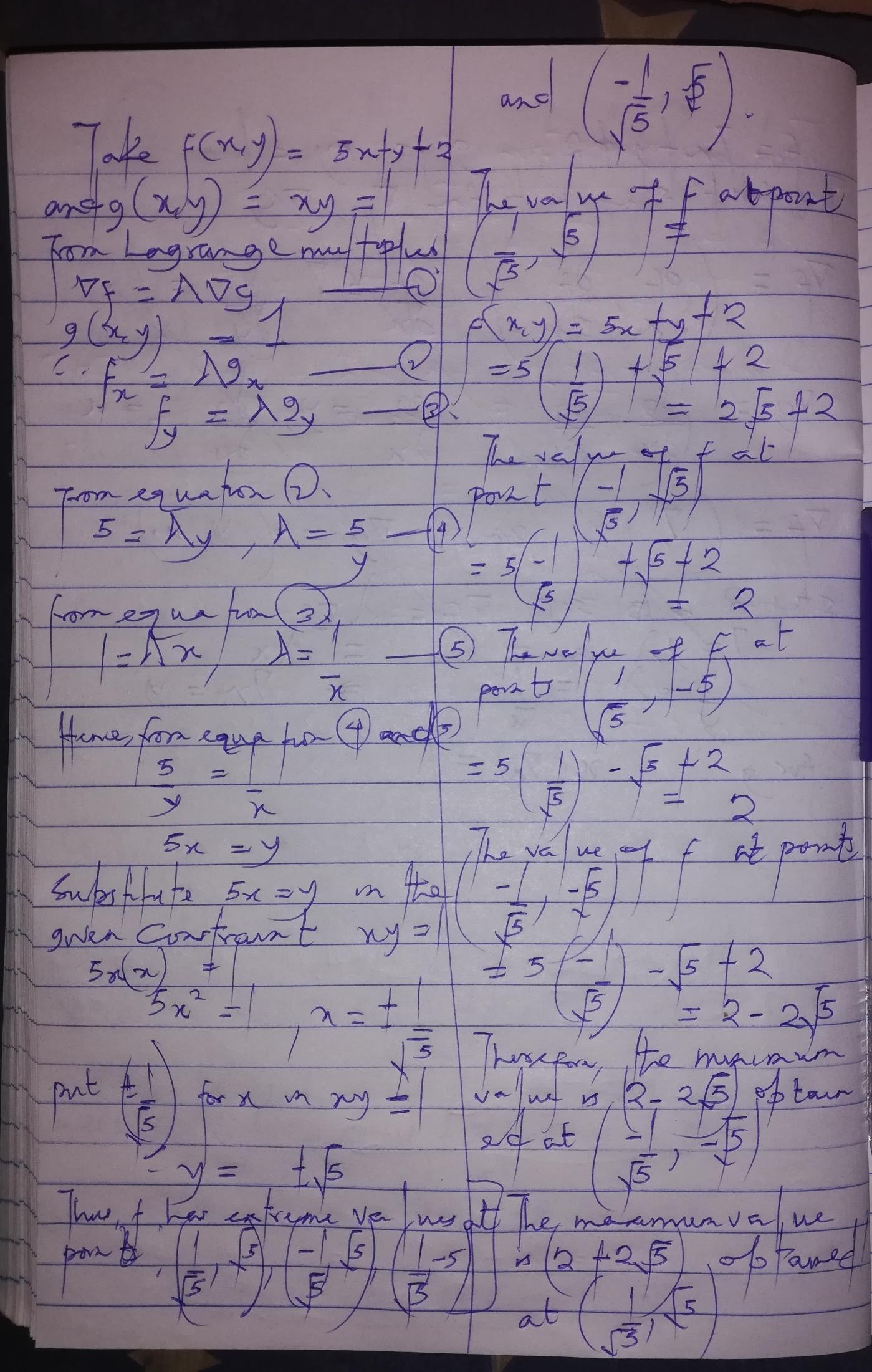
Use Lagrange multiplier techniques to find the local extreme values of the given function subject to the stated constraint. If a
Leno4ka [110]

Answer:

Explanation:

Given f(x, y) = 5x + y + 2 and g(x, y) = xy = 1

The step by step calculation and appropriate substitution is clearly shown in the attached file.

5 0
2 years ago
Other questions:
  • Determine the amount of gamma and alpha phases in a 10-kg, 1060 steel casting as it is being cooled to the following temperature
    6·1 answer
  • What can your employer do to protect you from overhead power lines?
    8·1 answer
  • A particle has an initial velocity of v0 = 14 ft/s to the right, at s0 = 0, and a = 2 ft/s2 to the left. determine its position
    5·1 answer
  • Universal Containers (UC) has a requirement to expose a web service to their business partners. The web service will be used to
    10·1 answer
  • Current density is given in cylindrical coordinates as J = −106z1.5az A/m2 in the region 0 ≤ rho ≤ 20 µm; for rho ≥ 20 µm, J = 0
    13·1 answer
  • Sal has many options for how to spend her afternoon. She placed them in the order in which she values them: 1) go to a movie, 2)
    14·1 answer
  • Technician A says that the most efficient method of EVAP system leak detection is introducing smoke under low pressure from a ma
    7·1 answer
  • Thermal energy generated by the electrical resistance of a 5-mm-diameter and 4-m-long bare cable is dissipated to the surroundin
    12·1 answer
  • Milton has been tracking the migrating patterns of whales in the northwest Atlantic Ocean for five years. He knows where and whe
    5·2 answers
  • Complete the following sentence.
    5·1 answer
Add answer
Login
Not registered? Fast signup
Signup
Login Signup
Ask question!