answer.
Ask question
Login Signup
Ask question
All categories
  • English
  • Mathematics
  • Social Studies
  • Business
  • History
  • Health
  • Geography
  • Biology
  • Physics
  • Chemistry
  • Computers and Technology
  • Arts
  • World Languages
  • Spanish
  • French
  • German
  • Advanced Placement (AP)
  • SAT
  • Medicine
  • Law
  • Engineering
trapecia [35]
2 years ago
4

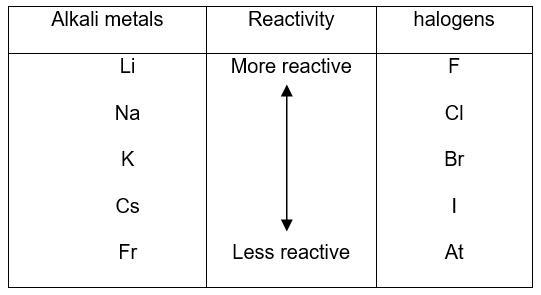
The elements in alkali metal and halogen groups of the periodic table are the most reactive since they only need to gain or lose

one electron to become stable by filling their valence orbital. What happens to reactivity, moving down the column of a group?
A) Reactivity stays the same because they are in the same group.
B) Reactivity increases because the valence level is further from the nucleus of the atom.
C) Reactivity decreases because the increased number of protons and electrons provides more stability.
D) Reactivity stays the same because the number of electrons needed to fill the valence orbital remains the same.

Chemistry
2 answers:
RUDIKE [14]2 years ago
6 0

Answer:

B) Reactivity increases because the valence level is further from the nucleus of the atom.

Explanation:

In both halogens and alkali metals, the reactivity decreases down the group. Both periodic groups required a change of one electron to complete their octet and be like the noble gases.

As we go down a periodic group, the number of shells of electrons increases. This makes the outermost valence electrons less protected from the shielding effect of the nucleus. Therefore, elements further down will have a low grip on their outermost shell electrons and the upper ones will have a better protection.

As we can see, the most reactive metal is francium and it is located further down in group I. The most electronegative atom which would not readily lose an electron is fluorine and it is up the group of halogens.

kozerog [31]2 years ago
5 0

<u>Answer:</u>

<em>B) Reactivity increases because the valence level is further from the nucleus of the atom.</em>

<em></em>

<u>Explanation:</u>

Moving down a group reactivity increases. The number of shell increases as we move down a group from one element to the other in a group. So the distance from the nucleus to the outer shell electron increases. As a result attraction between the nucleus (positive) to the outer shell electron (negative) increases.

The inner shell electrons experience more shielding effect. Thus the outer shell electrons are easily gets lost or gained.

KCl +Br_2> No Reaction\\\\KBr+Cl_2>KCl+Br_2

Cl_2 is more reactive than Br_2

Thats why we see here Br is replaced from KBr by Cl_2

Br_2 cannot replace Cl from KCl since it is less reactive than Cl_2

You might be interested in
PLEASE HELP!!! Which of John Dalton's contributions are present in the modern atomic model and which were eventually disproven a
Yanka [14]
1) All matter is made of atoms. Atoms are indivisible and indestructible.

2) All atoms of a given element are identical in mass and properties

3) Compounds are formed by a combination of two or more different kinds of atoms.

4) A chemical reaction is a rearrangement of atoms.

1 and 2 were proved wrong.
5 0
2 years ago
A mixture of gases containing 0.20 mol of SO2 and 0.20 mol of O2 in a 4.0 L flask reacts to form SO3. If the temperature is 25ºC
diamong [38]

Answer : The pressure in the flask after reaction complete is, 2.4 atm

Explanation :

To calculate the pressure in the flask after reaction is complete we are using ideal gas equation.

PV=n_TRT\\\\P=(n_1+n_2)\times \frac{RT}{V}

where,

P = final pressure in the flask = ?

R = gas constant = 0.0821 L.atm/mol.K

T = temperature = 25^oC=273+25=298K

V = volume = 4.0 L

n_1 = moles of SO_2 = 0.20 mol

n_2 = moles of O_2 = 0.20 mol

Now put all the given values in the above expression, we get:

P=(0.20+0.20)mol\times \frac{(0.0821L.atm/mol.K)\times (298K)}{4.0L}

P=2.4atm

Thus, the pressure in the flask after reaction complete is, 2.4 atm

5 0
2 years ago
Three samples of gas each exert 740 mm hg in separate 2 L containers what pressure do they exert if they are all placed in a sin
Nesterboy [21]

Answer:

P(total) = 1110 mmHg

Explanation:

According to the Dalton law of partial pressure,

The pressure exerted by mixture of gases are equal to the sum of partial pressure of individual gases.

P(total) = P1 + P2 + P3+ .....+ Pn

Given data:

Sample A = 740 mmHg

Sample B = 740 mmHg

Sample C = 740 mmHg

Total pressure = ?

Solution:

<em>Sample A:</em>

P₁V₁ = P₂V₂

P₂ = P₁V₁ / V₂

P₂ = 740 mmHg × 2L/4L

P₂ = 370 mmHg

<em>Sample B:</em>

P₁V₁ = P₂V₂

P₂ = P₁V₁ / V₂

P₂ = 740 mmHg × 2L/4L

P₂ = 370 mmHg

<em>Sample C:</em>

P₁V₁ = P₂V₂

P₂ = P₁V₁ / V₂

P₂ = 740 mmHg × 2L/4L

P₂ = 370 mmHg

Total pressure:

P(total) = P1 + P2 + P3

P(total) =  370 mmHg +  370 mmHg+  370 mmHg

P(total) = 1110 mmHg

6 0
2 years ago
 A reaction container holds 5.77 g of P4 and 5.77 g of O2.
Dvinal [7]

Answer:

a) O2 is the limiting reactant

b) 5.75 grams P4O10

c) 5.79 grams P4O6

Explanation:

Step 1: Data given

Mass of P4 = 5.77 grams

Mass of O2 = 5.77 grams

Molar mass of P4 = 123.90 g/mol

Molar mass O2 = 32.0 g/mol

Step 2: The balanced equation

P4 + 3O2 → P4O6

Step 3: Calculate moles of P4

Moles P4 = mass P4 / molar mass P4

Moles P4 = 5.77 grams / 123.90 g/mol

Moles P4 = 0.0466 moles

Step 4: Calculate moles O2

Moles O2 = mass O2 / molar mass O2

Moles O2 = 5.77 grams / 32.0 g/mol

Moles O2 = 0.1803 moles

Step 5: Calculate limiting reactant

P4 is the limiting reactant in this reaction. It will completely be consumed (0.0466 moles). O2 is in excess, there will react 3*0.0466 = 0.1398 moles

There will remain 0.1803 - 0.1398 = 0.0405 moles O2

Step 6: Calculate the amount of P4O6

For 1 mol P4 we'll have 1 mol P4O6

For 0.0466 moles P4 we'll have 0.0466 moles P4O6

Step 7: The balanced equatio

P4O6 + 2O2 → P4O10

We have 0.0466 moles P4O6 and 0.0405 moles O2

Step 8: Calculate the limiting reactant

For 1 mol P4O6 we need 2 moles O2 to produce 1 mol P4O10

O2 is the limiting reactant. It will completely be consumed (0.0405 moles)

P4O6 is in excess. There will react 0.0405/2 = 0.02025 moles

There will remain 0.0466 - 0.02025 = 0.02635 moles P4O6

This is 0.02635 * 219.88 g/mol = 5.79 grams P4O6

Step 9: Calculate moles and mass of P4O10

For 1 mol P4O6 we need 2 moles O2 to produce 1 mol P4O10

For 0.0405 moles O2 we'll have 0.02025 moles P4O10

This is 0.02025 * 283.89 g/mol = 5.75 grams P4O10
3 0
2 years ago
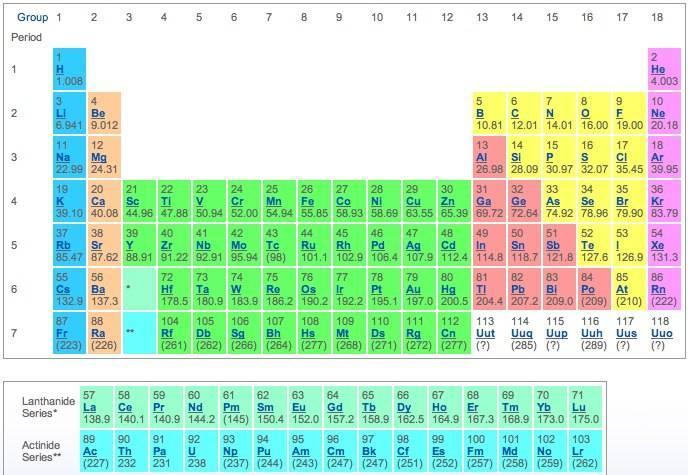
Some versions of the periodic table show hydrogen at the top of Group 1A(1) and at the top of Group 7A(17). What properties of h
lawyer [7]

Answer:Hydrogen is placed such because it exhibits some similar characteristics of both group1 and group VII elements.

Explanation:

The reason why hydrogen is similar to group 1 metals:

#It has same valence electron and inorder achieve octet state it can lose that electron and forms H+ ion

#It acts as a good reducing agent similar to group1 metals

#It can also halides

Similarity to halogens:

#hydrogen can also gain one electron to gain noble gas configuration. It can combine with other non metals to form molecules with covalent bonding.

#It exists as diatomin molecule,H2

#Have the same electronegativity nature

#its reaction with other metal

8 0
2 years ago
Other questions:
  • What will be the pressure in atmospheres in a 750.0 mL vessel containing 5.00 g of argon gas at 15°C?
    15·1 answer
  • What is the oxidation number for iodine in Mg(IO3)2 ?
    13·2 answers
  • Which of these is the lowest subgroup? kingdom, order, genus, or species.
    15·2 answers
  • In a sample consisting of 1.00 mol nabr and 0.300 mol ki, what is the mass percent of iodine? (a) 24.9% (b) 32.6% (c) 47.2% (d)
    10·1 answer
  • HELP!!!!!!! How many moles of AgNO3 must react to form 0.854 mol Ag?<br> mol AgNO3
    12·2 answers
  • Which of the following species is a molecular element?1. neon 2. carbon dioxide3. chlorine 4. sodium 5. none of the above
    6·1 answer
  • Draw the Lewis structure (including resonance structures) for diazomethane (CH2N2)(CH2N2). For each resonance structure, assign
    15·1 answer
  • Write a hypothesis about the pH level of common household solutions based on what you know about their physical and chemical pro
    8·2 answers
  • An element (gas) used to make colorfully lit advertising signs
    10·2 answers
  • 3.0m3 of sulfer dioxide is reacted with 2.0dm3 of oxygen . What volume of sulfur trioxide is form?
    8·1 answer
Add answer
Login
Not registered? Fast signup
Signup
Login Signup
Ask question!