answer.
Ask question
Login Signup
Ask question
All categories
  • English
  • Mathematics
  • Social Studies
  • Business
  • History
  • Health
  • Geography
  • Biology
  • Physics
  • Chemistry
  • Computers and Technology
  • Arts
  • World Languages
  • Spanish
  • French
  • German
  • Advanced Placement (AP)
  • SAT
  • Medicine
  • Law
  • Engineering
maks197457 [2]
2 years ago
4

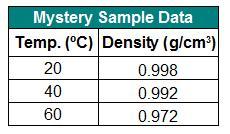
The table below shows the density of a sample of a mystery liquid you tested in the lab. Can you infer the identity of the subst

ance from these data?
A. Yes, the substance must be water.
B. No, more data are needed.
C. No, the data must be wrong because density always decreases with an increase in temperature.
D. Yes, but only if the data for 50ºC and 70ºC were also present.

Chemistry
1 answer:
Nostrana [21]2 years ago
8 0

Answer:

The answer to your question is: B

Explanation:

Although it seems that the substance  is water, is necessary to have more information.

If we compare the  density shown in the table shows with that reported in books, only the density at 20 and 40°C is equal in both. The density reported in books for water at 60°C is 0.982 g/cm3 and the reported in the table is 0.972 g/cm3. This last datum makes us conclude that is necessary to have more data.

You might be interested in
Ammonia gas is compressed from 21°C and 200 kPa to 1000 kPa in an adiabatic compressor with an efficiency of 0.82. Estimate the
Evgen [1.6K]

Explanation:

It is known that efficiency is denoted by \eta.

The given data is as follows.

     \eta = 0.82,       T_{1} = (21 + 273) K = 294 K

     P_{1} = 200 kPa,     P_{2} = 1000 kPa

Therefore, calculate the final temperature as follows.

         \eta = \frac{T_{2} - T_{1}}{T_{2}}    

         0.82 = \frac{T_{2} - 294 K}{T_{2}}    

          T_{2} = 1633 K

Final temperature in degree celsius = (1633 - 273)^{o}C

                                                            = 1360^{o}C

Now, we will calculate the entropy as follows.

       \Delta S = nC_{v} ln \frac{T_{2}}{T_{1}} + nR ln \frac{P_{1}}{P_{2}}

For 1 mole,  \Delta S = C_{v} ln \frac{T_{2}}{T_{1}} + R ln \frac{P_{1}}{P_{2}}

It is known that for NH_{3} the value of C_{v} = 0.028 kJ/mol.

Therefore, putting the given values into the above formula as follows.

     \Delta S = C_{v} ln \frac{T_{2}}{T_{1}} + R ln \frac{P_{1}}{P_{2}}

                = 0.028 kJ/mol \times ln \frac{1633}{294} + 8.314 \times 10^{-3} kJ \times ln \frac{200}{1000}

                = 0.0346 kJ/mol

or,             = 34.6 J/mol             (as 1 kJ = 1000 J)

Therefore, entropy change of ammonia is 34.6 J/mol.

3 0
2 years ago
Question 4: Which members of an ecosystem are part of the energy flow?
Vanyuwa [196]

Answer:

The answer is A (number 1)

5 0
2 years ago
Wet steam at 1100 kPa expands at constant enthalpy (as in a throttling process) to 101.33 kPa, where its temperature is 105°C. W
nikklg [1K]

Answer:

There are 3 steps of this problem.

Explanation:

Step 1.

Wet steam at 1100 kPa expands at constant enthalpy to 101.33 kPa, where its temperature is 105°C.

Step 2.

Enthalpy of saturated liquid Haq = 781.124 J/g

Enthalpy of saturated vapour Hvap = 2779.7 J/g

Enthalpy of steam at 101.33 kPa and 105°C is H2= 2686.1 J/g

Step 3.

In constant enthalpy process, H1=H2 which means inlet enthalpy is equal to outlet enthalpy

So, H1=H2

     H2= (1-x)Haq+XHvap.........1

    Putting the values in 1

    2686.1(J/g) = {(1-x)x 781.124(J/g)} + {X x 2779.7 (J/g)}

                        = 781.124 (J/g) - x781.124 (J/g) = x2779.7 (J/g)

1904.976 (J/g) = x1998.576 (J/g)

                     x = 1904.976 (J/g)/1998.576 (J/g)

                     x = 0.953

So, the quality of the wet steam is 0.953


7 0
2 years ago
Read 2 more answers
According to the octet rule, atoms tend to gain, lose, or share electrons until they are surrounded by ________ valence electron
Mazyrski [523]
According to the octet rule, atoms tend to gain, lose, or share electrons until they are surrounded by__8__ valence electrons.
6 0
2 years ago
A 103.8g sample of nitric acid solution that is 70.0% HNO3 contains by mass
soldi70 [24.7K]
w/w percentage <span>
               = mass of the pure compound / total mass of the sample x 100%

70% HNO₃ contains by mass means every 100 g of sample has 70 g of HNO₃.</span><span>

The mass of solution = 103.8 g
Hence the mass of HNO₃ = 103.8 g x 70%</span><span>
                                         = 103.8 g x (70 / 100)
<span>                                         = 72.66 g = 72.7 g.</span></span>
3 0
2 years ago
Other questions:
  • if 5 moles of P4 reacted with 22 moles Cl2 according to the above reaction, determine:How many moles PCl3 are produced
    14·1 answer
  • Identify the precipitate (if any) that forms when KOH and Cu(NO3)2 are mixed
    6·1 answer
  • Two well-known complex ions containing ni are [ni(h2o)6]2+, which is green, and [ni(en)3]2+, which is purple. which one of these
    10·1 answer
  • In looking at the bolded atoms in the answer choices, which pair consists of molecules having the same geometry? view available
    15·1 answer
  • The Karez well system _______. a. was the first known use of wells b. was a postindustrial system c. transported groundwater fro
    6·2 answers
  • A reaction A(aq)+B(aq)↽−−⇀C(aq) has a standard free‑energy change of −4.20 kJ/mol at 25 °C. What are the concentrations of A, B,
    8·1 answer
  • Phosphoric acid, which is commonly used as rust inhibitor, food additive and etching agent for dental and orthopedic use, can be
    9·1 answer
  • Helium (He) is the lightest noble gas component of air, and xenon (Xe) is the heaviest. Perform the following calculations, usin
    10·1 answer
  • A 200.-milliliter sample of CO2(g) is placed in a sealed, rigid cylinder with a movable piston at 296 K and 101.3 kPa. Determine
    5·1 answer
  • Determine the percent yield for the reaction
    5·1 answer
Add answer
Login
Not registered? Fast signup
Signup
Login Signup
Ask question!
