answer.
Ask question
Login Signup
Ask question
All categories
  • English
  • Mathematics
  • Social Studies
  • Business
  • History
  • Health
  • Geography
  • Biology
  • Physics
  • Chemistry
  • Computers and Technology
  • Arts
  • World Languages
  • Spanish
  • French
  • German
  • Advanced Placement (AP)
  • SAT
  • Medicine
  • Law
  • Engineering
stepan [7]
2 years ago
15

Decide which of the following statements are True and which are False about equilibrium systems:A large value of K means the equ

ilibrium position lies far to the right.For the following reaction: H2(g) + F2(g) ⇌ 2HF(g) the values of K and Kp are not the same.The value of K at constant temperature does not depend on the amounts of reactants and products that are mixed together initially.For the following reaction: CaCO3(s) ⇌ CaO(s) + CO2(g) the [CaCO3] appears in the denominator of the equilibrium expression.For a reaction with K >> 1, the rate of the forward reaction is less than the rate of the reverse reaction at equilibrium.

Chemistry
1 answer:
ivanzaharov [21]2 years ago
3 0

Answer:

a. True

b. False

c. True

d.  False

e. False

Explanation:

A. (true) The equilibrium constant K is defined as

\frac{Products}{reagents}

In any case  

aA +Bb ⇌ Cd +dD

where K is:

K= \frac{[C]^{c}[D]^{d}}{[A]^{a}[B]^{b}}

A large value on K means that the concentration of products is bigger than the concentrations of reagents, so the forward reaction is favored, and the equilibrium lies to the right.

B. (False) When we work with gases, we use partial pressure to make calculations in the equilibrium, so we estimate Kp as:

Kp= \frac{(P_{C})^{c}(P_{D})^{d}}{(P_{A})^{a}(P_{B})^{b}}

Using the ideal gas law, we can get a relationship between K and Kp  

Pv=nRT where P=\frac{n}{v}*RT we know that \frac{n}{v} is the molar concentration. When we replace P in the expression for Kp we get:

Kp= \frac{[C]^{c}*(RT)^{c}[D]^{d}*(RT)^{d}}{[A]^{a}*(RT)^{a}[B]^{b}*(RT)^{b}}

Reorganizing the equation:

Kp= \frac{[C]^{c}[D]^{d}}{[A]^{a}[B]^{b}}*\frac{(RT)^{c+d}}{(RT)^{a+b}}

We can see K in the expression  

Kp= K*(RT)^{c+d-a-b}

Delta n = c+d-a-b

Kp= K*(RT)^{delta n}

For the reaction  

H_{2}(g) + F_{2}(g)-- equilibrium---2HF(g)

Delta n = 2-1-1=0

Kp= K*(RT)^{0}

So Kp=K in this case.

C. (true) The value of K just depends on the temperature that’s why changing the among of products won’t have any effect on its value.  

D. (false) as we can see this reaction involve a heterogeneous system with solids and gases. For convention the concentration for solids and liquids can be considered constant during the reaction that’s why they’re not include in the calculation for the equilibrium constant. Taking this into account the expression for the equilibrium for this reaction is:

CaCO_{3}(s)---equilibrium----CaO(s) + CO_{2}(g)

K= [CO_{2}]

So we can see that [CaCO_{3}] is not include in the expression.  

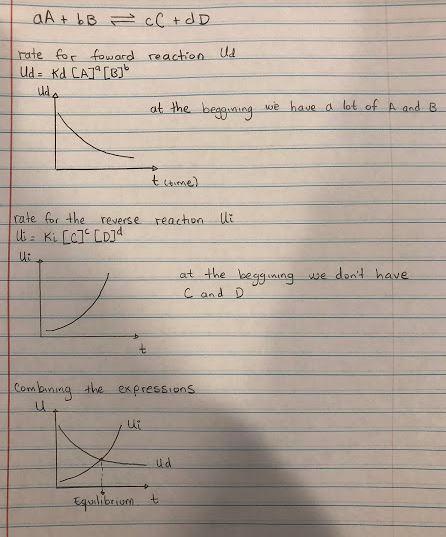
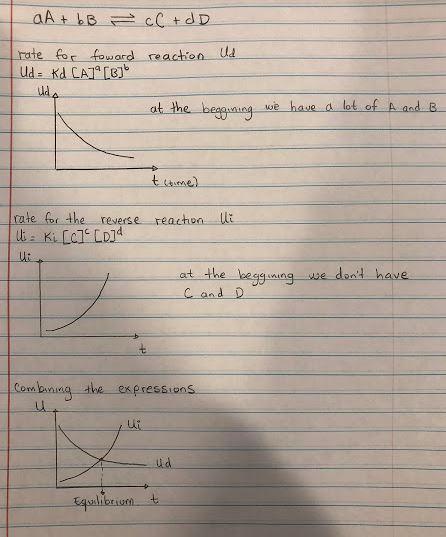
E. (False) The equilibrium is defined as the point where the rate of the forward reaction is the same to the rate of the reverse reaction. The value of K is telling you which reaction is favored but the rate of both reactions is the same in this point. (see picture)  

You might be interested in
Calculate the heat change in calories for melting 65 g of ice at 0 ∘c.
Genrish500 [490]

When ice melts, the physicals state changes from solid to liquid. The energy or the heat required (q) required to change a unit mass (m) of a substance from solid to liquid is known as the enthalpy or heat of fusion (ΔHf). The variables; q, m and ΔHf are related as:

q = m * ΔHf

the mass of ice m = 65 g

the heat of fusion of water at 0C = ΔHf = 334 J/g

Therefore: q = 65 g * 334 J/g = 21710 J

Now:

4.184 J = 1 cal

which implies that: 21710 J = 1 cal * 21710 J/4.184 J = 5188.8 cal

Hence the heat required is 5188.8 cal or 5.2 Kcal (approx)

5 0
2 years ago
The highest energy occupied molecular orbital in the f-f bond of the f2 molecule is _____
Morgarella [4.7K]
The basis of finding the answer to this problem is to know the electronic configuration of Fluorine. That would be: <span>[He] 2s</span>²<span> 2p</span>⁵. The valence electrons, which are the outermost electrons of the atom, are the ones that participate in bonding. <em>Since the highest orbital for F is 2p, that means the highest energy occupied would be 2.</em>
3 0
2 years ago
If an aqueous solution of urea n2h4co is 26% by mass and has density of 1.07 g/ml, calculate the molality of urea in the soln
Ksju [112]
Answer is: molality of urea is 5.84 m.

If we use 100 mL of solution:
d(solution) = 1.07 g/mL.
m(solution) = 1.07 g/mL · 100 mL.
m(solution) = 107 g.
ω(N₂H₄CO) = 26% ÷ 100% = 0.26.
m(N₂H₄CO) = m(solution) · ω(N₂H₄CO).
m(N₂H₄CO) = 107 g · 0.26.
m(N₂H₄CO) = 27.82 g.
1) calculate amount of urea:
n(N₂H₄CO) = m(N₂H₄CO) ÷ M(N₂H₄CO).
n(N₂H₄CO) = 27.82 g ÷ 60.06 g/mol.
n(N₂H₄CO) = 0.463 mol; amount of substance.
2) calculate mass of water:
m(H₂O) = 107 g - 27.82 g.
m(H₂O) = 79.18 g ÷ 1000 g/kg.
m(H₂O) = 0.07918 kg.
3) calculate molality:
b = n(N₂H₄CO) ÷ m(H₂O).
b = 0.463 mol ÷ 0.07918 kg.
b = 5.84 mol/kg.
5 0
2 years ago
Read 2 more answers
The three aspects of the measuring process are units, systems, and instruments.
lawyer [7]

Answer:

the answer for that is false

4 0
1 year ago
Read 2 more answers
Which of the following statements is true about energy quantization at the atomic level? Electrons in the outermost orbits are t
MAVERICK [17]
<h2>Answer:</h2>

The correct answer is option C which is, "Electrons in the orbit closest to the nucleus have the least amount of energy".

<h3>Explanation:</h3>
  • There are different orbitals around the nucleus on which the electrons moves around the nucleus.
  • These orbitals have a specific energy, due to which they are known as energy levels.
  • The energy level near to the nucleus has least amount of the energy and the energy of the orbitals increase as the distance of the orbitals increase to the nucleus.
8 0
2 years ago
Other questions:
  • Mr. martin's spanish class is 45 minutes long. if it starts at 3:30, what time does it end?
    5·1 answer
  • Two students are given different samples of a substance and are instructed to determine the properties of the substance. Which s
    7·2 answers
  • Give the nuclide symbol for an atom that has<br> mass number 64 and 35 neutrons.
    5·1 answer
  • Put the list in chronological order (1–5).
    7·2 answers
  • What is the concentration of an alcl3 solution if 150. ml of the solution contains 550. mg of cl- ion?
    15·1 answer
  • Which of the following does not participate in, nor is a component of, the electron transport chain? (Remember that molecules ca
    8·1 answer
  • A 0.1873 g sample of a pure, solid acid, H2X (a diprotic acid) was dissolved in water and titrated with 0.1052 M NaOH solution.
    9·1 answer
  • A chunk of ice breaks off a glacier and falls 30.0 m before it hits the water. Assuming it falls freely (there is no air resista
    9·1 answer
  • When filling a burette for a titration, adjust the burette so that______, preferably over a sink. Then,_______to add the titrant
    10·1 answer
  • Emma wants to go swimming the first day the pool opens in May, but she is worried it will be too cold since summer only just sta
    14·1 answer
Add answer
Login
Not registered? Fast signup
Signup
Login Signup
Ask question!