answer.
Ask question
Login Signup
Ask question
All categories
  • English
  • Mathematics
  • Social Studies
  • Business
  • History
  • Health
  • Geography
  • Biology
  • Physics
  • Chemistry
  • Computers and Technology
  • Arts
  • World Languages
  • Spanish
  • French
  • German
  • Advanced Placement (AP)
  • SAT
  • Medicine
  • Law
  • Engineering
Nadusha1986 [10]
2 years ago
5

Pipe Diameter and Reynolds Number. An oil is being pumped inside a 10.0-mm-diameter pipe at a Reynolds number of 2100. The oil d

ensity is 855 kg/m3 and the viscosity is 2.1 × 10⁻² Pa · s. What is the velocity in the pipe?It is desired to maintain the same Reynolds number of 2100 and the same velocity as in part (a) using a second fluid with a density of 925 kg/m3 and a viscosity of 1.5 × 10⁻² Pa · s. What pipe diameter should be used?
Engineering
1 answer:
alexdok [17]2 years ago
8 0

Answer:

The velocity in the pipe is 5.16m/s. The pipe diameter for the second fluid should be 6.6 mm.

Explanation:

Here the first think you have to consider is the definition of the Reynolds number (Re) for flows in pipes. Rugly speaking, the Reynolds number is an adimensonal parameter to know if the fliud flow is in laminar or turbulent regime. The equation to calculate this number is:

Re=\frac{\rho v D}{\mu}

where \rhois the density of the fluid, \mu is the viscosity, D is the pipe diameter and v is the velocity of the fluid.

Now, we know that Re=2100. So the velocity is:

v=\frac{Re*\mu}{\rho*D} =\frac{2100*2.1x10^{-2}Pa*s }{855kg/m^3*0.01m} =5.16m/s

For the second fluid, we want to keep the Re=2100 and v=5.16m/s. Therefore, using the equation of Reynolds number the diameter is:

D=\frac{Re*\mu}{\rho*v} =\frac{2100*1.5x10^{-2}Pa*s}{925kg/m^3*5.16m/s}=6.6 mm

You might be interested in
Q4. What happen when a steady potential is connected across the end points of the [3] conductor? Illustrate with an example.
den301095 [7]

Answer: Flow of current and the resistance to the flow of the current.

Explanation:

When a steady potential is connected across the end points of the conductor, there will be a of current through the conductor and the internal resistance in the conductor will tend to resist the flow of the current

A good example is a simple circuit comprises of a battery, wires and a touch bulb.

When the battery is connected to the two ends of the torch bulb, current flow through and the bulb is lit up.

4 0
2 years ago
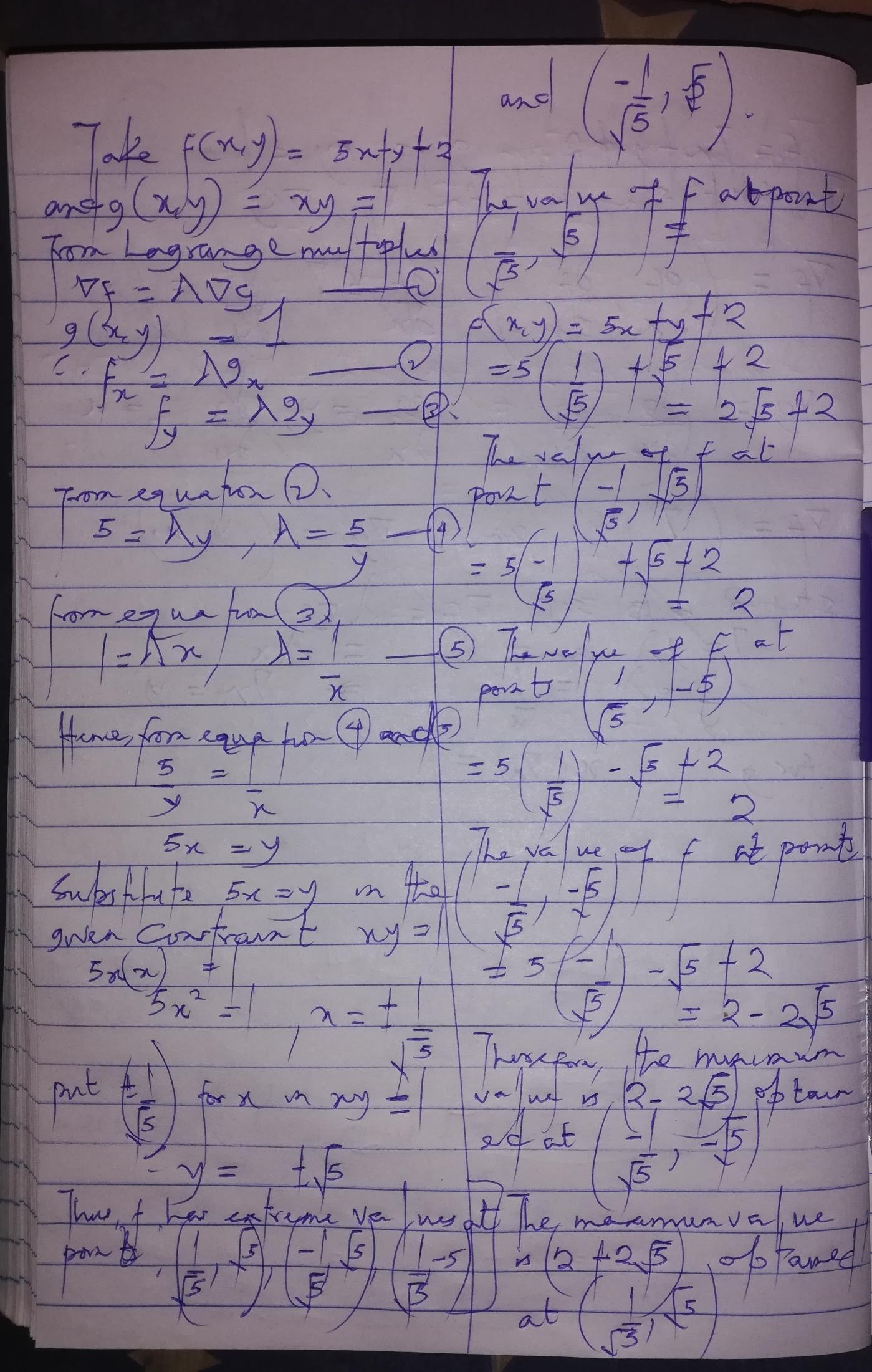
Use Lagrange multiplier techniques to find the local extreme values of the given function subject to the stated constraint. If a
Leno4ka [110]

Answer:

Explanation:

Given f(x, y) = 5x + y + 2 and g(x, y) = xy = 1

The step by step calculation and appropriate substitution is clearly shown in the attached file.

5 0
2 years ago
air at 600 kPa, 330 K enters a well-insulated, horizontal pipe having a diameter of 1.2 cm and exits at 120 kPa, 300 K. Applying
notsponge [240]

Answer:

a) 251.31 m/s and 55.29 m/s

b) The mass flow rate is 0.0396 kg/s

c) The rate of entropy production is 0.0144 kW/K

Explanation:

a) The steady state is:

mi = mo

\frac{A_{i}V_{i}  }{v_{i} } =\frac{A_{o}V_{o}  }{v_{o} } \\V_{i} =V_{o}(\frac{v_{i}}{v_{o}} )=V_{o}(\frac{T_{i}P_{o} }{T_{o}P_{i} } )=V_{o}(\frac{330*120}{300*600}) =0.22V_{o}

The energy balance is:

h_{i}+\frac{V_{i}^{2} }{2} =h_{2}+\frac{V_{o}^{2} }{2} \\h_{i}-h_{o}+(\frac{V_{i}^{2}-V_{o}^{2}  }{2} )=0\\V_{o}=\sqrt{\frac{2(h_{i}-h_{o})}{0.9516} } =\sqrt{\frac{2*(330.24-300.19)x10^{3} }{0.9516} } =251.31m/s

Vi = 0.22 * 251.31 = 55.29 m/s

b) The mass flow rate is:

m=\frac{A_{o}V_{o}}{v_{o}} =\frac{\pi d^{2}V_{o}P_{o} }{4RT_{o}} =\frac{\pi *(0.012^{2})*251.31*120x10^{3}  }{4*287*300} =0.0396kg/s

c) The entropy produced is equal to:

\frac{Q}{T} +S_{gen} =m(s_{2} -s_{1} )\\0+S_{gen} =m(s_{2} -s_{1} )\\S_{gen} =m(s_{2} -s_{1} )\\S_{gen}=0.0396*(c_{p} ln\frac{T_{o}}{T_{i}} -Rln\frac{P_{o}}{P_{i}} )=0.0396*(1.004ln\frac{300}{330} -0.287ln\frac{120}{600} )=0.0144kW/K

3 0
2 years ago
A converging-diverging nozzle is designed to operate with an exit Mach number of 1.75 . The nozzle is supplied from an air reser
Flura [38]

Answer:

a. 4.279 MPa

b. 3.198 MPa to 4.279 MPa

c. 0.939 MPa

d. Below 3.198 MPa

Explanation:

From the given parameters

M_{exit} = 1.75 MPa  

M at 1.6 MPa gives A_{exit}/A* = 1.2502

M at 1.8 MPa gives  A_{exit}/A* = 1.4390

Therefore, by interpolation, we have M_{exit} = 1.75 MPa  gives A

However, we shall use M_{exit} = 1.75 MPa and A

Similarly,

P_{exit}/P₀ = 0.1878

a) Where the nozzle is choked at the throat there is subsonic flow in the following diverging part of the nozzle. From tables, we have

A_{exit}/A* = 1.387. by interpolation M

Therefore P_{exit} = P₀ × P

Which shows that the nozzle is choked for back pressures lower than 4.279 MPa

b) Where there is a normal shock at the exit of the nozzle, we have;

M₁ = 1.75 MPa, P₁ = 0.1878 × 5 = 0.939 MPa

Where the normal shock is at M₁ = 1.75 MPa, P₂/P₁ = 3.406

Where the normal shock occurs at the nozzle exit, we have

P_b = 3.406\times 0.939 = 3.198 MPa

Where the shock occurs t the section prior to the nozzle exit from the throat, the back pressure was derived as P_b = 4.279 MPa

Therefore the back pressure value ranges from 3.198 MPa to 4.279 MPa

c) At M_{exit} = 1.75 MPa  and P

d) Where the back pressure is less than 3.198 MPa according to isentropic flow relations supersonic flow will exist at the exit plane    

8 0
2 years ago
A cylindrical specimen of a brass alloy having a length of 60 mm (2.36 in.) must elongate only 10.8 mm (0.425 in.) when a tensil
Gemiola [76]

The radius of the specimen is 60 mm

<u>Explanation:</u>

Given-

Length, L = 60 mm

Elongated length, l = 10.8 mm

Load, F = 50,000 N

radius, r = ?

We are supposed to calculate the radius of a cylindrical brass specimen in order to produce an elongation of 10.8 mm when a load of 50,000 N is applied. It is necessary to compute the strain corresponding to this

elongation using Equation:

ε = Δl / l₀

ε = 10.8 / 60

ε = 0.18

We know,

σ = F / A

Where A = πr²

According to the stress-strain curve of brass alloy,

σ = 440 MPa

Thus,

sigma = 50,000 / \pi  (r)^2\\\\440 X 10^6 = \frac{50,000}{3.14 X (r)^2}\\\\r = 0.06m\\r = 60mm\\\\\\

Therefore, the radius of the specimen is 60 mm

3 0
2 years ago
Other questions:
  • Define a) Principal Plane b) Principal Stress c) anelasticity d) yield point e) ultimate tensile stress f) hardness g) toughness
    5·1 answer
  • Water at 400 kPa with a quality of 75% has its pressure raised 200 kPa (to 600 kPa) in a constant volume process. What is the ne
    15·1 answer
  • The wall of drying oven is constructed by sandwiching insulation material of thermal conductivity k = 0.05 W/m°K between thin me
    8·1 answer
  • Water is the working fluid in an ideal Rankine cycle. The condenser pressure is 8 kPa, and saturated vapor enters the turbine at
    10·1 answer
  • 4.9 Given that I 4 amps when Vs 40 volts and Is 4 amps and I 1 amp when Vs 20 volts and Is 0, use superposition and linearity to
    5·1 answer
  • A thin-walled tube with a diameter of 12 mm and length of 25 m is used to carry exhaust gas from a smoke stack to the laboratory
    7·1 answer
  • Define initial set and final set. Briefly discuss one method used to determine them. The following laboratory tests are performe
    12·1 answer
  • Anytime scaffolds are assembled or __________, a competent person must oversee the operation.
    15·2 answers
  • You are the scheduler for a large commercial building project. The schedule that you prepared (based on feedback from the projec
    7·1 answer
  • Use the drop -down menus to select the appropriate question type. Picking between two possible alternatives: Showing an understa
    7·1 answer
Add answer
Login
Not registered? Fast signup
Signup
Login Signup
Ask question!