answer.
Ask question
Login Signup
Ask question
All categories
  • English
  • Mathematics
  • Social Studies
  • Business
  • History
  • Health
  • Geography
  • Biology
  • Physics
  • Chemistry
  • Computers and Technology
  • Arts
  • World Languages
  • Spanish
  • French
  • German
  • Advanced Placement (AP)
  • SAT
  • Medicine
  • Law
  • Engineering
harina [27]
2 years ago
3

An monatomic ideal gas at 300 K has a volume of 15 liters at a pressure of 15 atm. Calculate a. The final volume of the system b

. The work done by the system c. The heat entering or leaving the system d. The change in the internal energy e. The change in the enthalpy when the gas undergoes i. A reversible isothermal expansion to a pressure of 10 atm ii. A reversible adiabatic expansion to a pressure of 10 atm The constant-volume molar heat capacity of the gas, Cy, has the value 1.5 R.
Chemistry
1 answer:
Neporo4naja [7]2 years ago
3 0

Answer:

i) a) V2 = 22.5 L

b) W = 9249.451 J

c) Q = - 9249.451 J

d) ΔU = 0 J/mol

e) ΔH = 0 J/mol

ii) a) V2 = 19.154 L

b) W = 3390.346 J

c) Q = 0 J

d) ΔU = - 562.124 J/mol

e) ΔH = - 936.884 J/mol

Explanation:

an monoatomic ideal gas:

∴ PV = RTn

contants molar heat capacity:

∴ Cp,n = 2.5 R

∴ Cv,n = 1.5 R

i) a reversible isothermal expansion:

∴ T1 = T2 = 300 K

∴ P1 = 15 atm

∴ V1 = 15 L

∴ P2 = 10 atm

⇒ n = P1V1 / RT1 = ((15)*(15)) / ((0.082)*(300)) = 9.146 mol

a) V2 = RT2n/P2 = ((0.082)*(300)*(9.146)) / 10 = 22.5 L

b) W = nRT Ln (P1/P2)

⇒ W = (9.146)*(8.314)*(300) Ln(15/10)

⇒ W = 9249.451 J

c) Q = - W = - 9249.451 J

d) ΔU = CvΔT

∴ ΔT = 0

⇒ ΔU = 0

e) H = U + PV.....ideal gas

⇒ ΔH = ΔU + ΔPV = 0 + (P1V1 - P2V2) = 0 + 0 = 0

ii) a reversible adiabatic expansion:

∴ P2 = 10 atm

a) P1(V1)∧γ = P2(V2)∧γ....reversible adiabatic

∴ γ = Cp,n / Cv,n = 2.5R / 1.5R = 1.666

⇒ (V2)∧γ = ((15)(15)∧γ) / 10

⇒ (V2)∧γ = 136.849

⇒ V2 = ( 136.849 )∧(1/1.666)

⇒ V2 = 19.154 L

b) W = P1V1 - P2V2

⇒ W = ((15)*(15)) - ((10)*(19.154)) = 225 - 191.54 = 33.46 atm.L

⇒ W = 33.46 atm.L * (Pa/9.8692 E-6atm) * (m³/1000L) = 3390.346 Pa.m³

⇒ W = 3390.346 J

c) Q = 0 J...adiabatic

d) ΔU = Cv,n*ΔT

∴ T2/T1 = (V1/V2)∧(R/Cv,n)

⇒ T2 = T1 * [ (V1/V2)∧(R/Cv,n) ]

∴R/Cv,n = R/1.5R = 1/1.5= 0.666

⇒ T2 = 300K * [(15/19.154)∧(0.666)]

⇒ T2 = 254.925 K

⇒ ΔU = Cv,n*ΔT = 1.5*(8.314)*(254.925 - 300) = - 562.124 J/mol

e) ΔH = ∫Cp,n*δT  = Cp,n*ΔT.....constant  molar heat capacity

⇒ ΔH = 2.5*(8.314)*(254.925 - 300) = - 936.884 J/mol

You might be interested in
22. How many atoms are there in 344.75 g of gold nugget? a. 1.05 x 10 to the power of 24 atoms b. 1.05 x 10 to the power of 23 a
mixas84 [53]

Answer:

1.053×10²⁴ atoms of gold

Explanation:

Hello,

Gold nugget are usually the natural occurring gold and they contain 85% - 90% weight of pure gold.

In this question, we're required to find the number of atoms in 344.75g of a gold nugget.

We can use mole concept relationship between Avogadro's number and molar mass.

1 mole = molar mass

Molar mass of gold = 197 g/mol

1 mole = Avogadro's number = 6.022 × 10²³ atoms

Number of mole = mass / molar mass

Mass = number of mole × molar mass

Mass = 1 × 197

Mass = 197g

197g is present in 6.022×10²³ atoms

344.75g will contain x atoms

x = (344.75 × 6.022×10²³) / 197

X = 1.053×10²⁴ atoms

Therefore 344.75g of gold nugget will contain 1.053×10²⁴ atoms of gold

5 0
2 years ago
A mysterious white powder could be powdered sugar (C12H22O11), cocaine (C17H21NO4), codeine (C18H21NO3), norfenefrine (C8H11NO2)
rodikova [14]

Norfenefrine (C₈H₁₁NO₂).

<h3>Further explanation</h3>

We will solve a case related to one of the colligative properties, namely freezing point depression.

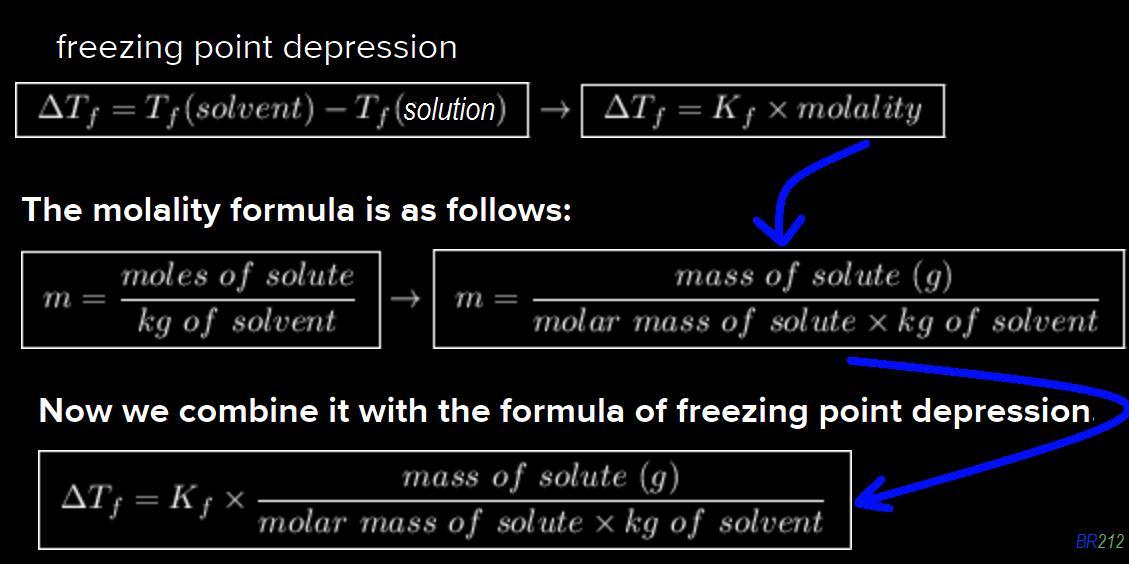
The freezing point of the solution is the temperature at which the solution begins to freeze. The difference between the freezing point of the solvent and the freezing point of the solution is called freezing point depression.

\boxed{ \ \Delta T_f = T_f(solvent) - T_f(solution) \ } \rightarrow \boxed{ \ \Delta T_f = K_f \times molality \ }

<u>Given:</u>

A mysterious white powder could be,

  • powdered sugar (C₁₂H₂₂O₁₁) with a molar mass of 342.30 g/moles,
  • cocaine (C₁₇H₂₁NO₄) with a molar mass of 303.35 g/moles,
  • codeine (C₁₈H₂₁NO₃) with a molar mass of 299.36 g/moles,
  • norfenefrine (C₈H₁₁NO₂) with a molar mass of 153.18 g/moles, or
  • fructose (C₆H₁₂O₆) with a molar mass of 180.16 g/moles.

When 82 mg of the powder is dissolved in 1.50 mL of ethanol (density = 0.789 g/cm³, normal freezing point −114.6°C, Kf = 1.99°C/m), the freezing point is lowered to −115.5°C.

<u>Question: </u>What is the identity of the white powder?

<u>The Process:</u>

Let us identify the solute, the solvent, initial, and final temperatures.

  • The solute = the powder
  • The solvent = ethanol
  • The freezing point of the solvent = −114.6°C
  • The freezing point of the solution = −115.5°C

Prepare masses of solutes and solvents.

  • Mass of solute = 82 mg = 0.082 g
  • Mass of solvent = density x volume, i.e., \boxed{ \ 0.789 \ \frac{g}{cm^3} \times 1.50 \ cm^3 = 1.1835 \ g = 0.00118 \ kg  \ }

We must prepare the solvent mass unit in kg because the unit of molality is the mole of the solute divided by the mass of the solvent in kg.

The molality formula is as follows:

\boxed{ \ m = \frac{moles \ of \ solute}{kg \ of \ solvent} \ } \rightarrow \boxed{ \ m = \frac{mass \ of \ solute \ (g)}{molar \ mass \ of \ solute \times kg \ of \ solvent} \ }

Now we combine it with the formula of freezing point depression.

\boxed{ \ \Delta T_f =  K_f \times \frac{mass \ of \ solute \ (g)}{molar \ mass \ of \ solute \times kg \ of \ solvent} \ }

It is clear that we will determine the molar mass of the solute (denoted by Mr).

We enter all data into the formula.

\boxed{ \ -114.6^0C - (-115.5^0C) = 1.99 \frac{^0C}{m} \times \frac{0.082 \ g}{Mr \times 0.00118 \ kg} \ }

\boxed{ \ 0.9 = \frac{1.99 \times 0.082}{Mr \times 0.00118} \ }

\boxed{ \ Mr = \frac{0.16318}{0.9 \times 0.00118} \ }

We get \boxed{ \ Mr = 153.65 \ }

These results are very close to the molar mass of norfenefrine which is 153.18 g/mol. Thus the white powder is norfenefrine.

<h3>Learn more</h3>
  1. The molality and mole fraction of water brainly.com/question/10861444
  2. About the mass and density of ethylene glycol as an  antifreeze brainly.com/question/4053884
  3. About the solution as a homogeneous mixture  brainly.com/question/637791

Keywords: a mysterious white powder, sugar, cocaine, codeine, norfenefrine, fructose, the solute, the solvent, dissolved, ethanol, normal freezing point, the freezing point depression, the identity

7 0
2 years ago
Read 2 more answers
You have 49.8 g of O2 gas in a container with twice the volume as one with CO2 gas. The pressure and temperature of both contain
IrinaVladis [17]

Answer:

34.2 g is the mass of carbon dioxide gas one have in the container.

Explanation:

Moles of O_2:-

Mass = 49.8 g

Molar mass of oxygen gas = 32 g/mol

The formula for the calculation of moles is shown below:

moles = \frac{Mass\ taken}{Molar\ mass}

Thus,

Moles= \frac{49.8\ g}{32\ g/mol}

Moles_{O_2}= 1.55625\ mol

Since pressure and volume are constant, we can use the Avogadro's law  as:-

\frac {V_1}{n_1}=\frac {V_2}{n_2}

Given ,  

V₂ is twice the volume of V₁

V₂ = 2V₁

n₁ = ?

n₂ = 1.55625 mol

Using above equation as:

\frac {V_1}{n_1}=\frac {V_2}{n_2}

\frac {V_1}{n_1}=\frac {2\times V_1}{1.55625}

n₁ = 0.778125 moles

Moles of carbon dioxide = 0.778125 moles

Molar mass of CO_2 = 44.0 g/mol

Mass of CO_2 = Moles × Molar mass = 0.778125 × 44.0 g = 34.2 g

<u>34.2 g is the mass of carbon dioxide gas one have in the container.</u>

5 0
2 years ago
Modern commercial airliners are largely made of aluminum, a light and strong metal. But the fact that aluminum is cheap enough t
Dafna11 [192]

Answer:

The plane with aluminium can lift more mass of passangers than the plane of steel.

Explanation:

The total mass the airplane canc lift is:

m_{tot}=m_{fuselage}+m_{passangers}

For aluminium:

m_{tot}=m_{fus-Al}+m_{pas-Al}

m_{fus-Al}=\delta _{Al}*V_{fuselage}

and

V_{fuselage}=\frac{\pi *L}{4}*[D^2-(D-e)^2]

where:

  • L is lenght
  • D is diameter
  • e is thickness

m_{tot}=\delta _{Al}*\frac{\pi *L}{4}*[D^2-(D-e)^2]+m_{pas-Al}

For steel (same procedure):

m_{tot}=\delta _{Steel}*\frac{\pi *L}{4}*[D^2-(D-e)^2]+m_{pas-Steel

Knowing that the total mass the airplane can lift is constant and that aluminum has a lower density than the steel, we can afirm that the plane with aluminium can lift more mass of passangers.

Also you can estimate an average weight of passanger to estimate a number of passangers it can lift.

5 0
2 years ago
Suppose there is 0.63 g of HNO3 per 100 mL of a particular solution. What is the concentration of the HNO3 solution in moles per
Vadim26 [7]

Answer:

There are 0.09996826 moles per liter of the solution.

Explanation:

Molar mass of HNO3: 63.02

Convert grams to moles

0.63 grams/ 63.02= 0.009996826

Convert mL to L and place under moles (mol/L)

100mL=0.1 L

0.009996826/0.1= 0.09996826 mol/L

4 0
2 years ago
Other questions:
  • According to reference table J, which of these metals would react most readily with 1.0 M HCl to produce H2(g)
    10·1 answer
  • What does the chemical formula cacl2 show about the compound it represents? The person who answered this question first was wron
    12·2 answers
  • How many moles of libr are contained in 347 g of water in a 0.175 m libr solution?
    7·1 answer
  • How does a conductivity apparatus test whether a solution has ionic or covalent substances in it? It fails to light up except in
    8·2 answers
  • The structure of carbonic acid, an important component of ocean chemistry, is depicted below. What type of model best describes
    10·2 answers
  • Please use the E/Z notation when specifying stereochemistry remembering to use parentheses and a dash. Reminder - the double bon
    5·1 answer
  • 1. What is the significance of understanding the characteristics of the earth? essay​
    8·1 answer
  • A student noticed a yellow, solid substance was formed when mixing two clear liquids during a lab. What term describes this yell
    11·1 answer
  • Calculate the number of total atoms in 195 grams of Ni(OH)2. Use 6.022x10^23mol-1 for Avogadro’a number
    10·1 answer
  • What is the lewis structure for RnF2
    12·1 answer
Add answer
Login
Not registered? Fast signup
Signup
Login Signup
Ask question!