answer.
Ask question
Login Signup
Ask question
All categories
  • English
  • Mathematics
  • Social Studies
  • Business
  • History
  • Health
  • Geography
  • Biology
  • Physics
  • Chemistry
  • Computers and Technology
  • Arts
  • World Languages
  • Spanish
  • French
  • German
  • Advanced Placement (AP)
  • SAT
  • Medicine
  • Law
  • Engineering
Mandarinka [93]
2 years ago
8

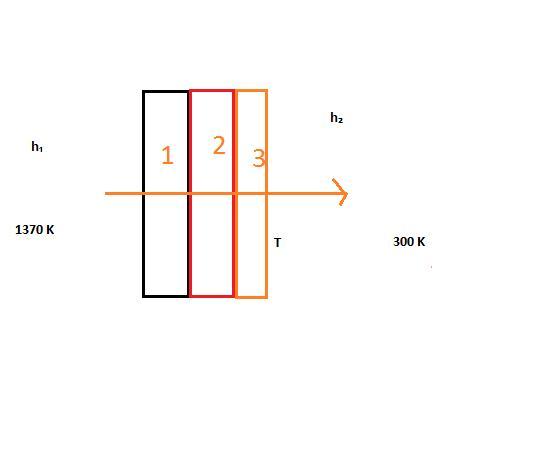
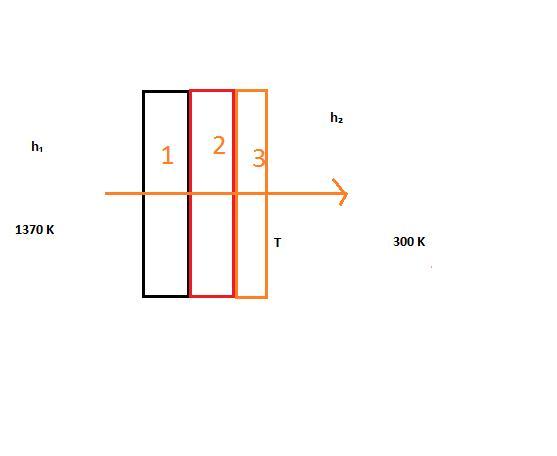
A furnace wall consisting of 0.25 m of fire clay brick, 0.20 m of kaolin, and a 0.10‐m outer layer of masonry brick is exposed t

o furnace gas at 1370 K with air at 300 K adjacent to the outside wall. The inside and outside convective heat‐transfer coefficients are 115 and 23 W/m2 ⋅ K, respectively. Determine the heat loss per square foot of wall and the temperature of the outside wall surface under these conditions.

Engineering
1 answer:
dalvyx [7]2 years ago
4 0

Answer:

q=1910.71 W/m²

T=383.07 K

Explanation:

Given that

L₁=0.25 m  ,K₁=1.13 W/(m.K)

L₂=0.2 m   ,  K₂=1.45 W/(m.K)

L₃= 0.1 m   , K₃=0.66 W/(m.K)

h₁=115 W/(m².K)

h₂=23 W/(m².K)

The total thermal resistance

R=\dfrac{L_1}{K_1A}+\dfrac{L_2}{K_2A}+\dfrac{L_3}{K_3A}+\dfrac{1}{h_1A}+\dfrac{1}{h_2A}\ K/W

Now by putting the values

Put A= 1 m²      ( To find heat transfer per unit area)

R=\dfrac{L_1}{K_1A}+\dfrac{L_2}{K_2A}+\dfrac{L_3}{K_3A}+\dfrac{1}{h_1A}+\dfrac{1}{h_2A}\ K/W

R=\dfrac{0.25}{1.13}+\dfrac{0.2}{1.45}+\dfrac{0.1}{0.66}+\dfrac{1}{115}+\dfrac{1}{23}\ K/W

R= 0.56 K/W

We know that

q= ΔT/R

Here  ΔT = 1370 - 300 K =1070 K

Now by putting the values

q= 1070/0.56

q=1910.71 W/m²

Lets T is the outside surface temperature

q = h₂ ( T- 300)

Now by putting the values

1910.71 = 23 ( T- 300)

T=383.07 K

You might be interested in
Poles are values of Laplace transform variable, s, that make denominator of transfer function zero. Zeros are values of Laplace
Ostrovityanka [42]

Answer:

Zero 1 = -1

Zero 2 = -3

Pole 1 = 0

Pole 2 = -2

Pole 3 = -4

Pole 4 = -6

Gain = 4

Explanation:

For any given transfer function, the general form is given as

T.F = k [N(s)] ÷ [D(s)]

where k = gain of the transfer function

N(s) is the numerator polynomial of the transfer function whose roots are the zeros of the transfer function.

D(s) is the denominator polynomial of the transfer function whose roots are the poles of the transfer function.

k [N(s)] = 4s² + 16s + 12 = 4[s² + 4s + 3]

it is evident that

Gain = k = 4

N(s) = (s² + 4s + 3) = (s² + s + 3s + 3)

= s(s + 1) + 3 (s + 1) = (s + 1)(s + 3)

The zeros are -1 and -3

D(s) = s⁴ + 12s³ + 44s² + 48s

= s(s³ + 12s² + 44s + 48)

= s(s + 2)(s + 4)(s + 6)

The roots are then, 0, -2, -4 and -6.

Hope this Helps!!!

3 0
2 years ago
A fatigue test was conducted in which the mean stress was 46.2 MPa and the stress amplitude was 219 MPa.
sleet_krkn [62]

Answer:

a)σ₁ = 265.2 MPa

b)σ₂ = -172.8 MPa

c)Stress\ ratio =-0.65

d)Range = 438 MPa

Explanation:

Given that

Mean stress ,σm= 46.2 MPa

Stress amplitude ,σa= 219 MPa

Lets take

Maximum stress level = σ₁

Minimum stress level =σ₂

The mean stress given as

\sigma_m=\dfrac{\sigma_1+\sigma_2}{2}

2\sigma_m={\sigma_1+\sigma_2}

2 x 46.2 =  σ₁ +  σ₂

 σ₁ +  σ₂ = 92.4 MPa    --------1

The amplitude stress given as

\sigma_a=\dfrac{\sigma_1-\sigma_2}{2}

2\sigma_a={\sigma_1-\sigma_2}

2 x 219 =  σ₁ -  σ₂

 σ₁ -  σ₂ = 438 MPa    --------2

By adding the above equation

2  σ₁ = 530.4

σ₁ = 265.2 MPa

-σ₂ = 438 -265.2 MPa

σ₂ = -172.8 MPa

Stress ratio

Stress\ ratio =\dfrac{\sigma_{min}}{\sigma_{max}}

Stress\ ratio =\dfrac{-172.8}{265.2}

Stress\ ratio =-0.65

Range = 265.2 MPa - ( -172.8 MPa)

Range = 438 MPa

8 0
2 years ago
The extruder head in a fused- deposition modeling setup has a diameter of 1.25 mm (0.05 in) and produces layers that are 0.25mm
Angelina_Jolie [31]

Answer:

The time taken will be "1 hour 51 min". The further explanation is given below.

Explanation:

The given values are:

Number of required layers:

= \frac{38}{0.25}

= 152 \ layers

Diameter (d):

= 1.25 mm

Velocity (v):

= 40 mm/s

Now,

The area of one layer will be:

= 38\times 38 \ mm^2

= 1444 \ mm^2

The area covered every \second will be:

= d\times v

= 1.25\times 40

= 50 \ mm^2

The time required to deposit one layer will be:

= \frac{1444}{50}

= 28.88 \ sec

The time required for one layer will be:

= 15 \ sec

∴ Total times required for one layer will be:

= 15+28.88

= 43.88 \ sec

So,

Number of layers = 152

Therefore,

Total time will be:

= 152\times 43.88

= 6669.76 \ sec

= 1 \ hour \ 51 \ min

6 0
2 years ago
All of these are true about GMA (MIG) welding EXCEPT that:
Hatshy [7]

Answer:

the welding gun liner regulates the shielding gas.

Explanation:

The purpose of the welding gun liner is to properly position the welding wire from the wire feeder till it gets to the nozzle or contact tip of the gun. <em>Regulation of the shielding gas depends on factors such as the speed, current, and type of gas being used. </em>In gas metal arc welding, an electric arc is used to generate heat which melts both the electrode and the workpiece or base metal.

The electric arc produced is shielded from contamination by the shielding gas. The heat generated by the short electric arc is low.

3 0
1 year ago
1.00-L insulated bottle is full of tea at 90.08°C. You pour out one cup of tea and immediately screw the stopper back on the bot
liberstina [14]

Answer:

T_{f} = 90.07998 ° C

Explanation:

This is a calorimetry process where the heat given by the Te is absorbed by the air at room temperature (T₀ = 25ºC) with a specific heat of 1,009 J / kg ºC, we assume that the amount of Tea in the cup is V₀ = 100 ml. The bottle being thermally insulated does not intervene in the process

                 Qc = -Qb

                M c_{e_Te} (T₁ -T_{f}) = m c_{e_air} (T_{f}-T₀)

Where M is the mass of Tea that remains after taking out the cup, the density of Te is the density of water plus the solids dissolved in them, the approximate values are from 1020 to 1200 kg / m³, for this calculation we use 1100 kg / m³

   ρ = m / V  

   V = 1000 -100 = 900 ml  

   V = 0.900 l (1 m3 / 1000 l) = 0.900 10⁻³ m³  

   V_air = 0.100 l = 0.1 10⁻³ m³  

Tea Mass  

     M = ρ V_te  

     M = 1100 0.9 10⁻³  

     M = 0.990 kg  

Air mass  

     m = ρ _air V_air  

     m = 1.225 0.1 10⁻³  

     m = 0.1225 10⁻³ kg  

(m c_{e_air} + M c_{e_Te}) T_{f}. = M c_{e_Te} T1 - m c_{e_air} T₀  

T_{f} = (M c_{e_Te} T₁ - m c_{e_air} T₀) / (m c_{e_air} + M c_{e_Te})  

Let's calculate  

T_{f} = (0.990 1100 90.08– 0.1225 10⁻³ 1.225 25) / (0.1225 10⁻³ 1.225 + 0.990 1100)  

T_{f} = (98097.12 -3.75 10⁻³) / (0.15 10⁻³ +1089)  

T_{f} = 98097.11 / 1089.0002  

T_{f} = 90.07998 ° C  

This temperature decrease is very small and cannot be measured
3 0
2 years ago
Other questions:
  • Compute the mass fractions of α ferrite and cementite in pearlite. Assume T=726⁢ C∘.
    15·1 answer
  • A cylindrical drum (2 ft. dia ,3 ft height) is filled with a fluid whose density is 40 lb/ft^3. Determine (a. the total volume o
    10·1 answer
  • A system consisting of 3 lb of water vapor in a piston–cylinder assembly, initially at 350°F and a volume of 71.7 ft3, is expand
    11·1 answer
  • 5. A typical paper clip weighs 0.59 g and consists of BCC iron. Calculate (a) the number of
    5·1 answer
  • The components of an electronic system dissipating 90 W are located in a 1-m-long circular horizontal duct of 15-cm diameter. Th
    11·1 answer
  • - Consider a 2024-T4 aluminum material with ultimate tensile strength of 70 ksi. In a given application, a component of this mat
    7·1 answer
  • Benzene vapor at 480°C is cooled and converted to a liquid at 25°C in a continuous condenser. The condensate is drained into 1.7
    15·1 answer
  • Identify the four engineering economy symbols and their values from the following problem statement. Use a question mark with th
    10·1 answer
  • A three-phase line has an impedance of 0.4 j2.7 ohms per phase. The line feeds two balanced three-phase loads that are connected
    9·1 answer
  • Question 14<br> Which of these is true of a spray wash cabinet?
    6·1 answer
Add answer
Login
Not registered? Fast signup
Signup
Login Signup
Ask question!