answer.
Ask question
Login Signup
Ask question
All categories
  • English
  • Mathematics
  • Social Studies
  • Business
  • History
  • Health
  • Geography
  • Biology
  • Physics
  • Chemistry
  • Computers and Technology
  • Arts
  • World Languages
  • Spanish
  • French
  • German
  • Advanced Placement (AP)
  • SAT
  • Medicine
  • Law
  • Engineering
arsen [322]
2 years ago
12

A smoking lounge is to accommodate 13 heavy smokers. The minimum fresh air requirement for smoking lounges is specified to be 30

L/s per person (ASHRAE, Standard 62, 1989). Determine the minimum required flow rate of fresh air that needs to be supplied to the lounge and the diameter of the duct if the air velocity is not to exceed 8 m/s
Engineering
1 answer:
n200080 [17]2 years ago
4 0

Answer:

The minimum required flow rate of fresh air that needs to be supplied to the lounge is 390L/s.

The diameter of the duct mus be of 24.9cm at least if thte air velocity is not to exceed 8m/s.

Explanation:

First, in order to find the minimum required flow rate of fresh air, we need to take the ASHRAE standard and multiply it by the number of heavy smokers, so we get:

V'=30\frac{L}{s-persons}*13persons=390\frac{L}{s}

This value can be converted to m^{3}/s

390\frac{L}{s}*\frac{1000cm^{3}}{1L}*\frac{1m^{3}}{(100cm)^{3}}=0.39m^{3}/s

Once we got this value we use the volumetric flow formula, which tells us that:

V'=Av

where A is the area of the duct and v is the velocity of the air flow.

We also know that:

A=\frac{\pi d^{2}}{4}

so we can substitute that into our equation, so we get:

V'=\frac{\pi d^{2}}{4}v

which can be solved for the diameter, which yields:

d=\sqrt{\frac{4V'}{\pi v}}

and we can next substitute the values the problem provides us with:

d=\sqrt{\frac{4()0.39m^{3}/s}{\pi (8m/s)}}=0.249m

so the duct must have a diameter of at least 24.9cm for the velocity not to exceed 8m/s.

You might be interested in
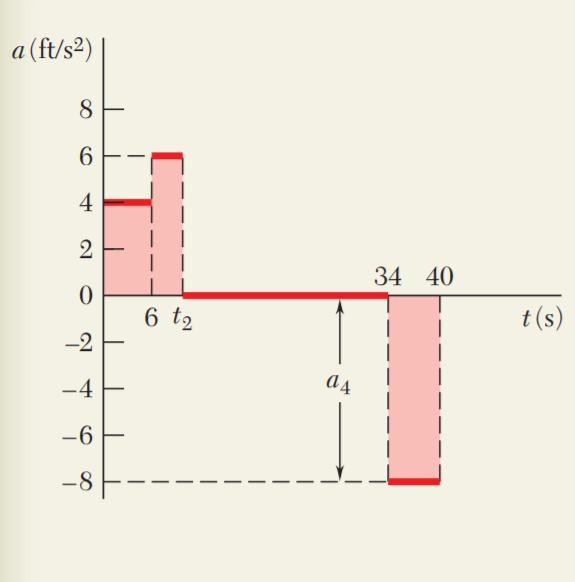
A subway car leaves station A; it gains speed at the rate of 4 ft/s^2 for of until it has reached and then at the rate 6 then th
salantis [7]

Answer:

See attachment

1512 ft

Explanation:

Since the acceleration is either constant or zero,  the a−t curve is made of horizontal straight-line segments. The values of t2  and a4 are determined as follows:

Acceleration - Time

0 < t < 6: Change in v = area under a–t curve

V_6 - 0 =  (6 s)(4 ft/s2 ) = 24 ft/s

6 < t < t2: Since the velocity increases from 24 to 48 ft/s,

Change in v = area under a–t curve

48 - 24 = (t2 - 6) * 6

t2 = 10 s

t2 < t < 34: Since the velocity is constant, the acceleration is zero.

34 < t < 40: Change in v = area under a–t curve

0 - 42 = 6*a4

a4 = - 8 ft / s^2

The acceleration being negative, the corresponding area is below the t axis;  this area represents a decrease in velocity.

Velocity - Time

Since the acceleration is either constant or zero, the  v−t curve is made of straight-line segments connecting the points determined above.

Change in x = area under v−t curve

0 < t < 6:     x6 - 0 = 0.5*6*24 = 72 ft

6 < t < 10:    x10 - x6 = 0.5*4*(24 + 48) = 144 ft

10 < t < 34:     x34 - x10 = 48*24 = 1152 ft

34 < t < 40:     x40 - x34 = 0.5*6*48 = 144 ft

Adding the changes in x, we obtain the distance from A to B:

d = x40 - 0 = 1512 ft

8 0
2 years ago
) A given system has four sensors that can produce an output of 0 or 1. The system operates properly when exactly one of the sen
Rashid [163]
A given system has four sensors that can produce an output of 0 or 1. The system operates proper . An alarm must be raised when two or more sensors have the output of 1. Design the simplest circuit that can be used to raise the alarm ly when exactly one of the sensors has its output equal to Repeat problem #4 for a system that has 7 sensors. Hint: Before you slog through a truth table with 128 rows in it, think about whether SOP or POS might be a better approach.
7 0
2 years ago
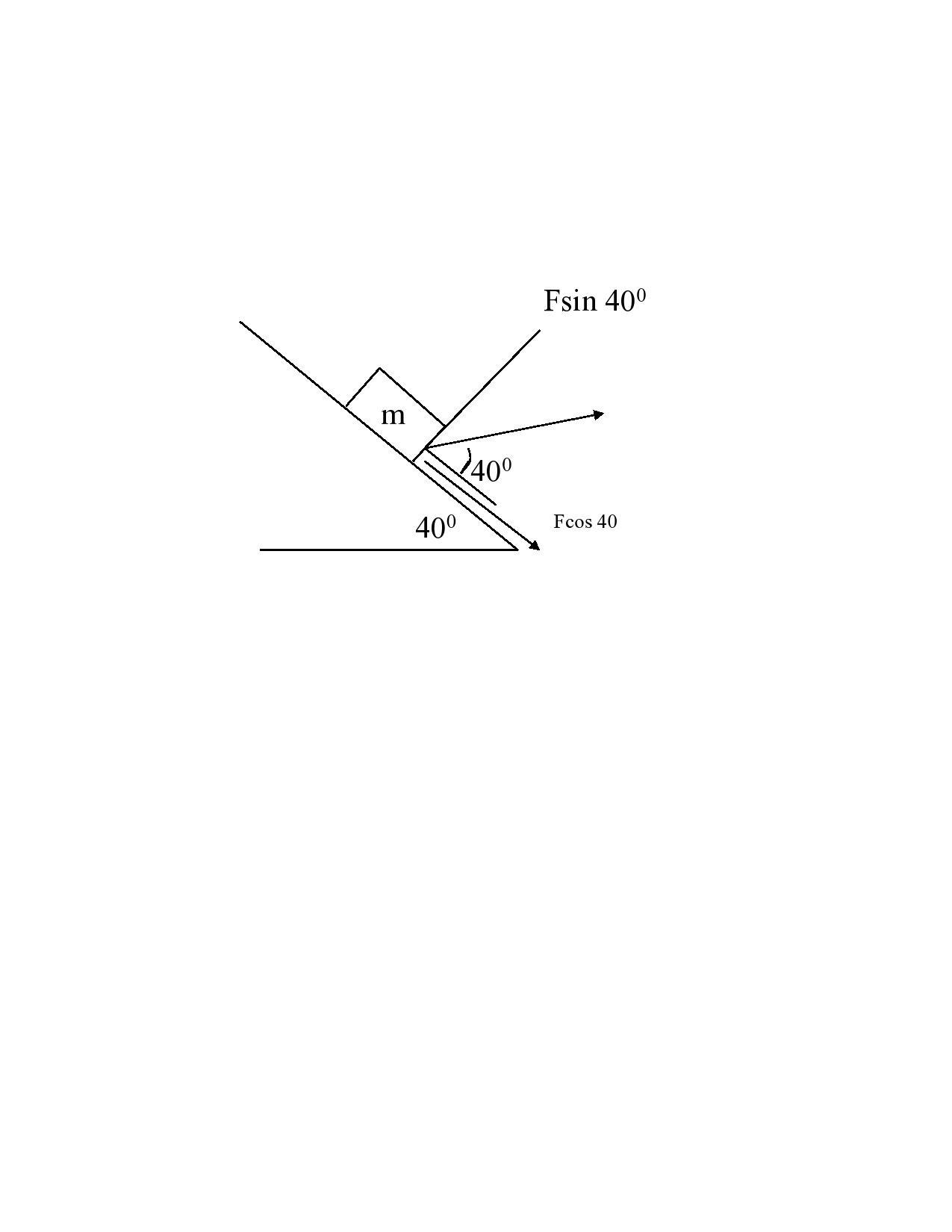
The 10-kg block slides down 2 m on the rough surface with kinetic friction coefficient μk = 0.2. What is the work done by the fr
Rashid [163]

Answer:

153.2 J

Explanation:

Let's first list our given parameters;

mass (m) of the block = 10 kg

which slides down ( i.e displacement) = 2 m

kinetic coefficient of friction (μk) = 0.2

In the diagram shown below;  if we take an integral look at the component of force in the direction of the displacement; we have

F_x= Fcos 40°

F_x= 100 (cos 40°)

F_x= 76.60 N

Workdone by the friction force can now be determined as:

W = F_x × displacement

W = 76.60 × 2

W = 153.2 J

∴  the work done by the friction force = 153.2 J

7 0
2 years ago
A three-phase line has an impedance of 0.4 j2.7 ohms per phase. The line feeds two balanced three-phase loads that are connected
Viktor [21]

Answer:

a. The magnitude of the line source voltage is

Vs = 4160 V

b. Total real and reactive power loss in the line is

Ploss = 12 kW

Qloss = j81 kvar

Sloss = 12 + j81 kVA

c. Real power and reactive power supplied at the sending end of the line

Ss = 540.046 + j476.95 kVA

Ps = 540.046 kW

Qs = j476.95 kvar

Explanation:

a. The magnitude of the line voltage at the source end of the line.

The voltage at the source end of the line is given by

Vs = Vload + (Total current×Zline)

Complex power of first load:

S₁ = 560.1 < cos⁻¹(0.707)

S₁ = 560.1 < 45° kVA

Complex power of second load:

S₂ = P₂×1 (unity power factor)

S₂ = 132×1

S₂ = 132 kVA

S₂ = 132 < cos⁻¹(1)

S₂ = 132 < 0° kVA

Total Complex power of load is

S = S₁ + S₂

S = 560.1 < 45° + 132 < 0°

S = 660 < 36.87° kVA

Total current is

I = S*/(3×Vload)   ( * represents conjugate)

The phase voltage of load is

Vload = 3810.5/√3

Vload = 2200 V

I = 660 < -36.87°/(3×2200)

I = 100 < -36.87° A

The phase source voltage is

Vs = Vload + (Total current×Zline)

Vs = 2200 + (100 < -36.87°)×(0.4 + j2.7)

Vs = 2401.7 < 4.58° V

The magnitude of the line source voltage is

Vs = 2401.7×√3

Vs = 4160 V

b. Total real and reactive power loss in the line.

The 3-phase real power loss is given by

Ploss = 3×R×I²

Where R is the resistance of the line.

Ploss = 3×0.4×100²

Ploss = 12000 W

Ploss = 12 kW

The 3-phase reactive power loss is given by

Qloss = 3×X×I²

Where X is the reactance of the line.

Qloss = 3×j2.7×100²

Qloss = j81000 var

Qloss = j81 kvar

Sloss = Ploss + Qloss

Sloss = 12 + j81 kVA

c. Real power and reactive power supplied at the sending end of the line

The complex power at sending end of the line is

Ss = 3×Vs×I*

Ss = 3×(2401.7 < 4.58)×(100 < 36.87°)

Ss = 540.046 + j476.95 kVA

So the sending end real power is

Ps = 540.046 kW

So the sending end reactive power is

Qs = j476.95 kvar

7 0
2 years ago
Which of the following is NOT true about hydraulic valves? A. Directional control valves determine the path of a fluid in a give
Lelechka [254]

Answer: Option D is not true of hydraulic valves. A hydraulic valve is a device that can change the opening degree of liquid flow path

Explanation:

The pilot check valve allows flow of liquid in one direction and blocks flow in the opposite direction

5 0
2 years ago
Other questions:
  • A 1020 CD steel shaft is to transmit 15 kW while rotating at 1750 rpm. Determine the minimum diameter for the shaft to provide a
    10·1 answer
  • The wall of drying oven is constructed by sandwiching insulation material of thermal conductivity k = 0.05 W/m°K between thin me
    8·1 answer
  • What can your employer do to protect you from overhead power lines?
    8·1 answer
  • Define a function pyramid_volume with parameters base_length, base_width, and pyramid_height, that returns the volume of a pyram
    10·1 answer
  • Consider the following class definitions: class smart class superSmart: public smart { { public: public: void print() const; voi
    6·1 answer
  • Sea water with a density of 1025 kg/m3 flows steadily through a pump at 0.21 m3 /s. The pump inlet is 0.25 m in diameter. At the
    8·1 answer
  • Check the answer that best describes the relationship between f(x) and x. (For example if f(x) is Θ(x) check that as your answer
    12·1 answer
  • Hot combustion gases, modeled as air behaving as an ideal gas, enter a turbine at 10 bar, 1500 K and exit at 1.97 bar and 900 K.
    7·1 answer
  • A mixture of air and methane is formed in the inlet manifold of a natural gas-fueled internal combustion engine. The mole fracti
    14·1 answer
  • The molecular weight of a 10g rubber band
    12·1 answer
Add answer
Login
Not registered? Fast signup
Signup
Login Signup
Ask question!