answer.
Ask question
Login Signup
Ask question
All categories
  • English
  • Mathematics
  • Social Studies
  • Business
  • History
  • Health
  • Geography
  • Biology
  • Physics
  • Chemistry
  • Computers and Technology
  • Arts
  • World Languages
  • Spanish
  • French
  • German
  • Advanced Placement (AP)
  • SAT
  • Medicine
  • Law
  • Engineering
Vikki [24]
2 years ago
13

Rank the members of each set of compounds according to the ionic character of their bonds. a. Most ionic bonds? a. PCl3 b. PBr3

c. PF3 Least ionic bonds? a. PCl3 b. PBr3 c.PF3 b.Most ionic bonds? a. BF3 b. NF3 c. CF3 Least ionic bonds?a. BF3 b. NF3 c. CF3 c. Most ionic bonds? a. SeF4 b. TeF4 c. BrF3 Least ionic bonds? a. SeF4 b. TeF4 c. BrF3

Chemistry
1 answer:
Makovka662 [10]2 years ago
7 0

Answer: Most ionic bonds:  PF3

Least ionic bonds  PBr3

Most ionic bonds BF3

Least ionic bonds  NF3  

Most ionic bonds TeF4

Least ionic bonds BrF3

Explanation:

In order to classify the type of bond, we calculate the molecule electronegativity by  subtracting the individual electronegativity of each atom.

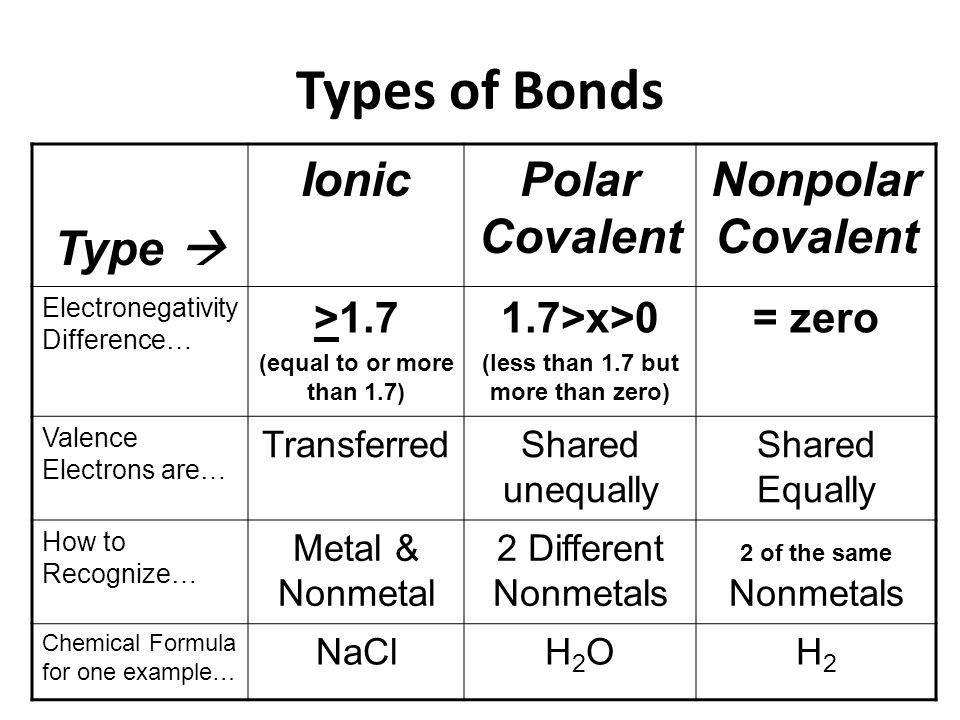
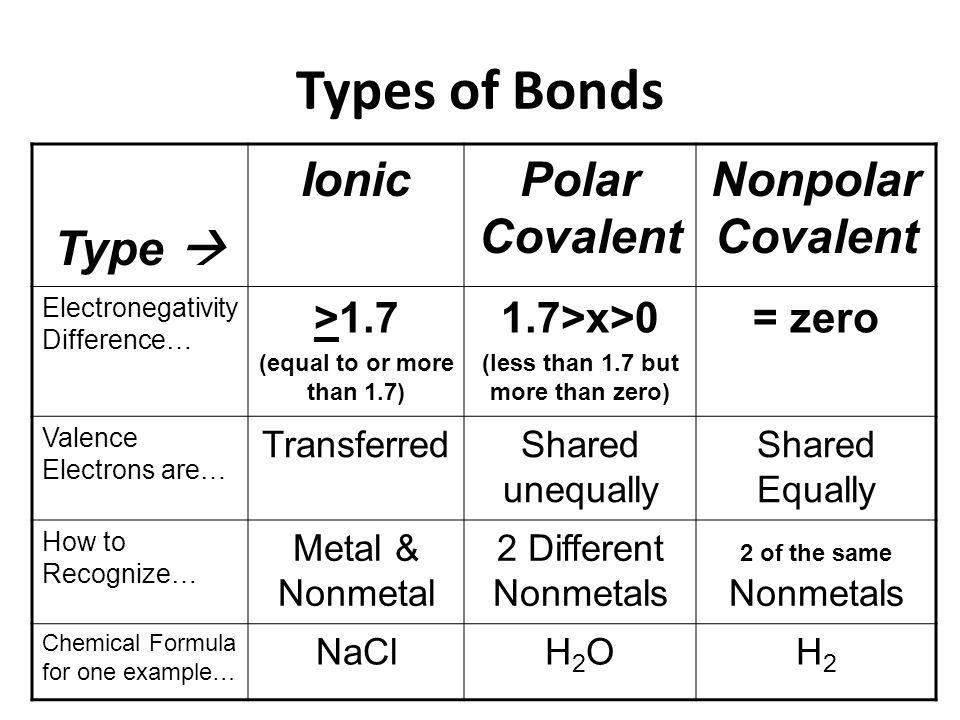
Keep in mind that a result of 1.7 or more, will let you know that it is an ionic bond ( as you can see in the image)

Let´s check each atom electronegativity: P = 2.1 ;  Cl= 3.0;  Br= 2.8 ; F =4.0  ; B= 2.0;  N=3.0 ;   C=2.5;   Se=2.4 ; Te= 2.1 ;   Br =2.8

Now we start with the first set members : PCl3 = 3.0- 2.1 = 0.9

PBr3 = 2.8- 2.1 = 0.7

PF3= 4.0 - 2.1 = 1.9

as we can see,  PF3 has the higher value of electronegativity, more than 1.7 of electronegativity as we have previously mentioned, means it has more character ionic bond than others.

<em>By substracting electronegativities of each atom, you will realize that is pretty easy to rank any member as more or less electronegative.</em>

You might be interested in
Which process is based on repulsion of oil and water?
Inessa [10]

Answer:

We can seprate oil and water by the process of seprating funnel

5 0
2 years ago
Read 2 more answers
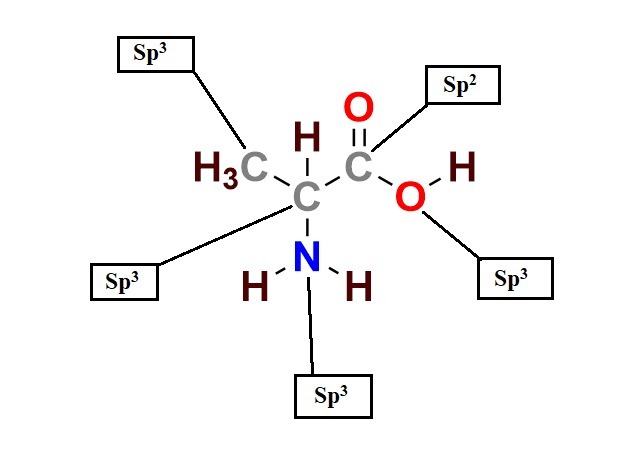
Consider the structure of the amino acid alanine. indicate the hybridization about each interior atom.
OLEGan [10]
The structure of Alanine is shown below,
Except the carbon atom of carbonyl group which is Sp² Hybridized, all remaining atoms are Sp³ Hybridized. The hybridization of each element is depicted in a box below,

5 0
2 years ago
Read 2 more answers
A newborn blue whale measures 6.0 to 7.9 m long and weighs up to 3003 kg. The blue whale produces the loudest sound by any livin
Dafna11 [192]
H
Ztdtdyfugughfhfhdtxycycyfugufufuvuguguv
3 0
2 years ago
A 100.0 ml sample of 0.18 m hclo4 is titrated with 0.27 m lioh. determine the ph of the solution after the addition of 30.0 ml o
gizmo_the_mogwai [7]
From the molarity and volume of HClO4, we can determine how many moles of H+ we initially have: 
     0.18 M HClO4 * 0.100 L HClO4 = 0.018 moles H+

We can determine how many moles of OH- we have from the molarity and volume of LiOH:
     0.27 M LiOH * 0.030 L LiOH = 0.0081 moles OH-

When the HClO4 and LiOH neutralize each other, the remaining will be
     0.018 moles H+ - 0.0081 moles OH- = 0.0099 moles of excess H+

This means that the molarity [H+] will be
     [H+] = 0.0099 moles H+ / (0.100 L + 0.030 L) = 0.07615 M

The pH of the solution will therefore be
     pH = -log [H+] = -log 0.07615 = 1.12
6 0
2 years ago
Read 2 more answers
Liquid nitrogen has a density of 0.807 g/ml at –195.8 °c. if 1.00 l of n2(l) is allowed to warm to 25°c at a pressure of 1.00 at
Flauer [41]
Step 1: Change density from g/mL to g/L;

                                  0.807 g/mL  =  807 g/L

Step 2: Find Moles of N₂;
As,
             Density  =  Mass / Volume
Or,
             Mass  =  Density × Volume

Putting Values,

            Mass  =  807 g/L × 1 L

            Mass  =  807 g
Also,
            Moles  =  Mass / M.mass

Putting values,

            Moles  =  807 g / 28 g.mol⁻¹

            Moles  =  28.82 moles

Step 3: Apply Ideal Gas Equation to Find Volume of gas occupied,

As,
                        P V  =  n R T

                            V  =  n R T / P
Putting Values, remember! don't forget to change temperatue into Kelvin (25 °C + 273 = 298 K)

                 V  =  (28.82 mol × 0.08206 atm.L.mol⁻¹.K⁻¹ × 298 K) ÷ 1 atm

                 V  =  704.76 L

8 0
2 years ago
Other questions:
  • One molecule of a compound weighs 2.03x10⁻²² g. what is the molar mass of that compound?
    15·2 answers
  • To begin the experiment, 1.11g of methane CH4 is burned in a bomb calorimeter containing 1000 grams of water. The initial temper
    7·1 answer
  • In the correct lewis structure for the nitrate ion, no3 –­, nitrogen has how many covalent bonds?
    7·1 answer
  • If the coefficient 2 is placed in front of the product tetraiodine nonaoxide (I4O9), then, how many atoms of each element must b
    14·1 answer
  • A generic gas, x, is placed in a sealed glass jar and decomposes to form gaseous y and solid z. 2x(g)↽−−⇀y(g)+z(s) how are these
    6·2 answers
  • A compound that contains both potassium and oxygen formed when potassium metal was burned in oxygen gas. the mass of the compoun
    7·2 answers
  • When a 500. gram sample of water at 19.0oC absorbs 8.40 kiloJoules of heat, the temperature of the water will change to?
    11·1 answer
  • Question 1(Multiple Choice Worth 3 points)
    14·1 answer
  • An equimolar mixture of N2(g) and Ar(g) is kept inside a rigid container at a constant temperature of 300 K. The initial partial
    9·1 answer
  • What is the percent composition by mass of nitrogen in the compound N2H4 (gram-formula mass = 32 g/mol)?
    6·2 answers
Add answer
Login
Not registered? Fast signup
Signup
Login Signup
Ask question!