answer.
Ask question
Login Signup
Ask question
All categories
  • English
  • Mathematics
  • Social Studies
  • Business
  • History
  • Health
  • Geography
  • Biology
  • Physics
  • Chemistry
  • Computers and Technology
  • Arts
  • World Languages
  • Spanish
  • French
  • German
  • Advanced Placement (AP)
  • SAT
  • Medicine
  • Law
  • Engineering
MatroZZZ [7]
2 years ago
4

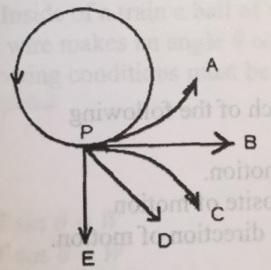
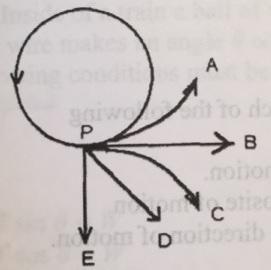
A girl attaches a rock to a string, which she then swings counter-clockwise in a horizontal circle. The string breaks at point P

in the figure, which shows a bird's-eye view (as seen from above). Which path (A-E) will the rock follow?
A. Path A
B. Path B
C. Path C
D. Path D
E. Path E

Physics
1 answer:
levacccp [35]2 years ago
8 0

Answer:

B. Path B

Explanation:

Since the velocity v is tangent to the circular path, the rock will follow the path B.

You can see the paths in the pic.

You might be interested in
A 1.5 m cylinder of radius 1.1 cm is made of a complicated mixture materials. Its resistivity depends on the distance x from the
Elis [28]

Answer:

a)R = 171μΩ

b)E = 1.7 *10^{-4} V/m

c)R_{2} = 1.16 *10^{-4}Ω

here * stand for multiplication

Explanation:

length of cylinder = 1.5 m

radius of cylinder  =  1.1 cm

resistivity depends on the distance x from the left

p(x)=a+bx^2 ............(i)

using equation

R = \frac{pl}{a}

let dR is the resistance of thickness dx

dR =\frac{p(x)dx}{a}

where p(x) is resistivity  l is length

a is area

\int\limits^R_0 {dR}  =\frac{1}{\pi r^2} \int\limits^L_0 {(a+bx^2)} \, dx  \\.........................(2)

after integration

R = \frac{[aL+\frac{bL^3}{3}] }{\pi  r^2}  ...............(3)

it is given p(0) = a = 2.25 * 10 ^{-8}Ωm

p(L) = a + b(L)^2  = 8.5 * 10 ^{-8} Ωm

8.5 * 10 ^{-8} = 2.25 * 10^{-8}+b(1.5)^2\\

(here * stand for multiplication )

on solving we get

b = 2.78* 10^{-8} Ωm

put each value of a  and b and r value in equation 3rd we get

R = \frac{[aL+\frac{bL^3}{3}] }{\pi  r^2}

R = 1.71 * 10^{-4}Ω

R = 171μΩ

FOR (b)

for mid point  x = L/2

E = p(x)L

for x = L/2

p(L/2) = a+b(L/2)^2

for given current  I = 1.75 A

so electric field


E = \frac{[a+b(L/2)^2]I }{\pi  r^2}

by substitute the values

we get;

E = 1.7 *10^{-4} V/m

(here * stand for multiplication )

c ).

75 cm means length will be half

 that is   x =  L/2

integrate  the second equation with upper limit  L/2  

Let resistance is R_{1}

so after integration we get

R_{1}  =  \frac{[a(L/2) +(b/3)(L^3/8)]}{\pi r^2}

substitute the value of a , b and L we get

R_{1} = 5.47 * 10 ^{-5}Ω

for second half resistance

R_{2} =  R- R_{1}

R_{2}  = 1.7 *10^{-4} -5.47 *10^{-5}

R_{2} = 1.16 *10^{-4}Ω

(here * stand for multiplication )

5 0
2 years ago
Upon impact, bicycle helmets compress, thus lowering the potentially dangerous acceleration experienced by the head. A new kind
Dimas [21]

Answer:

acceleration = -15.3g

Explanation:

given data

speed = 6.00 m/s.

thickness = 12

moves the entire = 12.0 cm

solution

we will use here equation that is

v² - u²  = 2 × a × s    ........................1

here v = 0 is the final velocity and u = 6.0 m/s is initial velocity and s= 0.12 m is the distance covered and a is the acceleration

so we put here value and get acceleration

a = \frac{v^2-u^2}{2s}

a = \frac{0^2-6^2}{2\times 0.12}

a = -150 m/s² ( negative sign means it is a deceleration )

and

acceleration in units of g  

a = \frac{-150}{9.8}

a = -15.3 g

6 0
2 years ago
Find the average power Pavg created by the force F in terms of the average speed vavg of the sled.
Katena32 [7]

Complete Question

The complete question is shown on the first and second uploaded image

Answer:

The power created  is  P_{avg} =  F  *  v_{avg}

Explanation:

From the question we are told that

    The that the average power is  mathematically represented as

            P_{avg} =  \frac{W }{\Delta  t  }

Where W is  is the Workdone which is  mathematically represented as

         W =  F  *  s

      Where F is  the applies force and  s  is the displacement  due to the force  

        So  

                P_{avg} =  \frac{F *s  }{\Delta  t  }

Now this  displacement can be represented mathematically as  

            s =  v_{avg} *  \Delta  t

Where v_{avg } is the average  velocity and \Delta  t is the time  taken  

So  

            P_{avg} =  \frac{F *v_{avg} *  \Delta  t    }{\Delta  t  }

=>         P_{avg} =  F  *  v_{avg}

3 0
2 years ago
A particular string resonates in four loops at a frequency of 320 Hz . Name at least three other (smaller) frequencies at which
goldfiish [28.3K]

Answer:

160 Hz  ,  240 Hz  , 400 Hz

Explanation:

Given that

Frequency of forth harmonic is 320 Hz.

Lets take fundamental frequency = f₁

f_1=\dfrac{320}{4}\ Hz

f₁=80 Hz

Frequency of first harmonic = f₂

f₂=2 f₁

f₂ =2 x 80 = 160 Hz

Frequency of second harmonic = f₃

f₃= 3 f₁=3 x 80 = 240 Hz

Frequency of fifth harmonic = f₅

f₅=  5 f₁= 5 x 80 = 400 Hz

Three frequencies are as follows

160 Hz  ,  240 Hz  , 400 Hz

6 0
2 years ago
What type of wave cannot travel in a vacuum
lions [1.4K]

A sound wave. Because in a vacuum there is no medium in a vacuum. And the only wave that requires a medium to travel through is a sound wave.

5 0
2 years ago
Read 2 more answers
Other questions:
  • Which of the following ways is usable energy lost?
    14·2 answers
  • Calculate the amount of energy produced in a nuclear reaction in which the mass defect is 0.187456 amu.
    13·2 answers
  • An object moving at a constant velocity travels 274 m in 23 s. what is its velocity?
    9·2 answers
  • A tennis ball bounces on the floor three times. If each time it loses 22.0% of its energy due to heating, how high does it rise
    9·1 answer
  • A uniform rod of mass M and length L is free to swing back and forth by pivoting a distance x from its center. It undergoes harm
    14·1 answer
  • Tendons are strong elastic fibers that attach muscles to bones. To a reasonable approximation, they obey Hooke's law. In laborat
    14·1 answer
  • Calculate the force of Earth’s gravity on a spacecraft 2.00 Earth radii above the Earth’s surface (That would be 3.00 Earth radi
    5·1 answer
  • Given that the voltage across the capacitor as a function of time is V(t)=q0Ce−t/(ROC)V(t)=q0Ce−t/(RC), what is the current I(t)
    15·1 answer
  • A team of engineering students is testing their newly designed 200 kg raft in the pool where the diving team practices. The raft
    11·1 answer
  • Select the correct expression that gives the block's acceleration at a displacement x from the equilibrium position. Note that x
    12·2 answers
Add answer
Login
Not registered? Fast signup
Signup
Login Signup
Ask question!