answer.
Ask question
Login Signup
Ask question
All categories
  • English
  • Mathematics
  • Social Studies
  • Business
  • History
  • Health
  • Geography
  • Biology
  • Physics
  • Chemistry
  • Computers and Technology
  • Arts
  • World Languages
  • Spanish
  • French
  • German
  • Advanced Placement (AP)
  • SAT
  • Medicine
  • Law
  • Engineering
pav-90 [236]
2 years ago
4

Nylons are strong sythetic fibers commonly used to make clothing and other goods. One of the most common nylons, Nylon 66, is ma

de by the condensation reaction between adipic acid and hexamethylenediamine (hexane-1,6-diamine). Modify the monomers below to create one repeat unit of the polymer.What other, small molecule is produced in this reaction? Give the formula of the compound (not the name).

Chemistry
1 answer:
Readme [11.4K]2 years ago
6 0

Answer:

The small molecule produced in this condensation reaction is water.

Formula of the compound is given by [C_{12} H_{22}N_{2}O_{2}]_{n}

Explanation:

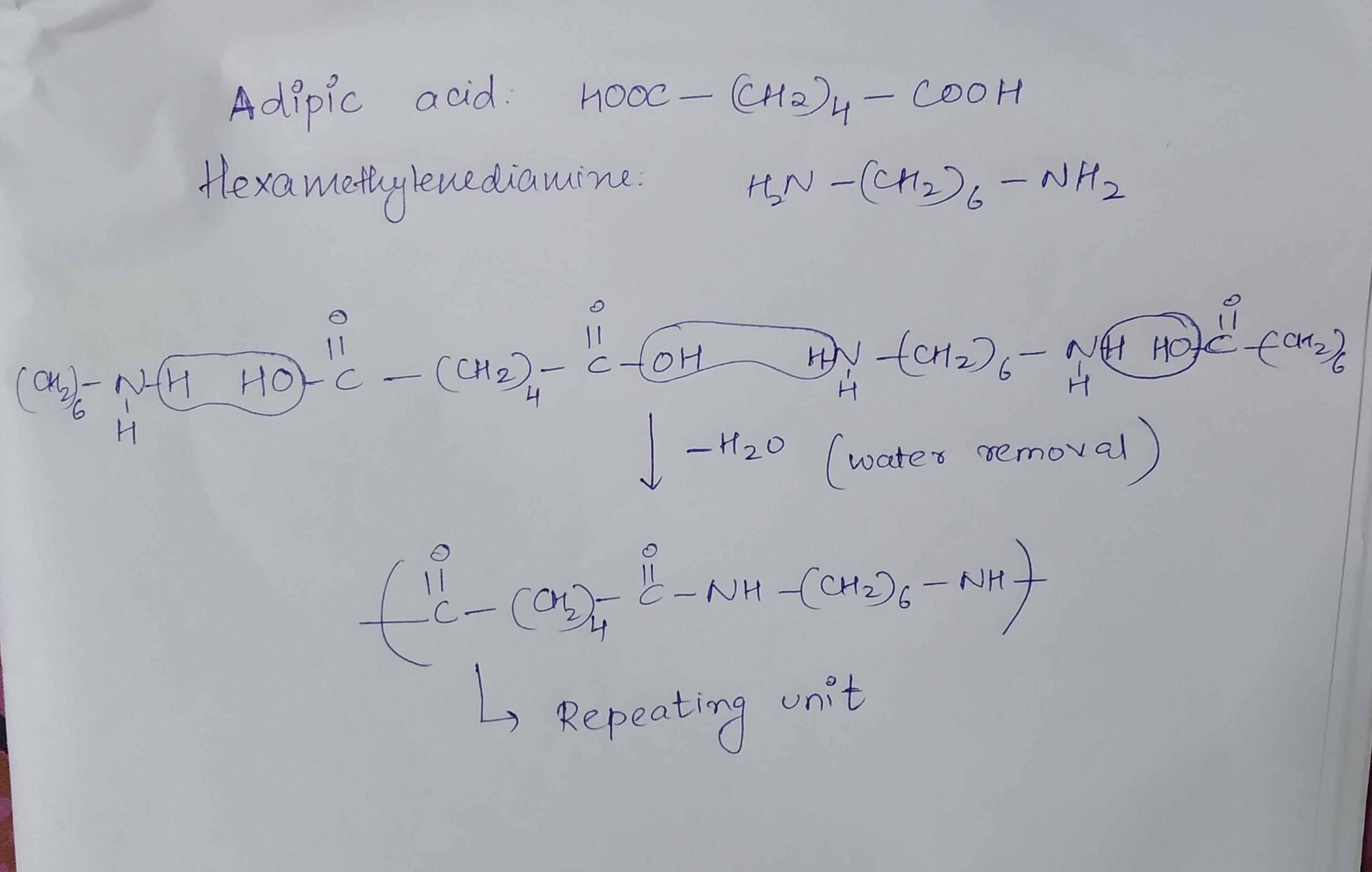
Nylon is a poly amide which is formed by the condensation reaction between adipic acid and hexamethylenediamine.

A reaction is called a condensation reaction when it involves removal of small molecules like water to form product.

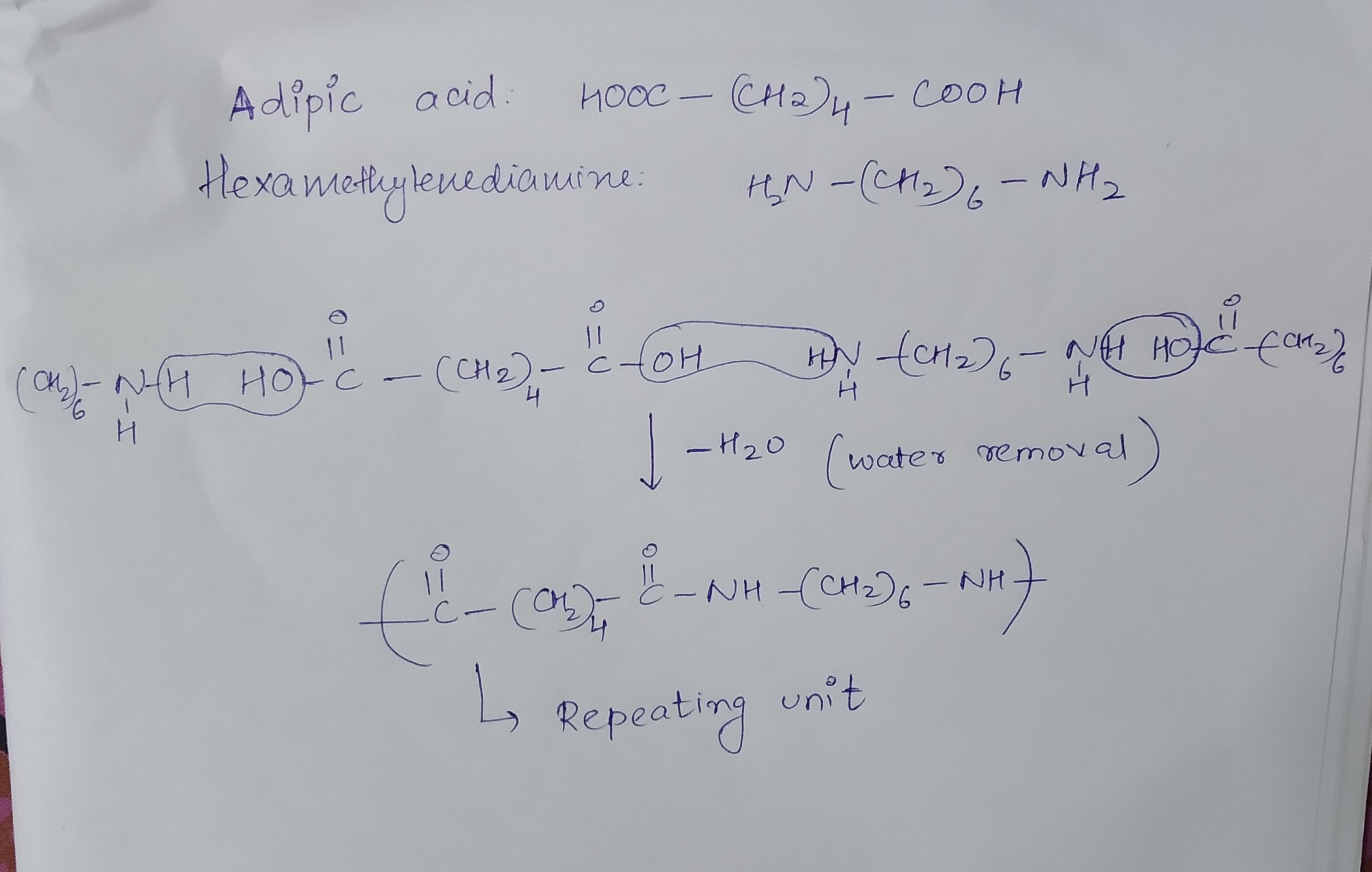
In this condensation reaction a molecule of water is removed between the monomers to form a repeating unit of polymer. This process is clearly explained by the figure below.    

We can see that the -OH group from the acid and -H atom from amine is removed to form a -CONH- group known as amide group.In effect a water molecule is removed in the formation of Nylon-6,6.

Since the monomers are connected by an amide group the polymer thus formed is a poly amide .We can see from the attachment that the formula of the polymer formed is [C_{12}H_{22}N_{2}O_{2}]_{n}.


You might be interested in
Rubbing alcohol contains 615g of isopropanol (C3H7OH) per liter (aqueous solution). Calculate the molality of this solution. Giv
faltersainse [42]

Answer:

Solution of isopropanol is 10.25 molal

Explanation:

615 g of isopropanol (C3H7OH) per liter

We gave the information that 615 g of solute (isopropanol) are contained in 1L of water. We need to find out the mass of solvent, so we use density.

Density of water 1g/mL → Density = Mass of water / 1000 mL of water

Notice we converted the L to mL

Mass of water = 1000 g (which is the same to say 1kg)

Molality are the moles of solute in 1kg of solvent, so let's convert the moles of isopropanol  → 615 g . 1mol / 60g = 10.25 moles

Molality (mol/kg) = 10.25 moles / 1kg = 10.25 m

4 0
2 years ago
An organelle that is not found in this illustration of a cell would be
zloy xaker [14]

Answer:

The answer is cell wall

Explanation:

Because it is

8 0
2 years ago
Read 2 more answers
According to reference table adv-10, which reaction will take place spontaneously?
olga_2 [115]
Missing table!! write the elements with the first letter of the symbol with Upper Caps letters!!!

http://www.chemeddl.org/services/moodle/media/QBank/GenChem/Tables/EStandardTable.htm

<span>Ni2+ +Pb(s) → Ni(s) + Pb2+
</span>The potential of the oxidation of Pb(s) --> Pb2+(aq) is 0.126 V 
The potential of the reduction go Ni2+(aq) --> Ni(s) is -0.25 V 

<span>Add the two together and the potential for the reaction is -0.124 V (NO SPONTANEOUS THE SIGN IS NEGATIVE)

</span><span>au3+ + al(s) → au(s) + al3+Au3+(aq) ->   Au(s)  +1.5 VAl -> Al3+  +1.66VV= 3.16 (SPONTANEOUS THE SIGN OF THE PONTENTIAL IS POSITIVE)</span><span>Sr2+ + Sn(s) → Sr(s) + Sn2+
</span>
Sr2+(aq) + 2 e–  <span>  Sr(s)  V= -2.89V
</span>Sn -> Sn2+ V= 0.14 V
V= -2.75 V (no spontaneous)

<span>Fe2+ + Cu(s) → Fe(s) + Cu2+
</span>Fe2+(aq) + 2 e–<span>  </span><span>  Fe(s)  V= -0.44 V
</span>Cu -> C2+  V = - 0.337V

V= - 0.777V (no spontaneous)
5 0
2 years ago
A 15.0-L rigid container was charged with 0.500 atm of kryp‑ ton gas and 1.50 atm of chlorine gas at 350.8C. The krypton and chl
Alecsey [184]

Answer: 32.94 g

Explanation: It's stoichiometry problem so balanced equation is required. The balanced equation is given below:

Kr+2Cl_2\rightarrow KrCl_4

From the balanced equation, krypton and chlorine react in 1:2 mol ratio. We will calculate the moles of each reactant gas using ideal gas law equation(PV = nRT) and then using mol ratio the limiting reactant is figured out that helps to calculate the amount of the product formed.

for Krypton, P = 0.500 atm and for chlorine, P = 1.50 atm

V = 15.0 L

T = 350.8 + 273 = 623.8 K

For krypton, n=\frac{0.500*15.0}{0.0821*623.8}

n = 0.146 moles

for chlorine, n=\frac{1.50*15.0}{0.0821*623.8}

n = 0.439

From the mole ratio, 1 mol of krypton reacts with 2 moles of chlorine. So 0.146 moles of krypton will react with 2 x 0.146 = 0.292 moles of chlorine.

Since 0.439 moles of chlorine are available, it is present in excess and hence the limiting reactant is krypton.

So, the amount of product formed is calculated from moles of krypton.

Molar mass of krypton tetrachloride is 225.61 gram per mol.

There is 1:1 mol ratio between krypton and krypton tetrachloride.

0.146molKr(\frac{1molKrCl_4}{molKr})(\frac{225.61gKrCl_4}{1molKrCl_4})

= 32.94 g of KrCl_4

So, 32.94 g of the product will form.

5 0
2 years ago
Describe how you would prepare exactly 100 mL of 0.109 M picolinate buffer, pH 5.61. Possible starting materials are pure picoli
Pepsi [2]

Answer:

1.342g of picolinic acid and 6.743mL of 1.0M NaOH diluting the mixture to 100.0mL

Explanation:

<em>The pKa of the picolinic acid is 5.4.</em>

Using Henderson-Hasselbalch formula for picolinic-picolinate buffer:

pH = pKa + log [Picolinate] / [Picolinic]

<em>Where [] could be taken as moles of each species</em>

<em />

5.61 = 5.4 + log [Picolinate] / [Picolinic]

0.21 = log [Picolinate] / [Picolinic]

1.62181 = [Picolinate] / [Picolinic] <em>(1)</em>

<em></em>

Now, both picolinate and picolinic acid will be:

0.100L * (0.109mol / L) =

0.0109 moles = [Picolinate] + [Picolinic] <em>(2)</em>

<em></em>

First, as we will start with picolinic acid, we need add:

0.0109 moles picolinic acid * (123.10g/mol) = 1.342g of picolinic acid

Now, replacing (2) in (1):

1.62181 = 0.0109 moles - [Picolinic] / [Picolinic]

1.62181 [Picolinic] = 0.0109 moles - [Picolinic]

2.62181 [Picolinic] = 0.0109 moles

[Picolinic] = 4.157x10⁻³ moles

And:

[Picolinate] = 0.0109 - 4.157x10⁻³ moles =

<h3>6.743x10⁻³ moles</h3><h3 />

To obtain these moles of picolinate ion we need to make the reaction of the picolinic acid with NaOH:

Picolinic acid + NaOH → Picolinate + Water

<em>That means to obtain 6.743x10⁻³ moles of picolinate ion we need to add 6.743x10⁻³ moles of NaOH</em>

<em />

6.743x10⁻³ moles of NaOH that is 1.0M are, in mL:

6.743x10⁻³ moles * (1L / 1mol) = 6.743x10⁻³L * 1000 =

<h3>6.743mL of the 1.0M NaOH must be added</h3><h3 />

Thus, we obtain the desire moles of picolinate and picolinic acid to obtain the buffer we want, the last step is:

<h3>Dilute the mixture to 100mL, the volume we need to prepare</h3>
3 0
2 years ago
Other questions:
  • Which reactants would lead to a spontaneous reaction?
    13·1 answer
  • If the coefficient 2 is placed in front of the product tetraiodine nonaoxide (I4O9), then, how many atoms of each element must b
    14·1 answer
  • If the following elements were to form ions, they would attain the same number of electrons as which noble gas? As , Be , O , S
    6·2 answers
  • In [cu(nh3)4]co3, how many 3d electrons does copper have?
    5·1 answer
  • Give the atomic symbol for an element that does not exist as a molecule or extended structure. that is, an element that exists o
    14·2 answers
  • For each reaction, identify the precipitate, or lack thereof. 2nacl(aq)+ba(oh)2(aq)⟶bacl2+2naoh naoh bacl2 no precipitate agclo3
    14·2 answers
  • What is the [h3o+] for a solution at 25°c that has poh = 5.640?
    12·1 answer
  • Phosphoric acid, which is commonly used as rust inhibitor, food additive and etching agent for dental and orthopedic use, can be
    9·1 answer
  • Two stones resembling diamonds are suspected of being fakes. To determine if the stones might be real, the mass and volume of ea
    15·1 answer
  • The human body burns glucose for energy according to this chemical reaction: The products of the reaction are carbon dioxide and
    11·1 answer
Add answer
Login
Not registered? Fast signup
Signup
Login Signup
Ask question!