answer.
Ask question
Login Signup
Ask question
All categories
  • English
  • Mathematics
  • Social Studies
  • Business
  • History
  • Health
  • Geography
  • Biology
  • Physics
  • Chemistry
  • Computers and Technology
  • Arts
  • World Languages
  • Spanish
  • French
  • German
  • Advanced Placement (AP)
  • SAT
  • Medicine
  • Law
  • Engineering
34kurt
2 years ago
6

Calculate the work associated with the compression of a gas from 121.0 L to 80.0 L at a constant pressure of 16.7 atm.

Chemistry
1 answer:
Mkey [24]2 years ago
4 0

Answer:

6.94 × 10⁴ J

Explanation:

We can calculate the work (W) associated with the compression of a gas at constant pressure using the following expression:

W = -P . ΔV

where,

P is the external pressure

ΔV is the change in the volume

Knowing that 1 atm.L = 101.325 J, the work of compression is:

W=-P\times \Delta V=-16.7atm\times(80.0L-121.0L)\times\frac{101.325J}{1atm.L} =6.94\times10^{4} J

The positive sign of the work means that the surroundings do work on the system.

You might be interested in
Two gases, A and B, are at equilibrium in a sealed cylinder. Individually, gas A is colorless, while gas B is dark colored. The
Dmitriy789 [7]

Answer:

(a) color

(b) endothermic

(c)

b The ΔH value would have the same magnitude value but opposite sign.

c The K expression would be inverted.

Explanation:

Let's consider the following reaction at equilibrium.

      A(g) ⇄ 2 B(g)

colorless    dark colored

<em>(a) The cylinder should appear (color or colorless)</em>

At equilibrium, there is a mixture of A and B, so the cylinder should appear colored.

<em>(b) When the system is cooled, the cylinder's appearance becomes very light colored. Therefore, the reaction must be (endothermic or exothermic)</em>

According to Le Chatelier's Principle when a perturbation is made to a system at equilibrium it will react to counteract such effect. When the system is cooled, it will tend to increase the temperature by releasing heat. In this case, the reaction is endothermic so when the reverse reaction is favored, colorless A is favored as well.

<em>Suppose the reaction equation were written as follows: 2 B(g) ⇄ A(g) </em>

<em>(c) Which of these statements would then be true?</em>

<em>a The value of K would not change.</em> FALSE. The new K would be the inverse of the direct K.

<em>b The ΔH value would have the same magnitude value but opposite sign. </em>TRUE. This is stated by Lavoisier-Laplace Law.

<em>c The K expression would be inverted.</em> TRUE. What was product before now is reactant and vice-versa.

<em>d The color of the cylinder would be darker.</em> FALSE. Changing the way the reaction is expressed has no effect on the equilibrium.


7 0
2 years ago
If a certain gas occupies a volume of 13 L when the applied pressure is 6.5 atm , find the pressure when the gas occupies a volu
Sav [38]
We should apply Boyle's Law here given initial pressure, initial volume and final volume.

P1V1= P2V2
(6.5 atm) (13 L) = P2 (3.3 L)

Solve for P2 on your calculator and that should get you to the answer.


5 0
2 years ago
Read 2 more answers
A poisoned pill contains 0.00048 moles of KCN. How many molecules are in this sample?
mario62 [17]

Answer:

2.89 \times  {10}^{20}  \:  \: molecules

Explanation:

The number of molecules of KCN can be found by using the formula

<h3>N = n × L</h3>

where n is the number of moles

N is the number of entities

L is the Avogadro's constant which is

6.02 × 10²³ entities

From the question we have

N = 0.00048 × 6.02 × 10²³

We have the final answer as

2.89 \times  {10}^{20}  \:  \:  \: molecules

Hope this helps you

7 0
1 year ago
For which of the following reactions is ΔH∘rxn equal to ΔH∘f of the product(s)?You do not need to look up any values to answer t
Nutka1998 [239]

Answer:

Reactions 1, 3 and 5

Explanation:

First thing's first, let's ensure that all the reactions given are balanced. This is given as;

CO(g) + 1/2 O2(g )→ CO2(g)

Li(s) + 1/2 F2(l) → LiF(s)

C(s) + O2(g) → CO2(g)

CaCO3(g) → CaO + CO2(g)

2Li(s) + F2(g) → 2LiF(s)

For the condition to be valid;

- There is by convention 1 mol of product made. This means we eliminate reactions with more than one mole of compound formed. This eliminates reaction 5.

- The lements haveto be in their state at room temperature. Fluorine is a gas, not a liquid, at room temperature ans pressure, so 2 is not a correct answer.

This leaves us with reactions 1, 3 and 5 as the correct reactions that satisify the condition.

3 0
2 years ago
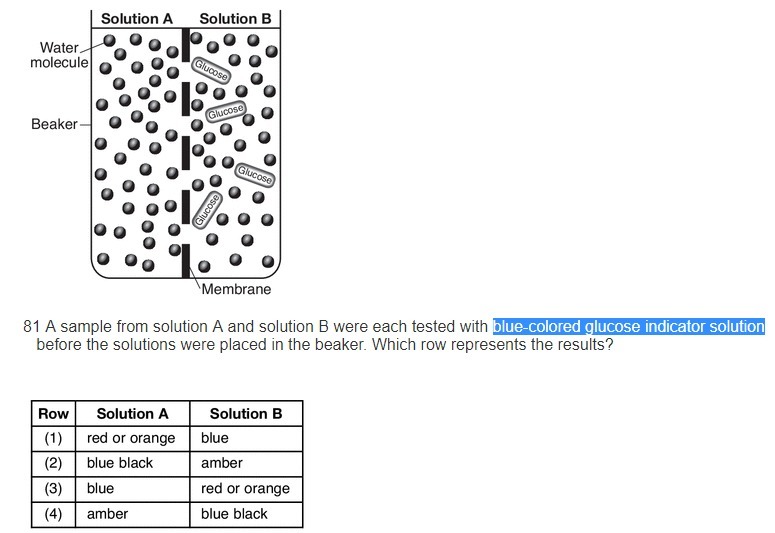
A sample from solution a and solution b were each tested with blue colored glucose indicator solution before the solutions were
vova2212 [387]
With the given problem you gave here, I can't answer the question because I need more details. Luckily, I found a similar problem that's provided with a diagram and a table shown in the attached picture.

This test is called the Benedict's test which is used as test for presence of sugars. If the solution contains sugar, like glucose, the solution would turn from blue to red. If not, it would stay blue. <em>Therefore, the correct results would be that in row 3.</em>

3 0
2 years ago
Other questions:
  • What is the total amount of heat required to completely melt 347 grams of ice at its melting point
    13·2 answers
  • Precipitation will increase in areas where there is A) less transpiration and less run-off. B) lower temperatures and more evapo
    11·2 answers
  • To neutralize 1.65g LiOH, how much .150 M HCl would be needed?
    6·1 answer
  • A person is standing on ice. He throws a snowball with a force of 4 N to the right, while the snowball pushes the person with a
    14·2 answers
  • Three samples of gas each exert 740 mm hg in separate 2 L containers what pressure do they exert if they are all placed in a sin
    13·1 answer
  • How much energy must be removed from a 125 g sample of benzene (molar mass= 78.11 g/mol) at 425.0 K to liquify the sample and lo
    9·1 answer
  • The stock concentration of dye is 3.4E-5M. The stock concentration of bleach is 0.36M. Assuming that the reaction goes to comple
    5·1 answer
  • Write a chemical formula for each molecular model. (Blue ball represents nitrogen atom, red ball represents oxygen atom, white b
    8·1 answer
  • When a candle is lit and allowed to burn for 15 minutes, some wax drips and collects at the base of the candle, and the candle b
    13·1 answer
  • The density of honey is 1.42 g/mL. If you poured honey into a glass of water, would it sink to the bottom or float on top? Expla
    11·1 answer
Add answer
Login
Not registered? Fast signup
Signup
Login Signup
Ask question!