answer.
Ask question
Login Signup
Ask question
All categories
  • English
  • Mathematics
  • Social Studies
  • Business
  • History
  • Health
  • Geography
  • Biology
  • Physics
  • Chemistry
  • Computers and Technology
  • Arts
  • World Languages
  • Spanish
  • French
  • German
  • Advanced Placement (AP)
  • SAT
  • Medicine
  • Law
  • Engineering
Mrac [35]
2 years ago
15

Explain how the lines seen in the spectroscope relate to the position of electrons in the metal atom?

Chemistry
1 answer:
mojhsa [17]2 years ago
7 0

Answer:

The lines fall somewhere in one or more of the colors in the spectroscope.  When electrons in an atom are excited by shooting electricity through them for instance, some electrons are forced to temporatily jump to a higher energy level. As it is only temporary, the electron soon falls back down to its own level.  However as it loses potential energy it gives off a brief burst of light energy which we can see.  If the light is red then the electron didn't jump very high, and therefore lost only a little eneergy falling back down.  If the light is violet or purple it fell from a high orbital and released a lot of energy falling back down.  Everything else falls in between.

Explanation:

You might be interested in
For the reaction PCl5(g) <--> PCl3(g) Cl2(g) at equilibrium, which statement correctly describes the effects of increasing
xenn [34]

The given question is incomplete. The complete question is :

For the reaction PCl_5(g)\rightleftharpoons PCl_3(g)+Cl_2(g) at equilibrium, which statement correctly describes the effects of increasing pressure and adding PCl_5, respectively

a) Increasing pressure causes shift to reactants, adding PCl_5 causes shift to products.

b) Increasing pressure causes shift to products ,adding PCl_5 causes shift to reactants.

c) Increasing pressure causes shift to products, adding PCl_5 causes shift to products.

d) Increasing pressure causes shift to reactants,adding PCl_5 causes shift to reactants

Answer: Increasing pressure causes shift to reactants, adding PCl_5 causes shift to products.

Explanation:

Any change in the equilibrium is studied on the basis of Le-Chatelier's principle.

This principle states that if there is any change in the variables of the reaction, the equilibrium will shift in the direction to minimize the effect.

For the given equation:

PCl_5(g)\rightleftharpoons PCl_3(g)+Cl_2(g)

a)  If the pressure is increased, the volume will decrease according to Boyle's Law. Now, according to the Le-Chatlier's principle, the equilibrium will shift in the direction where decrease in pressure is taking place. As the number of moles of gas molecules is lesser at the reactant side. So, the equilibrium will shift in the left direction. i.e. towards reactants.

b) If PCl_5 is added, the equilibrium will shift in the direction where PCl_5 is decreasing. So, the equilibrium will shift in the right direction. i.e. towards products.

8 0
2 years ago
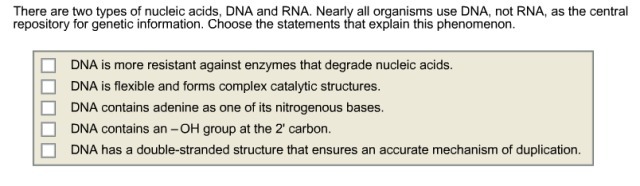
There are two types of nucleic acids, dna and rna. nearly all organisms use dna, not rna, as the central repository for genetic
Leya [2.2K]
Found the choices. Pls see attachment. 

The statements that explains this phenomenon are:
1) DNA contains adenine as one of its nitrogenous bases.
2) DNA has a double-stranded structure that ensures an accurate mechanism of duplication.

6 0
2 years ago
Two weak acids, A and B, have pKa values of 4 and 6, respectively. Which statement is true?A) Acid A dissociates to a greater ex
zalisa [80]

Answer:

A) Acid A dissociates to a greater extent in water than acid B

Explanation:

A) Acid A dissociates to a greater extent in water than acid B

We are given the pKa for both acids, and we know

pKa = - log Ka

Taking antilog to both sides of the equation we can solve for Ka

⇒ -pKa = log Ka

-antilog pKa = Ka

10 ^-pka = Ka

So ka for acid A = 10⁻⁴

and

ka for acid B = 10⁻⁶

True the equilibrium constant for acid A is greater, so it dissociates more.

B) For solutions of equal concentration, acid B will have a lower pH.

We know the stronger acid is A, and it dissociates more. Since pH is the negative log of H₃O⁺ concentration, it follows that at equal concentrations the acid A will have at equilibrium a greater [H₃O⁺] and hence a lower pH

C) B is the conjugate base of A

False:

If B were the conjugate base of A, its  Kb would have been given by:

Ka x Kb = Kw

Kb = 10⁻¹⁴/10⁻⁶ = 10⁻⁸ for the conjugate base of acid B

Kb = 10⁻¹⁴/10⁻⁴ = 10⁻¹⁰ for the conjugate base of acid A

which are not equal.

D) Acid A is more likely to be a polyprotic acid than acid B.

False

Just having the pkas for both acids one cannot know if any of the acids is polyprotic. We will need the formula for the acids.

E) The equivalence point of acid A is higher than that of acid B

False

The equivalence point depends on the the concentration of the acids  and their volumes.

The equivalence point is reached in the titration when the number of equivalents of base equals the number of equivalents of acid:

# equivalents acid = # equivalents of base  @ end point

and

# equivalents acid = Molarity of acid x Volume of acid

4 0
2 years ago
What mass of solid NaOH (97.0 % by mass) is required to prepare 1.00 L of a 10.0% solution of NaOH by mass? The density of the 1
Lelechka [254]

<u>Answer:</u> The mass of 97 % of NaOH solution required is 114.33 g

<u>Explanation:</u>

To calculate mass of a substance, we use the equation:

\text{Density of substance}=\frac{\text{Mass of substance}}{\text{Volume of substance}}

We are given:

Density of 10 % solution = 1.109 g/mL

Volume of 10% solution = 1 L = 1000 mL     (Conversion factor:  1 L = 1000 mL)

Putting values in above equation, we get:

1.109g/mL=\frac{\text{Mass of }10\%\text{ solution}}{1000mL}\\\\\text{Mass of }10\%\text{ solution}=1109g

The mass of 10 % solution is 1109 g.

To calculate the mass of concentrated solution, we use the equation:

c_1m_1=c_2m_2

where,

c_1\text{ and }m_1 are the concentration and mass of concentrated solution.

c_2\text{ and }m_2 are the concentration and mass of diluted solution.

We are given:

c_1=97\%\\m_1=?g\\c_2=10\%\\m_2=1109g

Putting values in above equation, we get:

97\times m_1=10\times 1109\\\\m_1=114.33g

Hence, the mass of 97 % of NaOH solution required is 114.33 g

3 0
2 years ago
The process of joining many small molecules into larger molecules is called(1) neutralization (3) saponification(2) polymerizati
yulyashka [42]
(2) polymerization. polymerization<span> is a process of reacting monomer molecules together in a chemical reaction to form polymer chains or three-dimensional networks.</span>
8 0
2 years ago
Read 2 more answers
Other questions:
  • How does the written lewis structure for potassium chloride differ from that of hydrogen chloride?
    9·1 answer
  • An article about half-lives describes a daughter isotope. What is a daughter isotope?
    10·1 answer
  • The ksp of zinc carbonate (znco3 is 1.0 × 10⁻¹⁰. what is the solubility concentration of carbonate ions in a saturated solution
    11·2 answers
  • Draw the alcohol needed to form isobutyl benzoate
    9·2 answers
  • Urea is a common fertilizer with the formula CO(NH2)2 that is sometimes used as a chemical de-icer for icy road surfaces in the
    15·1 answer
  • How many moles of lithium chloride will be formed by the reaction of chlorine with 0.046 mol of lithium bromide in the following
    6·1 answer
  • Eugenol is a molecule that contains the phenolic functional group. Which option properly identifies the phenol in eugenol
    8·1 answer
  • Suppose you are riding a bicycle. Describe a situation in which the bicycle has balanced forces acting on it. Describe a situati
    7·1 answer
  • A bottle has a capacity of 1.2 liters. If the density of ether is 0.74 g/mL, what mass of ether can the bottle hold?
    6·1 answer
  • Will is learning about a new kind of plastic used to make models. He learns that infrared light is absorbed by the plastic, X-ra
    7·2 answers
Add answer
Login
Not registered? Fast signup
Signup
Login Signup
Ask question!