answer.
Ask question
Login Signup
Ask question
All categories
  • English
  • Mathematics
  • Social Studies
  • Business
  • History
  • Health
  • Geography
  • Biology
  • Physics
  • Chemistry
  • Computers and Technology
  • Arts
  • World Languages
  • Spanish
  • French
  • German
  • Advanced Placement (AP)
  • SAT
  • Medicine
  • Law
  • Engineering
Margarita [4]
2 years ago
9

Changes in state are called phase changes. A phase change is a change from one physical state (gas, liquid, or solid) to another

. The amount of energy necessary to melt 1 mole of any solid is called its enthalpy of fusion. The amount of energy necessary to vaporize 1 g of any substance is called its enthalpy of vaporization. The enthalpy of fusion of solid sodium is 2.60 kJ/mol. Calculate the energy required to melt 43.6 g of solid sodium.
Chemistry
1 answer:
ivanzaharov [21]2 years ago
4 0

Answer:

the energy required is Q = 4.9 kJ

Explanation:

Since the energy required is

Q = L * n

where L = molar enthalpy of fusion of solid sodium =  2.60 kJ/mol

and n = number of moles involved

also we know that

n= m/ M , where m= mass involved , M = molecular weight of sodium

the molecular weight of sodium is M= 23 g / mol

therefore

Q = L * n = L* m / M

replacing values

Q = L* m / M =  2.60 kJ/mol * 43.6 g/ (23 g / mol) = 4.9 kJ

Q = 4.9 kJ

thus the energy required is Q = 4.9 kJ

You might be interested in
Jim collects a sample of beach sand during a class trip. After a close inspection of the sample he classifies it as a __________
Vesna [10]
Jim collects a sample of beach sand during a class trip. After a close inspection of the sample he classifies it as a ____________ mixture. A) heterogeneous
7 0
2 years ago
Read 2 more answers
Using the idea of electronegativity difference for predicting polarity of bonds and considering the shape of the following molec
Zinaida [17]
See electronegativity is the tendency of an atom to gain an electron and flourine with a valecy of one and a vey small size is the most electronegetive because its orbitals are quite closed to the nucleus and hence the attraction is quite strong so it can attract an electron.the question that arises is that some smaller atoms should be more electronegetive as they are closer to the nucleus but it need more energy for them as compared to flourine to complete their octet. now polarity increases when two atoms of quite different sizes form a compound ... the more electronegetive atom will always attract the bond pair forming a negetive charge on it and positive on the less electroneg. one and polarity increases with electronegetivity of the anion.now as your question says 
<span>5=I2.. because both the atoms are same there wont be permanent polarity </span>
<span>4=HI iodine is the least electronegetive of all the halogens due to its large size,electronegetivity decreases down the group </span>
<span>3=HBr bromine is the 2nd largest halogen </span>
<span>2=HCl chlorine is the 3rd largest halogen </span>
<span>1=HF fluorine is the smallest halogen making and hence makes the most polar</span>
8 0
2 years ago
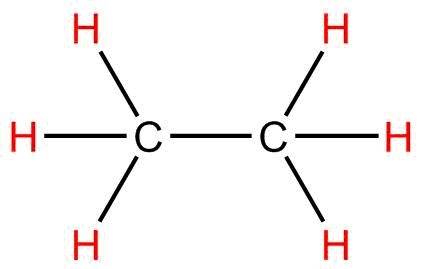
What is the maximum number of hydrogen atoms that can be covalently bonded in a molecule containing two carbon atoms?a) 2b) 3c)
aksik [14]

Answer:

           The correct answer is Option-D (6 Hydrogen atoms).

Explanation:

                  Carbon atom has a unique property of linking to it self and making a chain of carbon called as Catenation. In a molecule having two carbon atoms there must be a bond between the two carbon atoms. The bond can be saturated (single bond) or unsaturated (double or triple bond). But as the statement states maximum number of hydrogen atoms so, we will asume the bond between two carbon atoms to be single.

                  As carbon has four valence electrons so, it has the ability to make four single bonds. In given molecule each carbon has already made a single bond with another carbon therefore, each carbon is left with three more unpaired electrons which will make covalent bond with three hydrogen atoms each as shown in attached structure.

8 0
2 years ago
How to correctly solve this problem : 4.05Kg+567.95g+100.1g correct and best way
VARVARA [1.3K]
Check attached file for the answer.

7 0
2 years ago
Exactly 1.0 mol N2O4 is placed in an empty 1.0-L container and allowed to reach equilibrium described by the equation N2O4(g) 2N
Amanda [17]

Answer : The correct option is, (a) 0.44

Explanation :

First we have to calculate the concentration of N_2O_4.

\text{Concentration of }N_2O_4=\frac{\text{Moles of }N_2O_4}{\text{Volume of solution}}

\text{Concentration of }N_2O_4=\frac{1.0moles}{1.0L}=1.0M

Now we have to calculate the dissociated concentration of N_2O_4.

The balanced equilibrium reaction is,

                             N_2O_4(g)\rightleftharpoons 2NO_2(aq)

Initial conc.           1.0 M          0

At eqm. conc.     (1.0-x) M    (2x) M

As we are given,

The percent of dissociation of N_2O_4 = \alpha = 28.0 %

So, the dissociate concentration of N_2O_4 = C\alpha=1.0M\times \frac{28.0}{100}=0.28M

The value of x = C\alpha = 0.28 M

Now we have to calculate the concentration of N_2O_4\text{ and }NO_2 at equilibrium.

Concentration of N_2O_4 = 1.0 - x  = 1.0 - 0.28 = 0.72 M

Concentration of NO_2 = 2x = 2 × 0.28 = 0.56 M

Now we have to calculate the equilibrium constant for the reaction.

The expression of equilibrium constant for the reaction will be:

K_c=\frac{[NO_2]^2}{[N_2O_4]}

Now put all the values in this expression, we get :

K_c=\frac{(0.56)^2}{0.72}=0.44

Therefore, the equilibrium constant K_c for the reaction is, 0.44

8 0
2 years ago
Other questions:
  • If a large marshmallow has a volume of 2.75 in3 and density of 0.242 g/cm3, how much would it weigh in grams? 1 in3=16.39 cm3.
    9·1 answer
  • Choose all the answers that apply. Lakes are recharged by _____. 1.evaporation 2.precipitation 3.rivers 4.transpiration 5.ground
    12·2 answers
  • 1. How many grams of chromium metal are plated out when a constant current of 8.00 A is passed through an aqueous solution conta
    15·1 answer
  • What mass of excess reactant remains at the end of the reaction if 90.0 g of so2 are mixed with 100.0 g of o2? 2so2 + o2 → 2so3?
    10·1 answer
  • The oxidation numbers of nitrogen in NH3, HNO3, and NO2 are, respectively: -3, -5, +4 +3, +5, +4 -3, +5, -4 -3, +5, +4
    9·1 answer
  • What mass of carbon dioxide (co2) can be produced from 86.17 grams of c6h14 and excess oxygen?
    15·1 answer
  • What sample size (grams) of Na3PO4 (FW 164.00) known to be 50.00% pure should be used to consume exactly 40.00 mL of 0.1000 M HC
    6·1 answer
  • 1. What are small-scale techniques in chemistry? <br>​
    11·1 answer
  • There are three sets of sketches below, showing the same pure molecular compound (hydrogen chloride, molecular formula ) at thre
    15·1 answer
  • If two gases react, pumping more gas into the reaction container will _____ the rate of the reaction.
    12·2 answers
Add answer
Login
Not registered? Fast signup
Signup
Login Signup
Ask question!