answer.
Ask question
Login Signup
Ask question
All categories
  • English
  • Mathematics
  • Social Studies
  • Business
  • History
  • Health
  • Geography
  • Biology
  • Physics
  • Chemistry
  • Computers and Technology
  • Arts
  • World Languages
  • Spanish
  • French
  • German
  • Advanced Placement (AP)
  • SAT
  • Medicine
  • Law
  • Engineering
Airida [17]
2 years ago
12

Water flows through two smooth pipes with the same diameter and length as shown below. ipe is twice that through the first-pipe.

Both flows are The flow rate through the s laminar and fully _developed. Circle the letter of the statement that is correct about the pressure drop (pressure difference over the pipe length). (a) Pipe 1 has the higher pressure drop. (b) Pipe 2 has the higher pressure drop. (c) Pipes 1 and 2 have the same pressure drop. (d) T here is not enough information to answer the question.
Engineering
1 answer:
Alisiya [41]2 years ago
3 0

Answer:

The right answer is (d)

Explanation:

The pressure drop in smooth pipes with laminar flow is determined by the resistance of the fluid to flow, which is controlled by Reynolds's number. At higher Re, higher drop. But in this case, we have no information about the speed of the fluid in each pipe, and the ipe is not related to that speed. therefore we don´t have the information to say that any of the other options are the right ones

You might be interested in
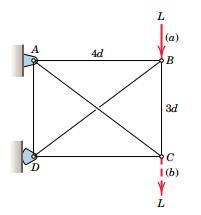
The rectangular frame is composed of four perimeter two-force members and two cables AC and BD which are incapable of supporting
Rama09 [41]

Answer:

Your question is lacking some information attached is the missing part and the solution

A) AB = AD = BD = 0, BC = LC

    AC = \frac{5L}{3}T, CD = \frac{4L}{3} C

B) AB = AD = BC = BD = 0

   AC = \frac{5L}{3} T, CD = \frac{4L}{3} C

Explanation:

A) Forces in all members due to the load L in position A

assuming that BD goes slack from an inspection of Joint B

AB = 0 and BC = LC from Joint D, AD = 0 and CD = 4L/3 C

B) steps to arrive to the answer is attached below

AB = AD = BC = BD = 0

AC = \frac{5L}{3} T,  CD = \frac{4L}{3}C

7 0
2 years ago
Consider insulation on a circular pipe For the same thickness and type of insulation, the thermal resistance of the insulation i
leonid [27]

Answer:

b). The same for all pipes independent of the diameter

Explanation:

We know,

R_{conduction}=\frac{ln(\frac{r_{2}}{r_{1}})}{2\pi LK}

R_{convection}=\frac{1}{h(2\pi r_{2}L)}

From the above formulas we can conclude that the thermal resistance of a substance mainly depends upon heat transfer coefficient,whereas radius has negligible effects on heat transfer coefficient.

We also know,

Factors on which thermal resistance of insulation depends are :

1. Thickness of the insulation

2. Thermal conductivity of the insulating material.

Therefore from above observation we can conclude that the thermal resistance of the insulation is same for all pipes independent of diameter.

5 0
2 years ago
An excited electron in an Na atom emits radiation at a wavelength 589 nm and returns to the ground state. If the mean time for t
11Alexandr11 [23.1K]

Answer:   Inherent width in the emission line: 9.20 × 10⁻¹⁵ m or 9.20 fm

                length of the photon emitted: 6.0 m

Explanation:

The emitted wavelength is 589 nm and the transition time is ∆t = 20 ns.

Recall the Heisenberg's uncertainty principle:-

                                 ∆t∆E ≈ h ( Planck's Constant)

The transition time ∆t corresponds to the energy that is ∆E

E=h/t = \frac{(1/2\pi)*6.626*10x^{-34} J.s}{20*10x^{-9} } = 5.273*10x^{-27} J =  3.29* 10^{-8} eV.

The corresponding uncertainty in the emitted frequency ∆v is:

∆v= ∆E/h = (5.273*10^-27 J)/(6.626*10^ J.s)=  7.958 × 10^6 s^-1

To find the corresponding spread in wavelength and hence the line width ∆λ, we can differentiate

                                                    λ = c/v

                                                    dλ/dv = -c/v² = -λ²/c

Therefore,

      ∆λ = (λ²/c)*(∆v) = {(589*10⁻⁹ m)²/(3.0*10⁸ m/s)} * (7.958*10⁶ s⁻¹)

                                 =  9.20 × 10⁻¹⁵ m or 9.20 fm

     The length of the photon (<em>l)</em> is

l = (light velocity) × (emission duration)

  = (3.0 × 10⁸  m/s)(20 × 10⁻⁹ s) = 6.0 m          


6 0
2 years ago
A shaft consisting of a steel tube of 50-mm outer diameter is to transmit 100 kW of power while rotating at a frequency of 34 Hz
nikitadnepr [17]

Answer:

25 - \sqrt[4]{26.66*10^{-8} }  mm

Explanation:

Given data

steel tube : outer diameter = 50-mm

power transmitted = 100 KW

frequency(f) = 34 Hz

shearing stress ≤ 60 MPa

Determine tube thickness

firstly we calculate the ; power, angular velocity and torque of the tube

power = T(torque) * w (angular velocity)

angular velocity ( w ) = 2\pif = 2 * \pi * 34 = 213.71

Torque (T) = power / angular velocity = 100000 / 213.71 = 467.92 N.m/s

next we calculate the inner diameter  using the relation

  \frac{J}{c_{2}  } = \frac{T}{t_{max} }  = 467.92 / (60 * 10^6) =  7.8 * 10^-6 m^3

also

c2 = (50/2) = 25 mm

\frac{J}{c_{2} } = \frac{\pi }{2c_{2} } ( c^{4} _{2} - c^{4} _{1} ) =  \frac{\pi }{0.050} [ ( 0.025^{4} - c^{4} _{1}  ) ]

therefore; 0.025^4 - c^{4} _{1} = 0.050 / \pi (7.8 *10^-6)

c^{4} _{1} = 39.06 * 10 ^-8 - ( 1.59*10^-2 * 7.8*10^-6)

    39.06 * 10^-8 - 12.402 * 10^-8 =26.66 *10^-8

c_{1} = \sqrt[4]{26.66 * 10^{-8} }  =

THE TUBE THICKNESS

c_{2} - c_{1} = 25 - \sqrt[4]{26.66*10^{-8} }  mm

4 0
2 years ago
Who want to play "1v1 lol unblocked games 76"
kotegsom [21]

Answer:I want to play what game?

Explanation:

3 0
2 years ago
Read 2 more answers
Other questions:
  • Determine the amount of gamma and alpha phases in a 10-kg, 1060 steel casting as it is being cooled to the following temperature
    6·1 answer
  • If a server takes precisely 15 seconds to serve a customer and customers arrive exactly every 20 seconds, what is the average wa
    7·1 answer
  • The rigid bar CDE is attached to a pin support at E and rests on the 30 mm diameter brass cylinder BD. A 22 mm diameter steel ro
    8·1 answer
  • Consider a very long rectangular fin attached to a flat surface such that the temperature at the end of the fin is essentially t
    9·1 answer
  • The 10-kg block slides down 2 m on the rough surface with kinetic friction coefficient μk = 0.2. What is the work done by the fr
    7·1 answer
  • Consider water at 27°C in parallel flow over an isothermal, 1‐m‐long flat plate with a velocity of 2 m/s. a) Plot the variation
    15·1 answer
  • Oil enters a counterflow heat exchanger at 600 K with a mass flow rate of 10 kg/s and exits at 200 K. A separate stream of liqui
    12·1 answer
  • John was a high school teacher earning $ 80,000 per year. He quit his job to start his own business in pizza catering. In order
    11·1 answer
  • Discuss your interpretation of the confidence-precision trade-off, and provide a few examples of how you might make a choice in
    14·1 answer
  • Determine the design angle ϕ (0∘≤ϕ≤90 ∘) between struts AB and AC so that the 400 lb horizontal force has a component of 600 lb
    10·1 answer
Add answer
Login
Not registered? Fast signup
Signup
Login Signup
Ask question!