answer.
Ask question
Login Signup
Ask question
All categories
  • English
  • Mathematics
  • Social Studies
  • Business
  • History
  • Health
  • Geography
  • Biology
  • Physics
  • Chemistry
  • Computers and Technology
  • Arts
  • World Languages
  • Spanish
  • French
  • German
  • Advanced Placement (AP)
  • SAT
  • Medicine
  • Law
  • Engineering
Sphinxa [80]
2 years ago
14

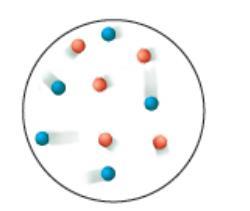
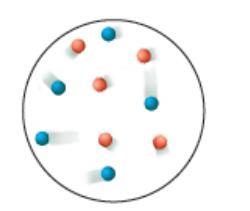
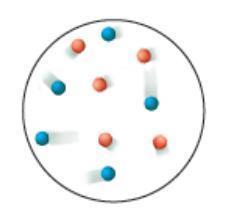
Choose a depiction of a gas sample containing equal molar amounts of xenon and argon as described by kinetic molecular theory. R

ed dots are used to represent xenon atoms and blue dots to represent argon atoms. Each atom is drawn with a "tail" that represents its velocity relative to the others in the mixture.

Chemistry
2 answers:
Setler79 [48]2 years ago
7 0

Answer:

On the attached picture.

Explanation:

Hello,

At first, it is important to remember that kinetic molecular theory help us understand how the molecules of a gas behave in terms of motion. In such a way, the relative velocity of a gas molecule has the following relationship with the gas' molar mass:

V∝\frac{1}{\sqrt{M} }

That is, an inversely proportional relationship which allows us to infer that the bigger the molecule the slower it. In this manner, as argon is smaller than xenon, it will move faster.

Now, as the gases are in equal molar amounts and considering that argon moves faster, on the attached picture you will find the suitable depiction of the gas sample, since red dots (argon) have a larger tail than the blue dots (xenon).

Best regards.

rusak2 [61]2 years ago
3 0

Answer:

<u>Kinetic Molecular theory(KMT):</u>Each molecules or atom of any gas is in a constant motion, and will have an elastic form of collision with other atoms present along with it inside any enclosed area or container.

And, the total kinetic energy of the molecules will be equal to the total or absolute temperature possessed by the number of atoms which are in motion inside the enclosed container.

Explanation:

<u>Xenon and Argon's molecules inside a container:</u>

When we study the properties of argon,Ar and xenon,Xe the denser molecule is the later one.As, the density of xenon,Xe is around 5.761 kg/m³, while the argon's density is about 1.7838 kg/m³. So, obviously the moment of argon's molecules will be more then that of xenon's. And the "tail" drawn with the molecules will be highlighted with high value of velocity inside the diagram.

You might be interested in
The combustion of propane is best described as an
GalinKa [24]
<h3><u>Answer;</u></h3>

Exothermic chemical reaction

<h3><u>Explanation;</u></h3>
  • Exothermic reactions are chemical reactions where the products have less energy that the reactants.
  • Exothermic reactions give off energy, usually in the form of heat, while endothermic reactions absorb energy.
  • The combustion of propane is definitely an exothermic reaction because it generates a lot of heat.

5 0
2 years ago
The table above summarizes data given to a student to evaluate the type of change that took place when substance X was mixed wit
Tamiku [17]

The question is incomplete, the complete question is;

The table above summarizes data given to a student to evaluate the type of change that took place when substance X was mixed with water. The student claimed that the data did not provide enough evidence to determine whether a chemical or physical change took place and that additional tests were needed. Which of the following identifies the best way to gather evidence to support the type of change that occurred when water and Xwere mixed?

A. Measuring the melting point of the mixture of water and X

B. Adding another substance to the mixture of water and X to see whether a solid forms

C Measuring and comparing the masses of the water,  X, and the mixture of water and X

D Measuring the electrical conductivities of X and the mixture of water and X

Answer:

D Measuring the electrical conductivities of X and the mixture of water and X

Explanation:

Unfortunately, I am unable to reproduce the table here. However, from the table,  the temperature of the of the mixture of the solid X and water was 101.6°C. This is above the boiling point of water and way below the temperature of the solid X.

This goes a long way to suggest that there was some kind of interaction between the water and X which accounted for the observed temperature of the system of X in water.

The only way we can be able to confirm if X actually dissolved in water is to measure the conductivity of the water. dissolved solids increase the conductivity of water.

6 0
2 years ago
If the symbol X represents a central atom, Y represents outer atoms, and Z represents lone pairs on the central atom, the struct
MA_775_DIABLO [31]

Answer:

1. sp  = XY₂

2. sp²  = XY₂Z, XY₃

3. sp3³ = XY₄, XY₂Z₂, XY₃Z

4. sp³d  = XY₅, XY₂Z₃, XY₃Z₂, XY₄Z

5. sp³d² = XY₆, XY₄Z₂, XY₅Z

Explanation:

this is quite dicey, so it should be looked into carefully.

we would classify each of the abbreviation according to their  hybridization and it electron domain.

⇒ sp hybridization = XY₂

in this, we can see that the central atom X is bonded to two outer atoms Y.

this makes the no of hybrid orbitals and the no of sigma bonds both 2.

electron domain = 2.

⇒ sp² hybridization = XY₂Z, XY₃

Here we can see the central atom X bonded with three outer atoms Y in XY₂Z and in XY₃. For XY₂Z molecule, the no of sigma bonds is 2 and the no of hybrid orbitals is 3. While for XY₃ molecule, the no of sigma bonds is 3 while the no of hybrid orbital is 3.

electron domain = 3.

⇒ sp³ hybridization = XY₄, XY₂Z₂, XY₃Z

for XY₄ molecule, the central atom X is bonded with four outer atoms Y. It has 4 numbers of both the sigma and orbital atoms.

In XY₂Z₂, the central atom X is bonded to 2 outer atoms Y, and has 2 lone pairs Z. From this, the no of hybrid orbitals is 4 and the no of sigma bonds is 2, with 2 lone pairs causing the sp³ hybridization.

⇒ sp³d hybridization = XY₅, XY₂Z₃, XY₃Z₂, XY₄Z

for all the molecules listed above, the sum of both the lone pairs and the outer atoms both give a total of 5, hence have the sp³d structure, viz;

XY₂Z₃:

total electron domain = 2+3 = 5  

XY₃Z₂:

total electron domain = 2+3 = 5

XY₄Z:

total electron domain = 1+4 = 5

⇒ sp³d² hybridization = XY₆, XY₄Z₂, XY₅Z

Same thing goes for the above molecule, where the sum of both the outer atoms and the lone pairs gives a total of 6 as can be seen in the example below.

XY4Z2:

total electron domain = 2+4 = 6

cheers, i hope this helps.

5 0
2 years ago
A person loses 2.70 lbs in two weeks how many grams did he lose?
Evgesh-ka [11]
He person lost 1224.7 grams.
6 0
3 years ago
Read 2 more answers
The reaction of 0.779 g K with O2 forms 1.417 g potassium superoxide, a substance used in self-contained breathing devices. Dete
zhannawk [14.2K]
First we need to find the number of moles of both K and O reacted
K - 0.779 g / 39 g/mol
  = 0.02 mol
the mass of O₂ reacted = 1.417 g - 0.779 g = 0.638 g
O₂ moles = 0.638 g / 32 g/mol
               = 0.02 mol 
the number of both K and O₂ moles reacted are equal 
therefore stoichiometry of K to O₂ reacted are 1:1 
then the formula of potassium superoxide is KO₂
3 0
2 years ago
Other questions:
  • Enter the symbol of a sodium ion, Na+, followed by the formula of a sulfate ion, SO42−. Separate the ions with a comma only—spac
    15·2 answers
  • If a person burns 2171 Cal each day, how much energy (kJ) does she burn in 2 days??
    7·1 answer
  • Describe how you would prepare approximately 2 l of 0.050 0 m boric acid, b(oh)3.
    12·1 answer
  • How many moles of MgCl2 are there in 319 g of the compound?
    5·1 answer
  • Which statement is true about molarity and percent by mass?
    12·2 answers
  • Which statements about reducing sugars are true? D‑Glucose (an aldose) is a reducing sugar. The oxidation of a reducing sugar fo
    7·1 answer
  • A chemist adds 180.0 mL of a 1.42M sodium carbonate (Na CO,) solution to a reaction flask. Calculate the millimoles of sodium ca
    8·1 answer
  • Using the data, which of the following is the rate constant for the rearrangement of methyl isonitrile at 320 ∘C? (HINT: the act
    13·1 answer
  • Bromine has two isotopes, Br79 and Br81. The isotopes occur in a 50:50 (1:1) ratio. Given that the mass spectrum of bromine cont
    12·1 answer
  • The molar mass of an imaginary molecule is is 93.89 g/mol. Determine its density at STP.
    14·1 answer
Add answer
Login
Not registered? Fast signup
Signup
Login Signup
Ask question!