answer.
Ask question
Login Signup
Ask question
All categories
  • English
  • Mathematics
  • Social Studies
  • Business
  • History
  • Health
  • Geography
  • Biology
  • Physics
  • Chemistry
  • Computers and Technology
  • Arts
  • World Languages
  • Spanish
  • French
  • German
  • Advanced Placement (AP)
  • SAT
  • Medicine
  • Law
  • Engineering
Lelechka [254]
2 years ago
7

The difference between ideal voltage source and the ideal current source​

Engineering
2 answers:
DENIUS [597]2 years ago
5 0
An ideal voltage source provides no energy when it is loaded by an open circuit (i.e. an infinite impedance), but approaches infinite energy and current when the load resistance approaches zero (a short circuit). ... An ideal current source has an infinite output impedance in parallel with the source.
Margarita [4]2 years ago
4 0
The ideal voltage source maintains a fixed voltage, and zero internal resistance. A current source is supposed to support any amount of potential difference across its terminals, and supply the same amount of current into the nodes it is connected to. No physical current source is ideal, just as ideal voltage sources.
You might be interested in
Problem 5) Water is pumped through a 60 m long, 0.3 m diameter pipe from a lower reservoir to a higher reservoir whose surface i
kap26 [50]

Answer:

\epsilon = 0.028*0.3 = 0.0084

Explanation:

\frac{P_1}{\rho} + \frac{v_1^2}{2g} +z_1 +h_p - h_l =\frac{P_2}{\rho} + \frac{v_2^2}{2g} +z_2

where P_1 = P_2 = 0

V1 AND V2  =0

Z1 =0

h_P = \frac{w_p}{\rho Q}

=\frac{40}{9.8*10^3*0.2} = 20.4 m

20.4 - (f [\frac{l}{d}] +kl) \frac{v_1^2}{2g} = 10

we know thaTV  =\frac{Q}{A}

V = \frac{0.2}{\pi \frac{0.3^2}{4}} =2.82 m/sec

20.4 - (f \frac{60}{0.3} +14.5) \frac{2.82^2}{2*9.81} = 10

f  = 0.0560

Re =\frac{\rho v D}{\mu}

Re =\frac{10^2*2.82*0.3}{1.12*10^{-3}} =7.53*10^5

fro Re = 7.53*10^5 and f = 0.0560

\frac{\epsilon}{D] = 0.028

\epsilon = 0.028*0.3 = 0.0084

4 0
2 years ago
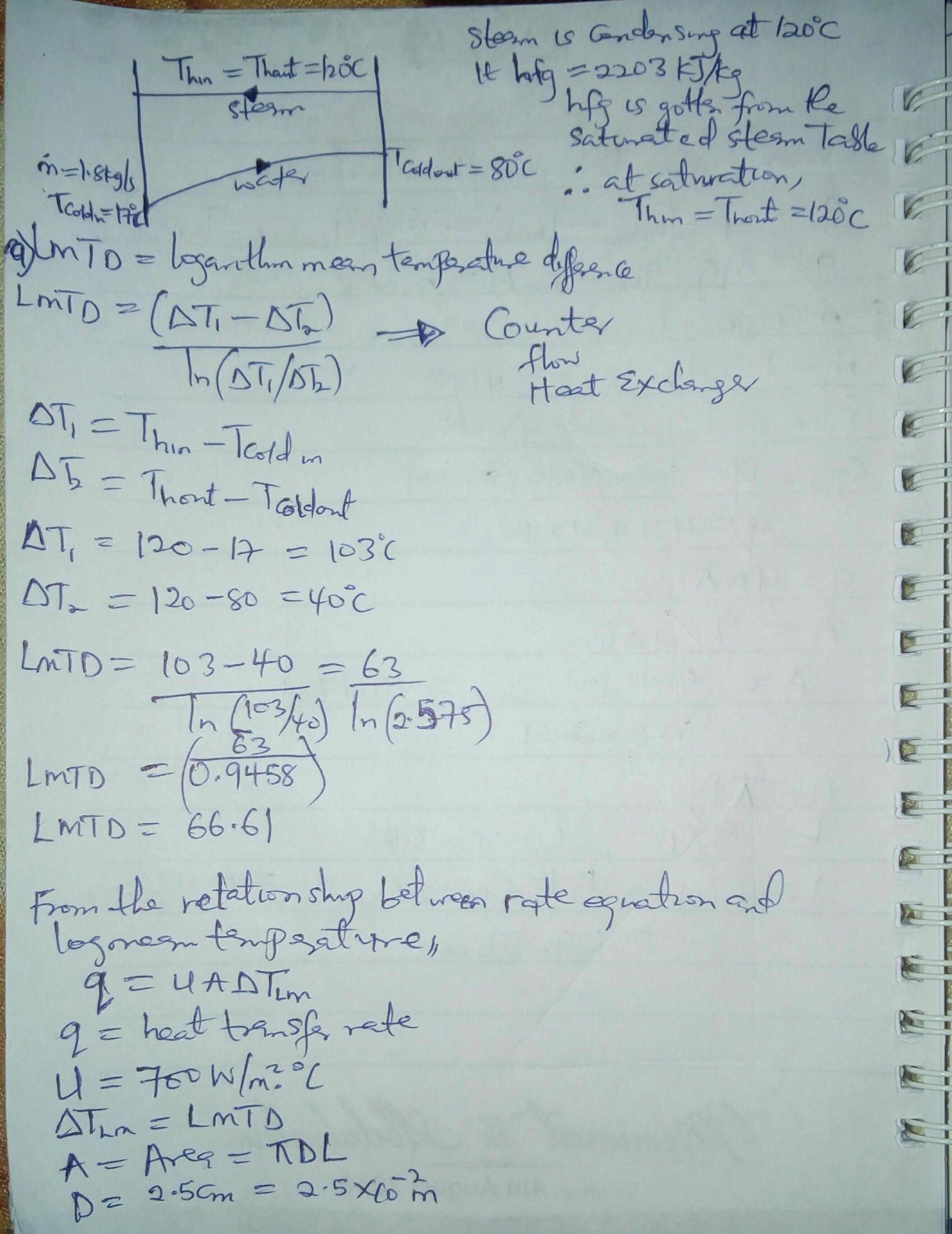
Water (cp = 4180 J/kg·°C) enters the 2.5 cm internal diameter tube of a double-pipe counter-flow heat exchanger at 17°C at a rat
aksik [14]

Answer:

Length = 129.55m, 129.55m

Explanation:

Given:

cp of water = 4180 J/kg·°C

Diameter, D = 2.5 cm

Temperature of water in =  17°C

Temperature of water out = 80°C

mass rate of water =1.8 kg/s.

Steam condensing at 120°C

Temperature at saturation = 120°C

hfg of steam at 120°C = 2203 kJ/kg

overall heat transfer coefficient of the heat exchanger = 700 W/m2 ·°C

U = 700 W/m2 ·°C

Since Temperature of steam is at saturation,

temperature of steam going in = temperature of steam out = 120°C

Energy balance:

Heat gained by water = Heat loss by steam

Let specific capacity of steam = 2010kJ/Kg .°C

Find attached the full solution to the question.

3 0
2 years ago
A cylindrical drum (2 ft. dia ,3 ft height) is filled with a fluid whose density is 40 lb/ft^3. Determine (a. the total volume o
Ksivusya [100]

Answer:

a)V=9.42\ ft^3

b)Mass in lb = 376.8 lb

Mass in slug = 11.71 slug

c)v=0.025\ ft^3/lb

d)w=1276 \ lb/ft.s^2

Explanation:

Given that

d= 2 ft

r= 1 ft

h= 3 ft

Density

\rho = 40\ lb/ft^3

a)

We know that volume V given as

V=\pi r^2 h

V=\pi \times 1^2\times 3

V=9.42\ ft^3

b)

Mass = Density x volume

mass =40\times 9.42\ lb

mass= 376.8 lb

We know that

1 lb = 0.031 slug

So 376.8 lb= 11.71 slug

Mass in lb = 376.8 lb

Mass in slug = 11.71 slug

c)

we know that specific volume(v) is the inverse of density.

v=\dfrac{1}{\rho}\ ft^3/lb

v=\dfrac{1}{40}\ ft^3/lb

v=0.025\ ft^3/lb

d)

Specific weight(w) is the product of density and the gravity(g).

w= ρ X g

w = 40 x 31.9

w=1276 \ lb/ft.s^2

8 0
2 years ago
As the porosity of a refractory ceramic brick increases:
ivolga24 [154]

Answer:

A) strength decreases, chemical resistance decreases, and thermal insulation increases

Explanation:

Strength always decreases, chemical resistence decreases, and thermal condictivity must be reduced therefore themal insulation must increase.

7 0
2 years ago
In which of the following branches of engineering is the practice not restricted?
fgiga [73]

Answer:

a) civil engineering.

Explanation:

Civil engineering is a professional engineering program that deals with the construction, design, and maintenance of all the natural and man-made environments including dams, buildings, railways, and roads.

Civil engineering is the branch of engineering that is the practice not restricted because civil engineer is not restricted to academic profession but practice in designing and construction can make someone a professional civil engineer.

Hence, the correct answer is "a)."

6 0
2 years ago
Read 2 more answers
Other questions:
  • Define a) Principal Plane b) Principal Stress c) anelasticity d) yield point e) ultimate tensile stress f) hardness g) toughness
    5·1 answer
  • A steam power plant operates on an ideal reheat- regenerative Rankine cycle and has a net power output of 80 MW. Steam enters th
    10·1 answer
  • Given a 5x5 matrix for Playfair cipher a. How many possible keys does the Playfair cipher have? Ignore the fact that some keys m
    6·1 answer
  • An aircraft component is fabricated from an aluminum alloy that has a plane-strain fracture toughness of 40 MPa1m (36.4 ksi1in.)
    15·1 answer
  • One mole of iron (6 1023 atoms) has a mass of 56 grams, and its density is 7.87 grams per cubic centimeter, so thecenter-to-cent
    15·1 answer
  • The driving force for fluid flow is the pressure difference, and a pump operates by raising the pressure of a fluid (by converti
    13·1 answer
  • The purification of hydrogen gas is possible by diffusion through a thin palladium sheet. Calculate the number of kilograms of h
    8·1 answer
  • Solid spherical particles having a diameter of 0.090 mm and a density of 2002 kg/m3 are settling in a solution of water at 26.7C
    8·1 answer
  • if the mine winch drum diameter is 6 m, calculate how far the cage will drop for each single rotation of the drum
    9·1 answer
  • George is replacing a burned out resistor in a circuit board. The board has a 10, a 20, and a 40 on resistor, all in parallel. W
    5·1 answer
Add answer
Login
Not registered? Fast signup
Signup
Login Signup
Ask question!