answer.
Ask question
Login Signup
Ask question
All categories
  • English
  • Mathematics
  • Social Studies
  • Business
  • History
  • Health
  • Geography
  • Biology
  • Physics
  • Chemistry
  • Computers and Technology
  • Arts
  • World Languages
  • Spanish
  • French
  • German
  • Advanced Placement (AP)
  • SAT
  • Medicine
  • Law
  • Engineering
Tamiku [17]
2 years ago
9

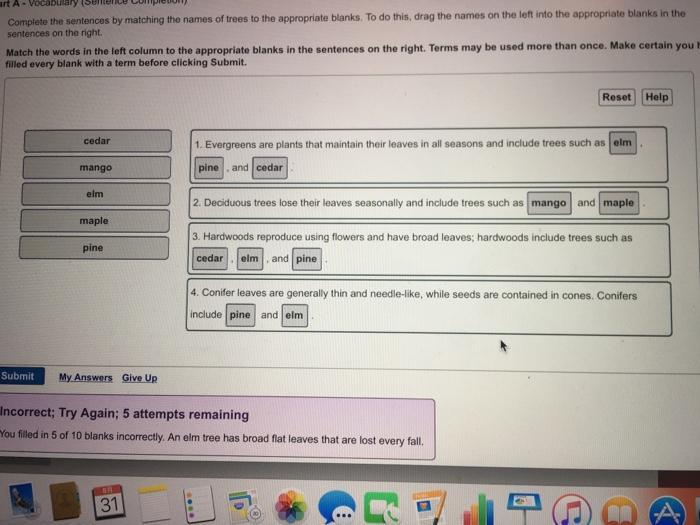
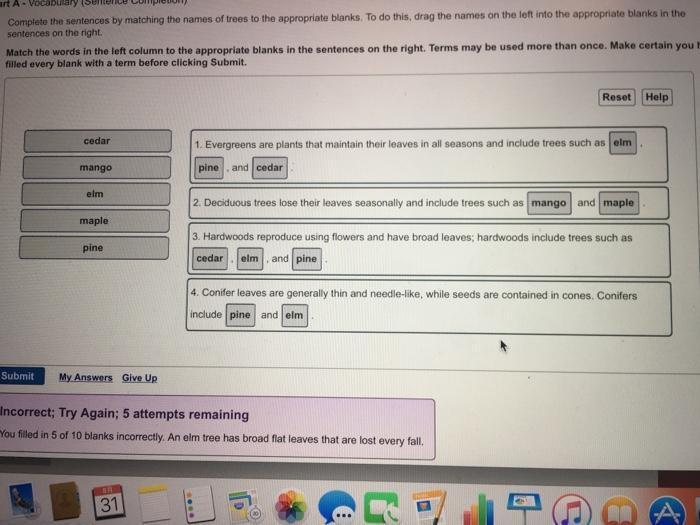
Complete the sentences by matching the names of trees to the appropriate blanks. To do this, drag the names on the left into the

appropriate blanks in the sentences on the right. Match the words in the left column to the appropriate blanks in the sentences on the right. Terms may be used more than once. Make certain you have filled every blank with a term before clicking Submit.

Chemistry
1 answer:
nlexa [21]2 years ago
7 0

Answer:  1. Pine, Cedar, Mango

2. Maple and ELm.

3. Mango. Elm and Maple.

4. Pine and Cedar.

Explanation:

Before I give the answers, I would like to explain the listed type or category of trees given in the question.

Evergreen;

Evergreen plants are those plants that retains its leaves throughout the year and into the following year. Their leaves are usually thicker and leatherier when compared to deciduous tree. Example of evergreen include most conifers species (such as blue spruce, pine, cedar) and mango.

Deciduous trees;

These are huge flowering plants that are found in many parts of the world. They are normally round shaped with branches spread out as they grow.

They include oaks, maples and beeches. The word deciduous means to “fall off”.

Hardwoods;

This is a wood from dicot trees. They are classified as Angiosperms i.e. flowering plants, which is the largest group of land plants. Hardwoods usually have broad leaves, enclosed nuts or seed.

Some notable examples of hardwoods include; balsa, beech, mahogany, oak etc.  

Conifers;

They are division of vascular land plants containing a single extant class. They are gymnosperms, cone-bearing seed plants and are normally perennial woody plants with secondary growth. Popular examples include; cedar, pine, redwoods, spruces etc.

1. Evergreen are plants that maintain their leaves in all seasons and include trees such as Pine, Cedar and Mango.

2. Deciduous trees lose their leaves seasonally and include trees such as Maple and Elm.

3. Hardwoods reproduce using flowers and have broad leaves such as Mango, Elm, Maple.

4. Conifers leaves are generally thin and needle-like, while seeds are contained in cones. Conifers include Pine and Cedar.

You might be interested in
A person loses 2.70 lbs in two weeks how many grams did he lose?
Evgesh-ka [11]
He person lost 1224.7 grams.
6 0
3 years ago
Read 2 more answers
Acetone major species present when dissolved in water
jek_recluse [69]

Answer: acetone molecule ( CH₃-CO-CH₃)


Explanation:


1) Acetone is CH₃-CO-CH₃


2) That is a molecule (build up of covalent bonds).


3) When dissolved, covalent bonded compounds remain as separate molecules, then it is said that the major species present in the solution is the molecule. The molecules of acetone are surrounded (sovated) by the molecules of water.


This as opposed to the case of ionic compounds that ionize. When a compound as NaCl dissolves in water, it ionizes completely, so the major speceies are not NaCl formulas, but the ions Na⁺ and Cl⁻, not molecules.


That leads to the answer: the major species present when acetone is dissolved in water is the molecules of acetone (you do not need to state the fact that the molecules of water are part of the solution, because that is not the target of the question).


3 0
2 years ago
How many grams of CaF2 are present in 1.25 L of a 0.15 M solution of CaF2? How do I find the grams I am confused on that part?
dybincka [34]

Answer:

Mass = 14.64 g

Explanation:

Given data:

Volume of solution = 1.25 L

Molarity of Solution = 0.15 M

Mass of CaF₂ = ?

Solution:

Molarity is used to describe the concentration of solution. It tells how many moles are dissolve in per litter of solution.

Formula:

Molarity = number of moles of solute / L of solution

We will calculate the number of moles of CaF₂ and then determine the mass by using number of moles.

0.15 M =  number of moles of solute / 1.25 L

number of moles of solute = 0.15 M ×  1.25 L

number of moles of solute = 0.1875 mol/L × L

number of moles of solute = 0.1875 mol

Mass in gram:

Mass = number of moles × molar mass

Mass = 0.1875 mol ×78.07 g/mol

Mass = 14.64 g

7 0
2 years ago
A 1.0-gram sample of solid iodine is placed in a tube and the tube is sealed after all of the air is removed. The tube and the s
yKpoI14uk [10]

Answer:

27.0

Explanation:

Because Mass can neither be created nor be destroyed hence total mass of sample of iodine and tube remain equal as it is sealed.

7 0
2 years ago
8.03 Solutions Lab Report<br> Does anyone have a PDF or Document of FLVS 8.03 Solutions Lab
GarryVolchara [31]

8.03 solutions report is described below.

Explanation:

8.03 Solutions Lab Report

In this laboratory activity, you will investigate how temperature, agitation, particle size, and dilution affect the taste of a drink. Fill in each section of this lab report and submit it and your pre-lab answers to your instructor for grading.  

Pre-lab Questions:

In this lab, you will make fruit drinks with powdered drink mix. Complete the pre-lab questions to get the values you need for your drink solutions.  

Calculate the molar mass of powered fruit drink mix, made from sucrose (C12H22O11).

Using stoichiometry, determine the mass of powdered drink mix needed to make a 1.0 M solution of 100 mL.

7 0
2 years ago
Read 2 more answers
Other questions:
  • The mechanism for the reaction described by 2N2O5(g) ---&gt; 4NO2(g) + O2(g) is suggested to be (1) N2O5(g) (k1)---&gt;(K-1) NO2
    9·1 answer
  • A 1.25 g gas sample occupies 663 ml at 25∘ c and 1.00 atm. what is the molar mass of the gas?
    15·1 answer
  • Elements whose names end with âium are usually metals; sodium is one example. Identify a nonmetal whose name also ends with âium
    14·1 answer
  • To find the Ce4+ content in a solid sample, 4.3718 g of the solid sample were dissolved and treated with excess iodate to precip
    6·2 answers
  • Calculate the molarity of 1.0 mol of KCl in 750 ml of solution
    9·2 answers
  • Which choice(s) correctly rank(s) the bonds in terms of increasing polarity?
    9·1 answer
  • How can a piece of wood floating on water illustrate the condition of lowest potential energy and maximum
    10·1 answer
  • Every single-celled organism is able to survive because it carries out *
    5·1 answer
  • Daniel Harris has always enjoyed eating tuna fish. Unfortunately, a study of the mercury content of canned tuna in 2010 found th
    13·1 answer
  • The three aspects of the measuring process are units, systems, and instruments.
    15·2 answers
Add answer
Login
Not registered? Fast signup
Signup
Login Signup
Ask question!