answer.
Ask question
Login Signup
Ask question
All categories
  • English
  • Mathematics
  • Social Studies
  • Business
  • History
  • Health
  • Geography
  • Biology
  • Physics
  • Chemistry
  • Computers and Technology
  • Arts
  • World Languages
  • Spanish
  • French
  • German
  • Advanced Placement (AP)
  • SAT
  • Medicine
  • Law
  • Engineering
lorasvet [3.4K]
2 years ago
10

The quadratic equation y = –6x2 + 100x – 180 models the store’s daily profit, y, for selling soccer balls at x dollars. The quad

ratic equation y = –4x2 + 80x – 150 models the store’s daily profit, y, for selling footballs at x dollars. Use a graphing calculator to find the intersection point(s) of the graphs, and explain what they mean in the context of the problem

Mathematics
2 answers:
Mrac [35]2 years ago
6 0

Sample response:

points of intersection represent when the price and profit are the same for each type of ball.

The intersection points are approximately

(8.16, 236.49) and (1.84, –16.49).

When the store charges $8.16 for each type of ball, they make the same profit from each ball, approximately $236.49.

Charging $1.88 provides no profit for either type of ball.

AURORKA [14]2 years ago
6 0

Answer:

Step-by-step explanation:

The quadratic equation    y = -6x^2 + 100x - 180        models the store’s daily profit, y, for selling soccer balls at x dollars.

The quadratic equation    y = -4x^2 + 80x - 150    models the store’s daily profit, y, for selling footballs at x dollars.

Now we are supposed to find the intersection point(s) of the graphs using graphing calculator

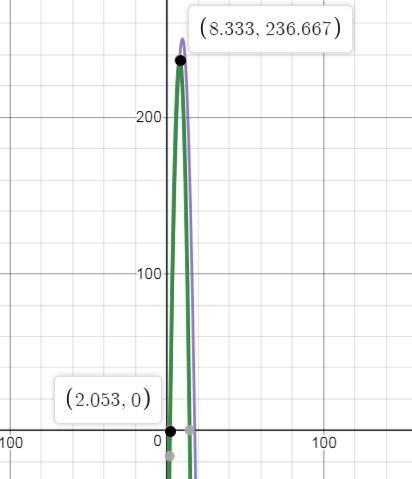
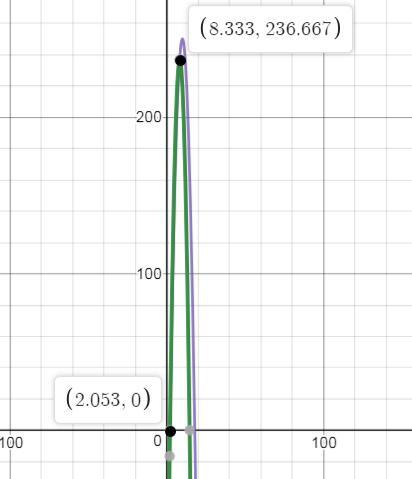
Refer the attached graph.

y = -6x^2 + 100x - 180   -- Green line

y = -4x^2 + 80x - 150    -- Purple line

So, from the graph we can see there are two intersection points :

(8.333,236.667)

(2.053,0)

So, from solution (8.333,236.667) we depict that at x = 8.333 dollars the store's daily profit y = 236.667 for selling football or soccer ball.

From solution (2.053,0)we depict that at x = 0 dollars the store's daily profit y = 2.053 for selling football or soccer ball.

You might be interested in
Which of the following shows the extraneous solution to the logarithmic equation below???
avanturin [10]
Short Answer x = - 6
Remark
You gave the second best answer. 

The trick here is not to divide both sides by 2. Solve the problem this way.

log_5(x + 1)^2 = 2 Take the antilog of both sides
(x + 1)^2 = 5^2       Expand the equation
x^2 + 2x + 1 = 25   Subtract 25 from both sides.
x^2 + 2x - 24 = 0    Factor
(x + 6)(x - 4) = 0     Find the zeros.

x + 6 = 0
x = - 6  <<<<<<<< Answer. This is the extraneous root.
The reason this is an extraneous root is that x<=0 do not have a logarithem

x - 4 = 0
x = 4    This is a legitimate result to the original equation.
7 0
2 years ago
Read 2 more answers
Moira borrowed $4,500 from her grandfather to pay for her first year of college. Three years later, she repaid the $4,500 along
Nataly [62]

Answer: 1.8%

Step-by-step explanation:

8 0
2 years ago
Carys is checking her tax bill for the last year.
mariarad [96]
£18240

since the amount she earned falls within the range of the tax rate 40%, multiply her earnings by 0.4.

£45600*0.4= 18240
3 0
2 years ago
Read 2 more answers
A researcher gathers data on the length of essays​ (number of​ lines) and the SAT scores received for a sample of students enrol
LenaWriter [7]

Answer:

(C) The slope of the regression equation is not significantly different from zero

Step-by-step explanation:

Let's suppose that we have the following linear model:

y= \beta_o +\beta_1 X

Where Y is the dependent variable and X the independent variable. \beta_0 represent the intercept and \beta_1 the slope.

In order to estimate the coefficients \beta_0 ,\beta_1 we can use least squares estimation.

If we are interested in analyze if we have a significant relationship between the dependent and the independent variable we can use the following system of hypothesis:

Null Hypothesis: \beta_1 = 0

Alternative hypothesis: \beta_1 \neq 0

Or in other wouds we want to check is our slope is significant.

In order to conduct this test we are assuming the following conditions:

a) We have linear relationship between Y and X

b) We have the same probability distribution for the variable Y with the same deviation for each value of the independent variable

c) We assume that the Y values are independent and the distribution of Y is normal

The significance level is provided and on this case is \alpha=0.05

The standard error for the slope is given by this formula:

SE_{\beta_1}=\frac{\sqrt{\frac{\sum (y_i -\hat y_i)^2}{n-2}}}{\sqrt{\sum (X_i -\bar X)^2}}

Th degrees of freedom for a linear regression is given by df=n-2 since we need to estimate the value for the slope and the intercept.

In order to test the hypothesis the statistic is given by:

t=\frac{\hat \beta_1}{SE_{\beta_1}}

The confidence interval for the slope would be given by this formula:

\hat \beta_1 + t_{n-2, \alpha/2} \frac{\sqrt{\frac{\sum (y_i -\hat y_i)^2}{n-2}}}{\sqrt{\sum (X_i -\bar X)^2}}

And using the last formula we got that the confidence interval for the slope coefficient is given by:

-0.88 < \beta_1

IF we analyze the confidence interval contains the value 0. So we can conclude that we don't have a significant effect of the slope on this case at 5% of significance. And the best option would be:

(C) The slope of the regression equation is not significantly different from zero
6 0
2 years ago
Which statement identifies how to show that j(x) = 11.6ex and k(x) = In (StartFraction x Over 11.6 EndFraction) are inverse func
Vadim26 [7]

Answer:

<h2>It must be shown that both j(k(x)) and k(j(x)) equal x</h2>

Step-by-step explanation:

Given the function  j(x) = 11.6e^x and k(x) = ln \dfrac{x}{11.6}, to show that both equality functions are true, all we need to show is that both  j(k(x)) and k(j(x)) equal x,

For j(k(x));

j(k(x)) = j[(ln x/11.6)]

j[(ln (x/11.6)] = 11.6e^{ln (x/11.6)}

j[(ln x/11.6)] = 11.6(x/11.6) (exponential function will cancel out the natural logarithm)

j[(ln x/11.6)] = 11.6 * x/11.6

j[(ln x/11.6)] = x

Hence j[k(x)] = x

Similarly for k[j(x)];

k[j(x)] = k[11.6e^x]

k[11.6e^x] = ln (11.6e^x/11.6)

k[11.6e^x]  = ln(e^x)

exponential function will cancel out the natural logarithm leaving x

k[11.6e^x]  = x

Hence k[j(x)] = x

From the calculations above, it can be seen that j[k(x)] =  k[j(x)]  = x, this shows that the functions j(x) = 11.6e^x and k(x) = ln \dfrac{x}{11.6} are inverse functions.

4 0
2 years ago
Other questions:
  • Find a vector function, r(t), that represents the curve of intersection of the two surfaces. the paraboloid z = 7x2 + y2 and the
    8·1 answer
  • How does 10 - 4 help you solve 30 - 4
    12·2 answers
  • A telephone pole 35 feet high is situated on an 11 degree slope from the horizontal. The measure of angle CAB is 21 degrees. Fin
    7·1 answer
  • Which oh the following are among the five basic postulates of Euclidean geometry
    6·1 answer
  • What is the value of minus 6 x cubed minus y squared minus 3 x y if if x = -2 and y = 4
    5·2 answers
  • Find the area under the standard normal curve to the right of z=1.9
    11·1 answer
  • Determine whether the following statements are true or false. ​(a) When a factor is controlled by setting it to three​ levels, t
    11·2 answers
  • Country A produces about four times the amount of diamonds in carats produced in country B. If the total produced in both countr
    6·1 answer
  • What is the product.... <br><br> (1.017)•(0.072)=
    10·2 answers
  • A dealer bought 3 gross buttons at $.38 a dozen. He sold the buttons at 5 cents each. How much was his profit per gross?(12 doze
    8·2 answers
Add answer
Login
Not registered? Fast signup
Signup
Login Signup
Ask question!