answer.
Ask question
Login Signup
Ask question
All categories
  • English
  • Mathematics
  • Social Studies
  • Business
  • History
  • Health
  • Geography
  • Biology
  • Physics
  • Chemistry
  • Computers and Technology
  • Arts
  • World Languages
  • Spanish
  • French
  • German
  • Advanced Placement (AP)
  • SAT
  • Medicine
  • Law
  • Engineering
Ray Of Light [21]
2 years ago
4

A steam power plant operates on an ideal reheat Rankine cycle between the pressure limits of 15 MPa and 10 kPa. The mass flow ra

te of steam through the cycle is 12 kg/s. Steam enters both stages of the turbine at 500C.
If the moisture content of the steam at the exit of the low-pressure turbine is not to exceed 10%, determine
(a) The pressure, in kPa ,at which reheating takes place,
(b) The total rate of heat input, in kW, in the boiler,
(c) The thermal efficiency of the cycle. Also, show the cycle on a T-s diagram with respect to the saturation lines.

Physics
1 answer:
tino4ka555 [31]2 years ago
6 0

Answer:

a) 2161 KPa

b) 45,012.6 kW

c) 42.6 % and see attachment for T-s diagram

Explanation:

Assumptions

1. SS − SF

2. heat loss to the surroundings is negligible

3. KE = P E → 0

4. properties are constant

Part a)

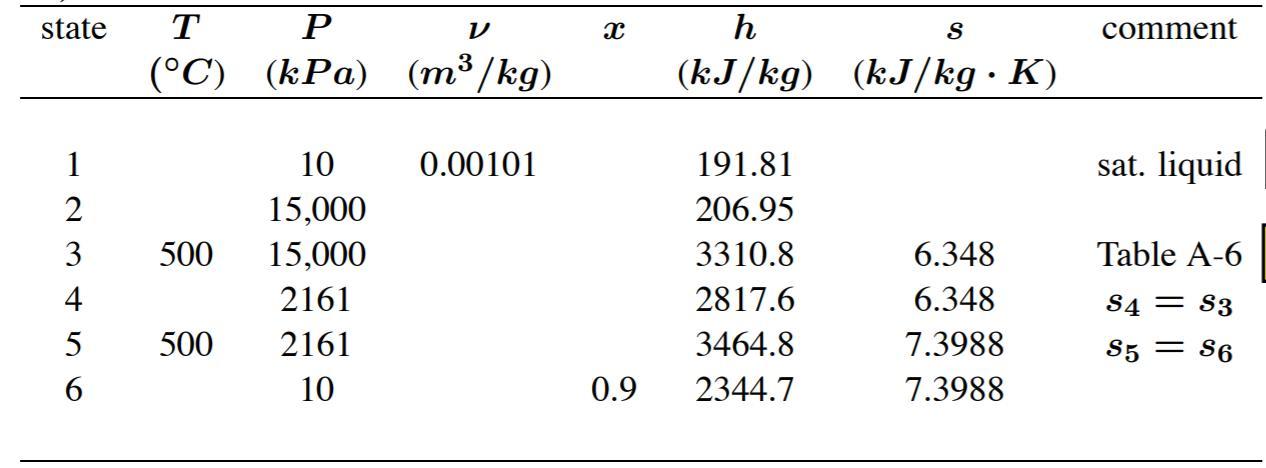
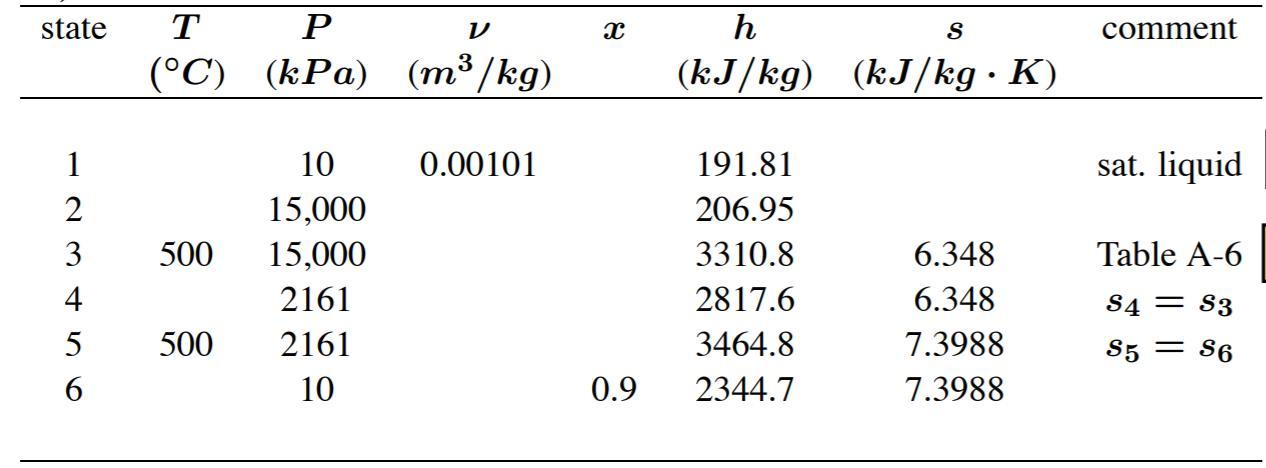
The values obtained from water property tables at respective state points are tabulated in the attachment.

Pump

wp,in = h2 − h1 = ν1(P2 − P1)

= (0.00101 m3/kg)*(15000 − 10) kPa

= 15.14 kJ/kg

h2 = h1 + wp,in

= 191.81 kJ/kg + 15.14 kJ/kg = 206.95 kJ/kg

State 6:

h6 = (1 − x)hf + xhg

= 0.1(191.81 kJ/kg)+0.9(2583.9 kJ/kg)

= 2344.7 kJ/kg

s6 = (1 − x)sf + xsg

= 0.1(0.6492 kJ/kg · K)+0.9(8.1488 kJ/kg · K)

= 7.3988 kJ/kg · K

State 5

To find the pressure at 5 we need to interpolate in the super heated tables. First the entropy at a pressure  above the desired value and then at a pressure below the desired value.

@500 ◦C, @2 MPa −→ s = 7.4337 kJ/kg · K

@500 ◦C, @2.5 MPa −→ s = 7.3254 kJ/kg · K

These values of s bound our value of s5 = 7.3988 kJ/kg · K.

Interpolate to find the pressure, P5

(7.4337 − 7.3988) /  (7.4337 − 7.3254)

= 0.32225

P3 = 2000 kP a + 0.32225 × (2500 − 2000) kPa

= 2161 kPa

h5 = 0.32225 × (3468.3 kJ/kg)+0.67775 × (3462.8 kJ/kg) = 3464.8 kJ/kg

State 4

To find h4 we need to interpolate within the super heated tables

@2 MPa, s = 6.348 kJ/kg · K −→ h = 2802.7 kJ/kg

@2.5 MPa, s = 6.348 kJ/kg · K −→ h = 2848.9 kJ/kg

To find the actual value of h4 we need to interpolate between these two pressures to find the value at  P4 = 2161 kPa

h4 = 0.678 * (2802.7 kJ/kg)+0.322 *(2848.9 kJ/kg) = 2817.6 kJ/kg

Part b

The heat input to the boiler is given as :

Q_in = m_flow*[(h3 − h2)+(h5 − h4)]

= (12 kg/s)*[(3310.8 − 206.95) + (3464.8 − 2817.6)] kJ/kg = 45,012.6 kW

Part c

Q_out = m_flow*[(h6-h1)]

= (12 kg/s)*(2344.7 - 191.8) KJ/kg

= 25,835 KW

n_{th} =  1 - \frac{Q_{out} }{Q_{in}} \\= 1 - \frac{25834}{45012.6} \\= 42.6 %

You might be interested in
According to the nebular theory of solar system formation, what key difference in their early formation explains why the jovian
svp [43]

Answer:

The Jovian planets formed beyond the Frostline while the terrestrial planets formed in the Frostline in the solar nebular

Explanation:

The Jovian planets are the large planets namely Saturn, Jupiter, Uranus, and Neptune. The terrestrial planets include the Earth, Mercury, Mars, and Venus. According to the nebular theory of solar system formation, the terrestrial planets were formed from silicates and metals. They also had high boiling points which made it possible for them to be located very close to the sun.

The Jovian planets formed beyond the Frostline. This is an area that can support the planets that were made up of icy elements. The large size of the Jovian planets is as a result of the fact that the icy elements were more in number than the metal components of the terrestrial planets.

3 0
2 years ago
Object A with a mass of 500 kilograms hits stationary object B with a mass of 920 kilograms. If the collision is elastic, what h
Vika [28.1K]
In elastic collision, both the kinetic energy and momentum are conserved. Conservation means that both the kinetic energy and momentum will have the same values before and after elastic collision.

<span>As the object A has low mass than object B. Hence upon collision, object B moves forward, while object A will move backward. So option "C" is correct. </span>

5 0
2 years ago
A charged box (m=445 g, ????=+2.50 μC) is placed on a frictionless incline plane. Another charged box (????=+75.0 μC) is fixed i
victus00 [196]

The concept required to perform this exercise is given by the coulomb law.

The force expressed according to this law is given by

F= \frac{kqQ}{r^2}

Where,

k = 8.99 * 10^9 N m^2 / C^2.

q = charges of the objects

r= distance/radius

Our values are previously given, so

q= 2.5*10^{-6}C\\Q= 75*10^{-6}C\\r=0.59

Replacing,

F=\frac{kqQ}{r^2}

F= \frac{(8.99 x 10^9)(2.5*10^{-6})(75*10^{-6})}{0.59^2}

F= 4.8423N

The force acting on the block are given by,

F-mgsin\theta = ma

a = \frac{F-mgsin\theta}{m}

a = \frac{4.8423-(0.445)(9.8)sin(35)}{0.445}a = 10.31m/s^2

Therefore the box is accelerated upward.

3 0
2 years ago
At 1 atm pressure, the heat of sublimation of gallium is 277 kj/mol and the heat of vaporization is 271 kj/mol. to the correct n
Andreyy89
Below are the choices that can be found elsewhere:

 a. 268 kJ 
<span>b. 271 kJ </span>
<span>c. 9 kJ </span>
<span>d. 6 kJ
</span>
So the key thing to realize here is what the information given to you actually means. Sublimation is going from a sold to a gas. Vaporization is going from a liquid to a gas. Hence you can create two equations from the information that you have: 

<span>Ga (s) --> Ga (g) delta H = 277 kJ/mol </span>

<span>Ga (l) --> Ga (g) delta H = 271 kJ/mol </span>

<span>From these two equations, you can then infer how to get the melting equation be simply finding the difference between the sublimation (two steps) and vaporization (one step). </span>

<span>Ga (s) --> Ga (l) delta H = 6 kJ/mol </span>

<span>At this point, all you need to do is a bit of stoichiometry. You start with 1.50 mol and multiply by the amount of energy per mole (6 kJ/mol). </span>

<span>*ANSWER* </span>
<span>9 kJ/mol (C)</span>
7 0
2 years ago
If you double the mass of an object while leaving the net force unchanged what is the result
valentinak56 [21]

Answer: If the net force acting on an object doubles, its acceleration is doubled. If the mass is doubled, then acceleration will be halved. If both the net force and the mass are doubled, the acceleration will be unchanged.

Explanation:

5 0
2 years ago
Other questions:
  • The energy gaps between the valence and conduction bands are called band gaps. For silicon, the band gap is 1.1 eV; for fused si
    6·1 answer
  • A rock, which weighs 1400 n in air, has an apparent weight of 900 n when submerged in fresh water (998 kg/m3). the volume of the
    14·1 answer
  • In the example pictured, the soda bottle would act as the?
    6·2 answers
  • What is a manifest function of a married father joining the military
    9·2 answers
  • What mass of water must evaporate from the skin of a 70.0 kg man to cool his body 1.00 ∘C? The heat of vaporization of water at
    9·1 answer
  • A 50-kg platform diver hits the water below with a kinetic energy of 5000 Joules. The height (relative to the water) from which
    15·1 answer
  • Kim has a metal casting company which makes commemorative coins. She has 0.12 cubic meters of silver which she needs to make int
    9·1 answer
  • You live on a planet far from ours. "Based on extensive communication with a physicist on earth", you have determined that all l
    6·1 answer
  • Read the claim about caffeine. Caffeine improves mental alertness and motor coordination. A university research study was conduc
    6·2 answers
  • if a net horizontal force of 175 N is applied to a bike whos mass is 43 kg what acceleration is produced
    15·1 answer
Add answer
Login
Not registered? Fast signup
Signup
Login Signup
Ask question!