answer.
Ask question
Login Signup
Ask question
All categories
  • English
  • Mathematics
  • Social Studies
  • Business
  • History
  • Health
  • Geography
  • Biology
  • Physics
  • Chemistry
  • Computers and Technology
  • Arts
  • World Languages
  • Spanish
  • French
  • German
  • Advanced Placement (AP)
  • SAT
  • Medicine
  • Law
  • Engineering
saw5 [17]
2 years ago
11

An atom of helium has a radius of 31. pm and the average orbital speed of the electrons in it is about 4.4x 10 m/s Calculate the

least possible uncertainty in a measurement of the speed of an electron in an atom of helium. Write your answer as a percentage of the average speed, and round it to 2 significant digits x 10
Chemistry
1 answer:
otez555 [7]2 years ago
3 0

The question is incomplete, here is the complete question:

An atom of helium has a radius of 31. pm and the average orbital speed of the electrons in it is about 4.4\times 10^6m/s. Calculate the least possible uncertainty in a measurement of the speed of an electron in an atom of helium. Write your answer as a percentage of the average speed, and round it to 2 significant digits

<u>Answer:</u> The percentage of average speed is 41 %

<u>Explanation:</u>

We are given:

Radius of helium atom = 31 pm = 31\times 10^{-12}m    (Conversion factor:  1m=10^{12}pm )

So, diameter of helium atom = (2\times r)=(2\times 31\times 10^{-12})=64\times 10^{-12}m

The diameter of the atom will be equal to the uncertainty in position.

The equation representing Heisenberg's uncertainty principle follows:

\Delta x.\Delta p=\frac{h}{2\pi}

where,

\Delta x = uncertainty in position = d = 64\times 10^{-12}m

\Delta p = uncertainty in momentum  = m\Delta v

m = mass of electron = 9.1095\times 10^{-31}kg

h = Planck's constant = 6.627\times 10^{-34}kgm^2/s^2

Putting values in above equation, we get:

64\times 10^{-12}m\times 9.1095\times 10^{-31}kg\times \Delta v=\frac{6.627\times 10^{-34}kgm^2/s}{2\times 3.14}\\\\\Delta v=\frac{6.627\times 10^{-34}kgm^2/s^2}{2\times 3.14\times 64\times 10^{-12}m\times 9.1095\times 10^{-31}kg}=1.81\times 10^6m/s

To calculate the percentage of average speed, we use the equation:

\text{Percentage of the average speed}=\frac{\text{Uncertainty in velocity}}{\text{Average orbital speed}}\times 100

We are given:

Average orbital speed = 4.4\times 10^6m/s

Putting values in above equation, we get:

\text{Percentage of the average speed}=\frac{1.81\times 10^6m/s}{4.4\times 10^6m/s}\times 100\\\\\text{Percentage of the average speed}=41.\%

Hence, the percentage of average speed is 41 %

You might be interested in
The number of sp2 hybrid orbitals on the carbon atom in CO32– is
Vladimir79 [104]
The number of sp2 hybrid orbitals on the carbon atom in CO32– is 3. Because hybrids = combination of 2 different types of orbitals
sp2 = 1/3 s character + 2/3 p character
7 0
2 years ago
Read 2 more answers
Arrange the following in order of increasing boiling point: RbCl, CH3Cl, CH3OH, CH4. A. CH3OH &lt; CH4 &lt; CH3Cl &lt; RbCl B. R
rosijanka [135]

Answer:

E. CH₄ < CH₃Cl < CH₃OH < RbCl

Explanation:

The molecule with the stronger intermolecular forces will have the higher boiling point.

The order of strength of intermolecular forces (strongest first) is

  • Ion-Ion
  • Hydrogen bonding
  • Dipole-dipole
  • London dispersion

RbCl is a compound of a metal and a nonmetal. It is an ionic compound, so it has the highest boiling point.

CH₃Cl has a C-Cl polar covalent bond. It has dipole-dipole forces, so it has the second lowest boiling point.

CH₃OH has an O-H bond. It has hydrogen bonding, so it has the second highest boiling point.

CH₄ has nonpolar covalent C-H bonds. It has only nonpolar bonds, so the only attractive forces are London dispersion forces. It has the lowest boiling point.

Thus, the order of increasing boiling points is

CH₄ < CH₃Cl < CH₃OH < RbCl

4 0
2 years ago
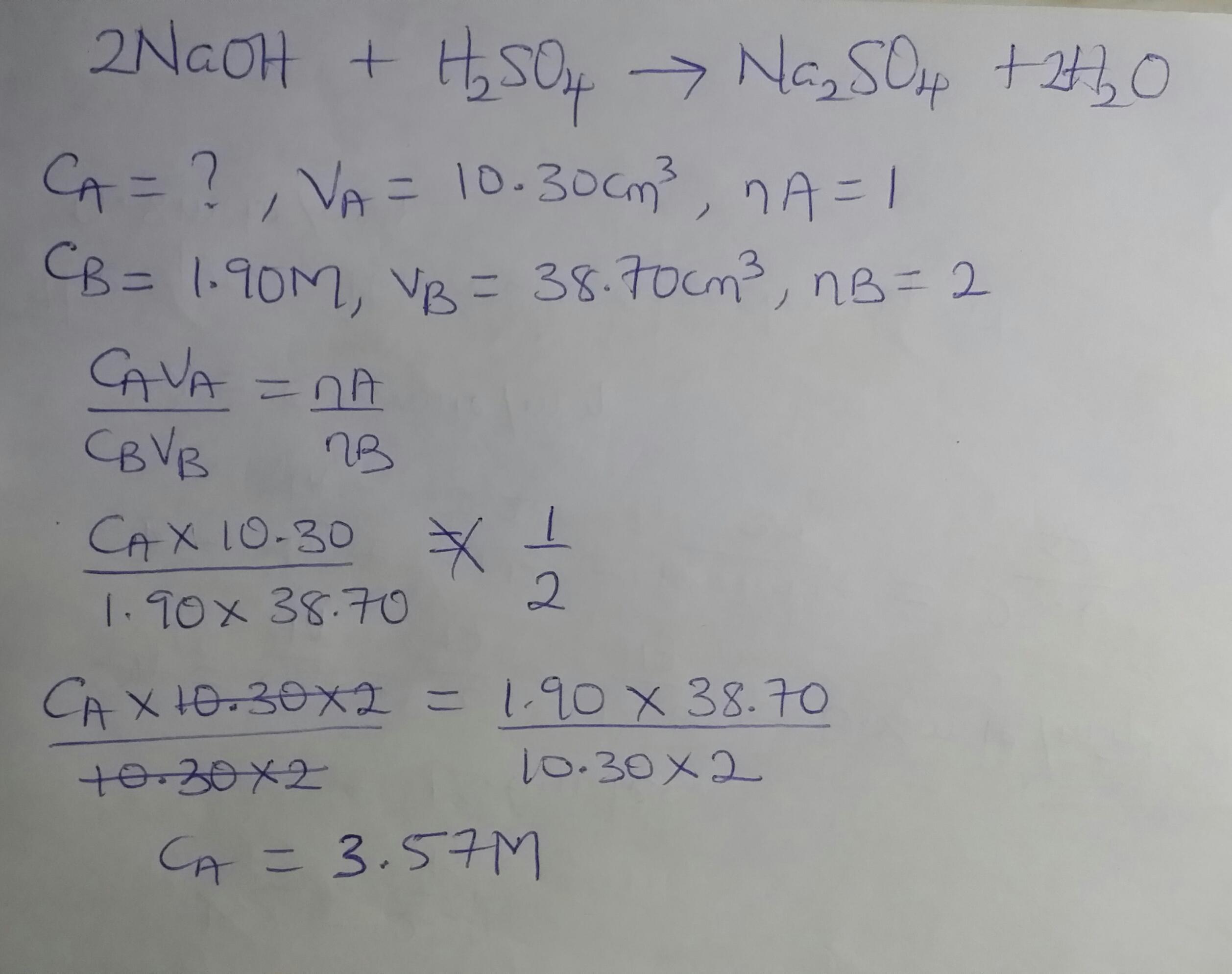
If it takes 38.70cm³ of 1.90 M NaOH to neutralize 10.30cm³ of H2SO4 in a battery, What's the Molarity of the H2SO4 ?​
arlik [135]

Answer: 3.57M

Explanation:Please see attachment for explanation

3 0
2 years ago
Read 2 more answers
If the actual yield of the reaction was 75% instead of 100%, how many molecules of no would be present after the reaction was ov
artcher [175]
To be able to answer this equations, we must set given information. Suppose the reaction to yield NO is:

N₂ + O₂ → 2 NO

Next, suppose you have 1 g of each of the reactants. Determine first which is the limiting reactant.

1 g N₂ (1 mol N₂/ 28 g)(2 mol NO/1 mol N₂)= 0.07154 mol NO present

Number of molecules = 0.07154 mol NO(6.022×10²³ molecules/mol)
<em>Number of molecules = 4.3×10²² molecules NO present</em>
8 0
2 years ago
Read 2 more answers
How might a collision between Neptune and Halley's Comet<br> affect Neptune's orbit?
Damm [24]

Answer:

It will mess up the orbit around the sun

Explanation:

7 0
2 years ago
Other questions:
  • Uranium–232 has a half–life of 68.9 years. A sample from 206.7 years ago contains 1.40 g of uranium–232. How much uranium was or
    12·2 answers
  • How many moles are contained in 3.131 × 1024 particles?
    8·1 answer
  • A gas of potassium chlorate molecules KClO3 all decompose into potassium chloride, KCl, and diatomic oxygen, O2. The products an
    9·1 answer
  • The solubility of acetanilide is 12.8 g in 100 mL of ethanol at 0 ∘C, and 46.4 g in 100 mL of ethanol at 60 ∘C. What is the maxi
    8·1 answer
  • certain alcohol contains only three elements, carbon, hydrogen, and oxygen. Combustion of a 40.00 gram sample of the alcohol pro
    14·1 answer
  • Ammonia NH3 may react with oxygen to form nitrogen gas and water.4NH3 (aq) + 3O2 (g) \rightarrow 2 N2 (g) + 6H2O (l)If 2.15g of
    5·1 answer
  • Which of the following solutions is a buffer?A) A solution made by mixing 100 mL of 0.100 M HClO and 50 mL of 0.100 M HCl.B) A s
    8·1 answer
  • Which option describes energy being released as heat?
    11·2 answers
  • For the reaction PCl5(g) &lt;--&gt; PCl3(g) Cl2(g) at equilibrium, which statement correctly describes the effects of increasing
    5·1 answer
  • The blue color in some fireworks occurs when copper(I) chloride is heated to approximately 1500 K and emits blue light of wavele
    9·1 answer
Add answer
Login
Not registered? Fast signup
Signup
Login Signup
Ask question!